
An offer that works at a small scale may not keep working after you scale it. The real challenges in the scaling stage are traffic quality, creative lifespan, account environment, and rule boundaries. These deserve attention before simply switching offers or creatives.
An offer works on a small budget: acquisition cost is under control and payouts are normal. Then you scale it, and performance often drops noticeably. At that point, many people first think about switching the offer, changing creatives, or moving to another channel, but the problem is often elsewhere.
Traffic quality is usually the first thing to decline after scaling
With a small budget, the platform has less money to spend, so it can focus on the most relevant segment of the audience. Strong conversion performance is therefore normal. Once the budget increases, the delivery range has to expand to spend that money, audience relevance falls, conversion rate declines, and refunds and complaints may rise instead.
Marginal efficiency will fall, and that needs to be accepted first. The goal of scaling is not to preserve the original conversion rate, but to find a new balance: increase spend within the original audience range first, then expand to similar audiences after reaching the ceiling. At the same time, watch valid conversions rather than raw conversion counts. If the refund rate rises too, bigger dashboard numbers may still amount to wasted effort.
Creatives have a limited lifespan
When the same creative repeatedly reaches the same group of people, performance will inevitably decay. A user may have seen it three times and simply stop clicking on the fourth. This is especially obvious in trending categories, where a creative may remain effective for only three to seven days.
That is why you should not wait until a creative stops working before making the next one. A steadier approach is to break a proven direction into several variations and test them continuously, rather than discarding everything and rebuilding a completely new concept each time. Track the performance curve as well, and have replacements ready before the decline becomes obvious.
There is also a repeatable production pattern for trending periods: extract the single most compelling selling point, combine it with different local scenarios, and produce a batch of a dozen or more differentiated pieces. This is much faster than forcing out one new idea at a time.
Accounts and environments are where scaling most often breaks down
Once the number of accounts grows, two problems appear at the same time. Platforms are usually stricter during hot periods, and shared signals between accounts can easily lead to a chain of suspensions. Meanwhile, manually switching logins across dozens or hundreds of accounts can slow the entire testing cycle to a crawl.
Multi-account operation is not just about increasing the count. Each account needs to run independently: a separate browser environment, a relatively stable network exit that matches the account's region, and no sharing of Cookies or local data between environments. Environment-isolation tools such as PurpleMark address this layer. Different team members can access only the accounts they are responsible for according to permissions, while actions remain traceable.
Landing pages and creatives also need to stay consistent, and you should confirm before launch that the pages open normally. Mismatched content and creatives, or pages that fail to load, are both common review and risk-control triggers.
Rule boundaries matter more than tactics
Every offer specifies which promotion methods are allowed and prohibited, especially restrictions on traffic sources. When scaling, it is easy to chase volume through methods outside those rules. These violations usually leave little room for appeal: commissions may be withheld and accounts may be banned.
There is another common distortion in the industry: earnings claims are often exaggerated. Other people's numbers are not a basis for your own decisions. What you need to calculate yourself is the valid conversion per unit of traffic, the real profit after refunds and all fees, and the time and labor invested.
Three checks worth making before you start scaling volume
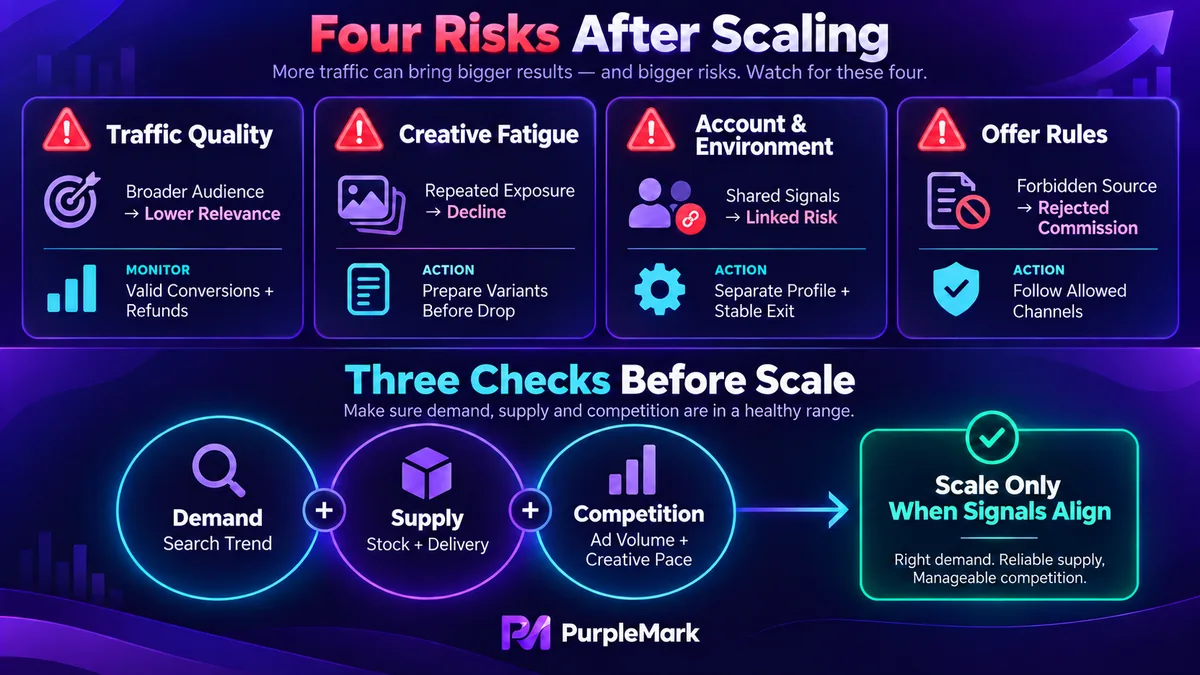
Whether a trending category is worth entering can be cross-checked from three angles. On the search side, look at the past week's trend for core keywords in the target country and changes in rankings for similar products on e-commerce platforms to judge whether demand is genuinely expanding or merely a short-lived spike. On the supply side, check offline inventory, stockout rates, and shipping lead times; the larger the gap, the more conversion headroom there usually is. On the competitive side, examine ad volume, creative refresh frequency, and landing-page maturity in the same niche. A real window exists when search volume is rising but relatively few competitors have entered.
The channel should match the category. High-ticket products with fast purchase decisions are suitable for search ads that capture users actively looking for the product. Lower-priced, impulse-driven categories are better suited to short-video feeds. Highly vertical categories can use review sites, forums, communities, and email; growth is slower, but usually steadier.
Finally, organize testing properly. Run accounts in groups, with each account testing two or three creatives plus one targeting set. Cut combinations that fail to produce results quickly and concentrate resources on directions that have already worked instead of spreading resources evenly.
Base earnings calculations on actual settlement data from your own account. This is not media-buying advice; follow the official rules of each platform and each offer.


