
Amazon does not look only at registration details when detecting account associations. Device and browser characteristics, network egress, and overlaps in products and operating behavior can also be compared. This article explains each dimension and why accounts with different registration data may still be linked.
One of the most confusing parts of Amazon account-association detection is the information imbalance: when an account is suspended, you usually do not know how the platform connected two stores.
The platform has a clear rule that the same seller may operate only one store on the same marketplace, and it does not allow multiple stores built around duplicate products, duplicate brands, or duplicate operating strategies. When the system finds technical links among several stores, association detection can be triggered. The question, therefore, is not simply whether multi-store operations are possible, but what the platform compares.
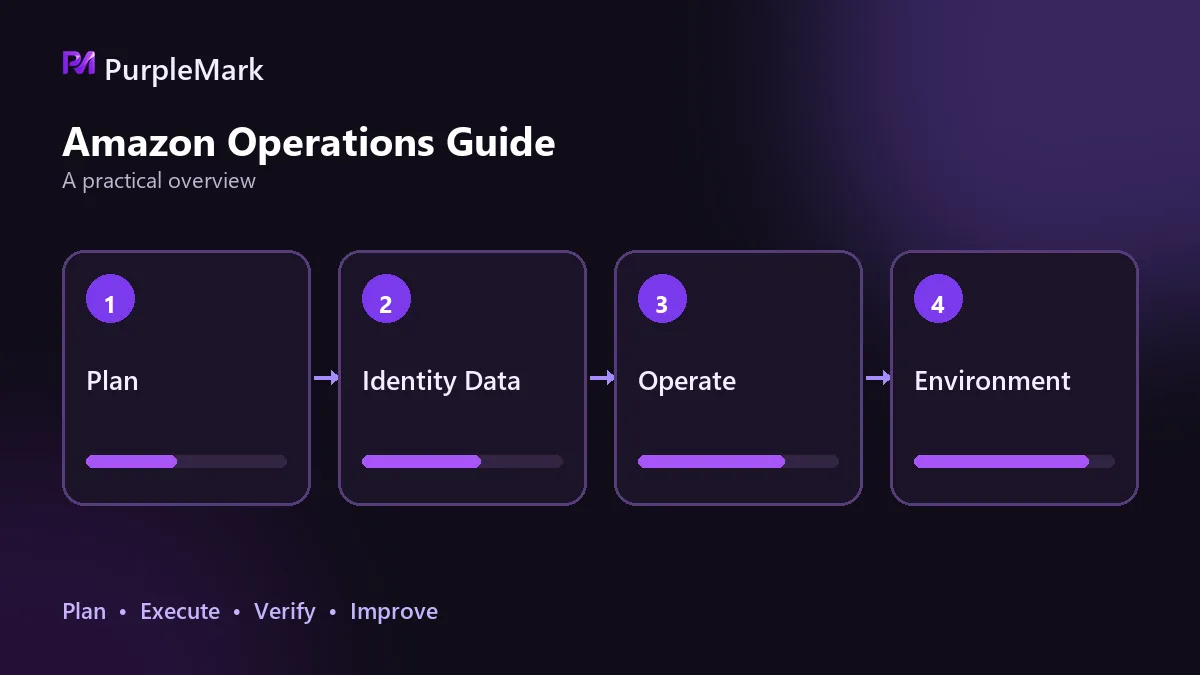
Four comparison dimensions
| Dimension | What the platform checks |
|---|---|
| Registration details | Entity and legal-representative information, business license, registered address, phone, email, credit card, and receiving account |
| Device and browser characteristics | Browser fingerprint, font list, graphics-card model, language settings, cookies, and local storage |
| Network egress and login location | IP geolocation, stability of the egress region, login times, and frequency |
| Products and operating behavior | Listing content, pricing cadence, back-office operating habits, listing times, and price-adjustment times |
These categories do not carry the same evidentiary weight. Devices and networks are hard technical signals, overlapping registration information is the most direct basis for a match, and similarities in behavior and products can help fill gaps where technical signals are inconclusive.
Why different registration details can still be linked
Many people assume that changing the legal representative, license, and receiving account is enough to stay separate. It is not. The platform can compare the full usage environment created by hardware and software, and that layer is independent of registration details.
Logging into two stores on the same computer with different browsers may change the UA, but underlying traits such as the font list, graphics information, screen parameters, and time zone remain the same. Clearing cookies, or even using incognito mode for another account, removes only surface-level data; the device fingerprint can still be compared. Sharing one network line across several stores is even more direct, because the egress IP is one of the easiest signals to compare across the whole environment.
If product and operating behavior are also similar, the match becomes stronger. Highly similar Listing copy, images, pricing cadence, and listing times can reinforce the technical evidence from the behavioral side.
What happens after an association is detected
The consequence is usually not a restriction on only one store. Associated accounts may be handled in batches: funds can be frozen, active products can be removed, and in serious cases brand registry status can also be revoked. This is why partial isolation can be more dangerous than it seems: the remaining shared characteristics can still connect the stores.
Isolation must cover every category
- Independent environment: give each store its own browser environment so fingerprints, cookies, and local storage are not shared.
- Independent egress: bind each store to its own network egress, use it consistently over time, and avoid sharing or frequent switching.
- Non-overlapping information: avoid overlap in registration details, contact information, and receiving accounts.
- Different operating cadence: do not make listing times, login periods, and price-adjustment patterns uniform across stores.
When there are many stores and work is divided among several people, it is easy to miss these rules if everyone relies on memory. PurpleMark can keep each store tied to a fixed login environment, bind the corresponding egress, and assign access permissions to specific members, turning the one-store-one-environment principle into a routine operational process.
There is another counterintuitive point: once isolation is established, do not keep changing the environment. Changing the IP today and the fingerprint tomorrow makes the platform see an account that repeatedly changes devices during use, which can itself look suspicious. The goal of isolation is to make each store appear to be operated consistently by different people from different places, not to make the environment as chaotic as possible.
Conclusion
Association detection compares four groups of signals: registration details, device and browser characteristics, network egress, and products and operating behavior. The first two are hard indicators, while the latter two provide supporting confirmation. Effective isolation means separating all four categories; isolating only one is close to not isolating at all.


