
Account warm-up is not about leaving a newly registered account idle until it gets older. It means moving through profile setup, light interaction, content publishing, and stable operation at a pace that resembles normal user behavior. Here is what to do and avoid at each stage, along with the compliance boundaries.
A common claim about warming up a Facebook account is that you should register it, leave it untouched for a few months, and only start using it after it has aged. An idle account does not become stronger on its own. What the platform looks at for credibility is whether there is a period of normal usage that follows a realistic human rhythm. An account with no activity for three months after registration is not necessarily more trustworthy than a new account.
Put simply, account warm-up is about building a behavioral history over time, not waiting.
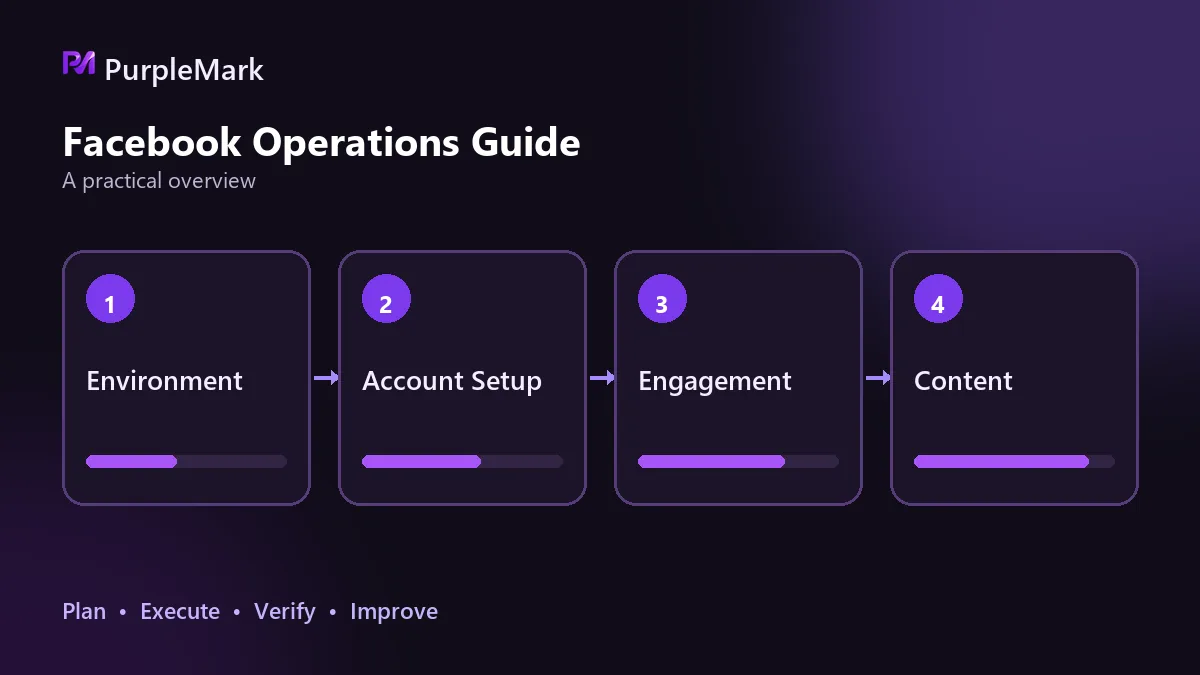
Before the stages, stabilize the environment
The most basic step should be done on day one: keep the account running long term in a stable, geographically consistent browser environment, with the IP, time zone, and language aligned. Do not switch to a different exit today and another node tomorrow. Frequent environmental changes themselves create many abnormal login records.
If you manage more than one account, also avoid switching back and forth between them in the same environment. Sessions and caches can overwrite one another, making it easy for the platform to determine that the accounts come from the same device. PurpleMark supports environment isolation so each account can run steadily with an independent device identity.
Profile setup stage: days 1 to 3 after registration
The system is most cautious at this stage. The principle is simple: observe more and act less. Log in for 10 to 15 minutes each day, scroll, pause, and read normally in the feed, occasionally like a post from official media or mainstream news, or watch one or two short videos. That is enough to leave a browsing trail.
Bind a working phone number and email and complete verification. Fill in basic details such as the profile photo, cover photo, bio, and location; these form the first layer of account identity. The actions to avoid are clear: do not add friends, join groups, publish posts, or click ad links yet. Any aggressive action may directly trigger automated restrictions on a new account.
Light interaction stage: days 4 to 7
After the cold-start period, keep online time steady at 30 to 60 minutes a day and begin creating a small amount of content. One or two everyday posts without commercial wording, such as a casual landscape photo or food photo, are enough to make the timeline look like it is being used by a normal person.
Start social actions on a small scale. Join one or two niche groups and only read posts at first; keep proactive friend requests to no more than five per day, prioritizing contacts suggested by the system or people who share a group; keep comments to no more than about 10 per day and do not copy and paste the same wording repeatedly.
Content publishing stage: days 8 to 15
By the second week, the account has accumulated some positive usage history and risk controls may become somewhat less sensitive, so the focus can shift toward building relationships. Friend requests can increase to 10 to 20 per day, targeting real and active users. The groups joined earlier can now become useful: reply thoughtfully under popular posts or share valuable group content to your own profile.
The key here is to control volume. Comments should contain substance rather than being posted merely to appear active. Public profile information can be filled in gradually, but there is no need to display commercial characteristics in a hurry.
Stable operation stage: days 16 to 30 and beyond
Once an account has operated steadily for more than half a month, it is generally past the highest-risk observation period. During this time, maintain a regular cadence of everyday content, stabilize the personal profile first, then consider creating a brand Page and adding product images, contact details, and similar information. You can also answer industry questions in groups and naturally begin handling some business-related activity.
In terms of sequence, it is better to open up only one dimension at a time. First get the profile running smoothly, then let a small ad spend complete the payment and review process, and only afterward consider scaling. Opening multiple dimensions at once can compound risk.
Volume reference for each stage
In the first week, do not add friends, publish posts, or join groups. In the second week, still add zero friends and only browse groups. In the third week, keep friend additions to single digits per day, publish two to three pieces of content per week, and make only a small number of group replies. From the fourth week onward, increase gradually according to the business rhythm, starting business actions at a small scale.
Actions most likely to cause problems
Frequent changes to the login environment rank near the top because every change leaves a new login record. Switching among multiple accounts in the same environment causes sessions and caches to overlap, making device-level associations difficult to hide. An overly regular operating rhythm is another common problem: doing exactly the same number of actions at the same time every day does not look very human. Finally, starting business activity immediately on a new account is a typical trigger for restrictions because the account moves into marketing before it has built any credible history.
Where the boundary is
The term “account warm-up” can make it sound like a contest against risk controls. A more accurate description is making account behavior match the usage rhythm of a real user so that platform trust can accumulate. Using scripts to simulate browsing in bulk, importing account credentials into shared tools, or using automation to manufacture fake activity may appear to save labor, but the behavioral patterns they create look even less human and also do not comply with platform policies.
Rhythm matters more than tricks, and the environment is even more fundamental than rhythm.
Shared only as operational experience. Facebook's official policies take precedence, and no operational outcome is guaranteed.


