
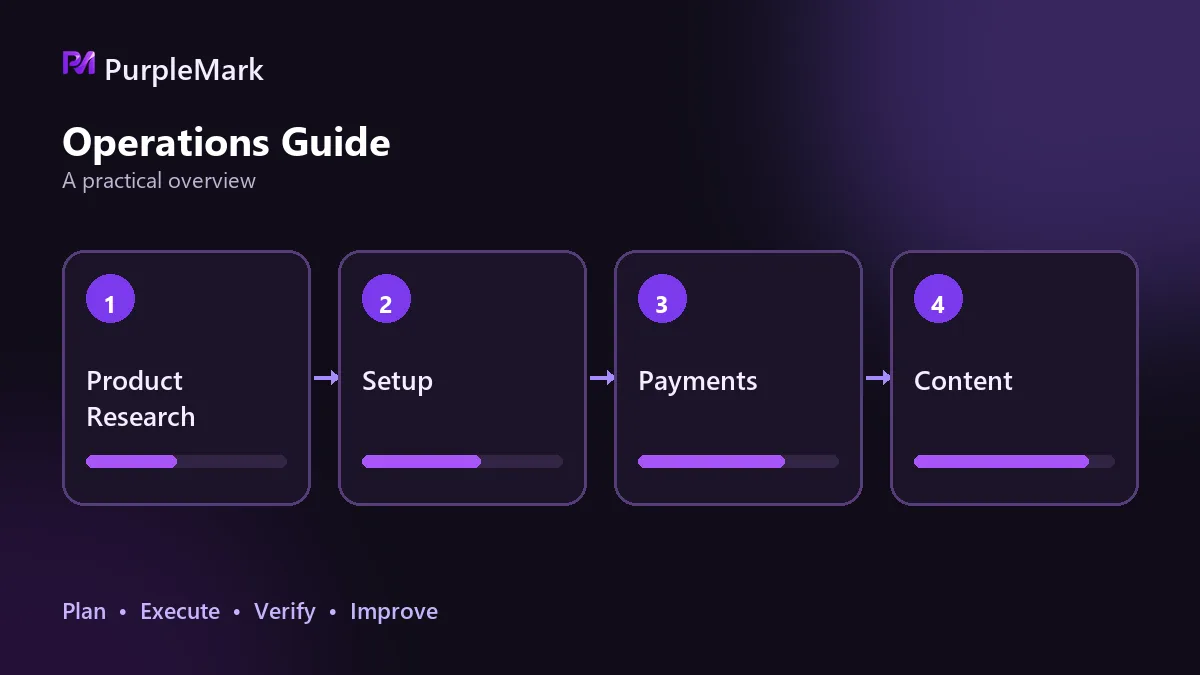
A six-stage roadmap from positioning and product selection to the first 30 days after launch, with clear checks for what to do, what to verify, and when each stage is ready to move on.
Marketplace stores receive traffic from the platform, and that traffic can disappear as soon as a listing is closed. An independent site is the opposite: every visit has to be earned, but the customers, data, and pricing control stay in your hands. Once that is clear, the order of work becomes much easier to see.
Stage One: Positioning and Product Selection
Independent sites suit two kinds of products especially well: categories where marketplace competition is already excessive and margins have been squeezed thin, and categories that need brand storytelling to support a higher price. Standardized products sold mainly on low price are a poorer fit—if the same item is easier to buy on a marketplace, users have little reason to make a special trip to your site.
After choosing products, you should be able to answer one question: in one sentence, who are you selling to, and what problem are you solving? If you cannot answer that clearly, the later design, copy, and advertising will all lose focus.
Completion sign: the first screen of the homepage states a clear positioning message, and the backend contains a product list of 10–20 SKUs.
Domain and Hosting Basics
Buy the domain yourself. For overseas markets, filing requirements that apply domestically are generally not needed. Place hosting close to where your customers are concentrated whenever possible. If you use a SaaS website builder, hosting, SSL certificates, and CDN services are managed by the platform, so you do not need to operate the server yourself.
Completion sign: DNS resolution works, the site opens in a browser, and it displays correctly on both mobile and desktop.
Site Building and Payment Integration
A common mistake is to perfect the site design before listing products. The order should be reversed: upload 10–20 products first, then start styling the store. Most homepage modules need real product data before you can judge how they actually look. With an empty catalog, you are only decorating a shell and will probably need to redo it later.
Payments are one of the most underestimated parts of the entire flow. Overseas users have different payment habits from domestic users, so you usually need both international card processing and local payment methods. Before signing, clarify three things: whether the processor supports the major card networks in your target market; how long payouts take and how fees are calculated; and how chargebacks are handled. The third point is especially important because it defines the safety boundary around the money in your account.
Choose logistics based on product value and customer expectations. For small, lightweight goods, dedicated parcel lines help control cost. For medium- and high-value items, commercial express services put delivery speed and tracking first, while fragile or expensive goods should also be insured. State in advance who pays customs duties; asking customers to pay unexpected tax on delivery often leads directly to poor reviews and refused parcels.
Completion sign: a test order can go from the product page through successful payment, and the backend shows both the order and its corresponding tracking number.
Basic SEO and Content Framework
An independent site does not come with built-in traffic. Search engines are one of the lowest-maintenance long-term sources, but they take time.
Start with keywords that are highly relevant to the product and have real search demand. In the early stage, target lower-competition long-tail queries instead of competing for head terms immediately. Build content around pillar pages, then add supporting pages that answer related questions and connect them with internal links. On the technical side, mobile compatibility, loading speed, and structured data are the foundation; weaknesses in any one of them can limit the site's ceiling.
Completion sign: major pages have unique titles and descriptions, the sitemap is accessible, and search engines have started indexing the site.
Before Launch, Click Through Everything Yourself
Do not rely on a general feeling that everything is fine. Run a test order through the full process and personally check payment, fulfillment, and refund paths. Complete pages for the privacy policy, returns and exchanges, and contact information. Review the site on phone, tablet, and computer. Confirm that analytics code is installed and receiving real data.
Completion sign: you have personally tested every item above instead of simply assuming it works.
The First 30 Days After Launch
The priority in this stage is not increasing budget; it is collecting real data. Small ad campaigns or social-media traffic are enough to test which product pages keep people engaged and which visitors actually place orders.
Add an email subscription entry point at the same time and start building a reachable audience from the very first visitor. The most effective emails are often not mass promotions but recommendations triggered by purchase history, because users care most about whether the message is relevant to them.
Once you expand across channels, account management becomes a continuing drain on attention. One person may need to manage official accounts on several platforms while supporting different content directions, and repeated logging in and out consumes time by itself. Keeping each account in a fixed, separate environment helps preserve a stable account-to-environment relationship and reduces cross-environment association issues. Multi-environment isolation tools such as PurpleMark are designed for this part of the workflow.
By the end of 30 days, you should know which channel brings the steadiest traffic, which kinds of pages convert best, and roughly what range your customer acquisition cost falls into.
Order Matters More Than Speed
The hard part of an independent site is never simply getting the website online. It is whether you can keep bringing in traffic and retain visitors after launch. Reaching a basic standard at each stage before moving on may look slower, but in practice it avoids repeated tear-downs and rebuilds.


