
A reliable overseas advertising workflow starts with clear goals, then allocates budget, tests audiences and creatives, and verifies landing pages and conversion tracking. If any link in the chain breaks, later data becomes unreliable and faster spending only magnifies the error.
Overseas advertising is one of the fastest ways for a brand to enter a new market, but it is also one of the easiest places to pay for expensive lessons. Accounts may fail to open, campaigns may not deliver, or campaigns that finally start may be interrupted by account issues, leaving teams unsure where the money went.
Viewed as a straight chain, the process has four parts: set goals, allocate budget, test audiences and creatives, and verify landing pages and conversions. If any part breaks, the data that follows cannot be trusted.
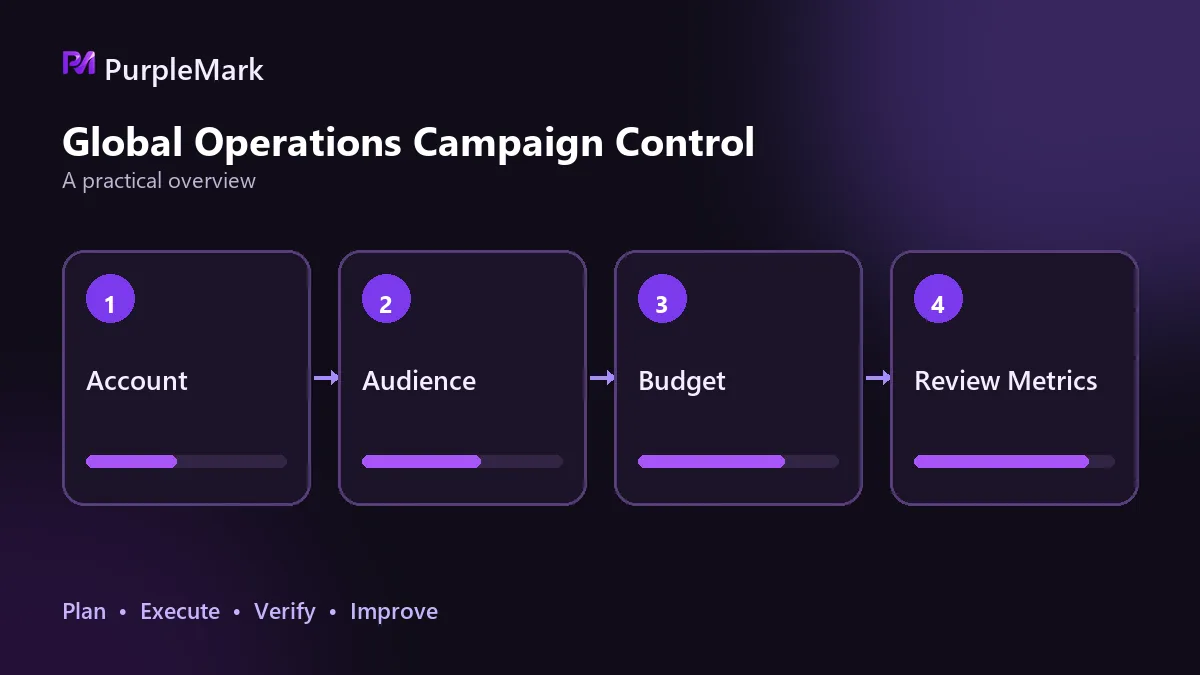
Set the goal first so the budget has a basis
Before launching, define the goal clearly: brand awareness, sales, or registrations. These three goals call for different channels, creative formats, and performance metrics. Mixing them in the same campaign can make the data interfere with itself.
The core difference between channels is the intent users bring when they arrive. Search advertising reaches people who already have clear demand and is geared toward immediate conversion; social and video channels are better for reach, engagement, and demand creation; programmatic channels can improve efficiency for teams with enough data; vertical and niche platforms are smaller but can be highly relevant for specific audiences or markets.
When the budget is limited, concentrating on one or two channels is usually more efficient than spreading spend across every channel. Allocation can be handled in two stages: first use a small budget to verify that the conversion path works, then gradually shift more spend toward combinations that perform consistently. Do not overhaul settings because of one or two days of volatility, because major changes can reset the platform's learning process.
Audience and creative are the two hands of testing
Do not put every audience into the campaign at once. A more stable sequence is to start with the core audience, then expand by interests, and finally scale with lookalike audiences. Use the same creative set at each layer so differences can be attributed to the audience.
Creative is often the largest variable. Within the same audience, changing the creative and copy can produce a bigger difference than changing bids. Do not wait until performance stalls before refreshing assets; supply new creative on a consistent schedule so testing remains continuous.
As for AI assistance, most platforms now offer features such as creative generation, audience suggestions, and automated bidding. These tools are effective for increasing production speed and testing density, but factual accuracy, compliance, and brand tone still need a human review.
Landing pages and conversion tracking determine whether the data is trustworthy
Ads bring people to a landing page, and that page must carry the same promise. The selling points, price, and timing highlighted in the creative should be immediately visible on the page; otherwise, clicks will arrive and leave. Mobile presentation deserves a separate review because differences in layout and above-the-fold information can directly affect conversion.
Conversion tracking is another line that must be verified in advance. Confirm before launch whether pixels or server-side callbacks fire correctly, whether the attribution window is reasonable, and how duplicate conversions are counted. If conversion data is inaccurate, the optimization direction is wrong, and the faster the budget is spent, the farther the campaign drifts.
Which metrics matter at each stage
During cold start, focus on whether the campaign can run at all: impressions, click-through rate, and landing-page opens help determine whether the creative matches the audience. Once enough volume accumulates, focus on cost: cost per click, cost per conversion, and conversion rate indicate whether the combination deserves more budget. In a stable phase, focus on structure: differences in conversion cost across combinations, budget concentration, and consistency of attribution rules help decide what to scale and what to cut.
Failures often cluster around a few causes. Problems with account documents or payment methods can interrupt delivery; policy violations can cause creatives to be rejected or restricted; launching before tracking is verified makes the data unusable; several accounts sharing the same environment and network exit can be judged as related by the platform; and spreading the budget too thin prevents each combination from generating enough learning volume. Start troubleshooting with account and tracking issues because they are easy to overlook and can be the most damaging.
Do not leave gaps on the account side
Prepare account-opening materials in advance. Company qualifications, legal representative information, and descriptions of the business and audience should be consistent, because contradictions can slow review. Since the account controls funds, enable two-factor authentication, use a separate protected login email, regularly review administrators, advertising permissions, and authorized applications, and set payment caps so abnormal spend can be contained.
Some teams use multiple advertising accounts to spread risk or test different strategies. Platforms have explicit rules for the structure of accounts and advertising assets, so operations must stay within those rules. Technically, platforms may use IP addresses, device information, and browser fingerprints to judge whether accounts are related, and multiple accounts sharing the same environment and network exit is a common trigger. A standardized approach is one account, one environment, and one exit, with Cookies, local storage, and fingerprint parameters isolated from one another. As account volume grows, multi-account environment tools such as PurpleMark can bind environments, proxies, and account profiles for management, separate purposes by group, and use member permissions to define operational boundaries, reducing mistakes in multi-person collaboration.
Frequently asked questions
Can overseas advertising work with a very small budget? Yes, but narrow the scope: one market, one channel, and one audience type. First verify that the conversion path works, then consider expanding.
What should I do if an account keeps getting restricted during delivery? First check three common causes: payment method, creative compliance, and account environment. Then consider strategy changes. Frequent changes to the environment or network exit can themselves trigger restrictions.
Are multiple advertising accounts necessary? No. First get a single account running reliably. If multiple accounts are genuinely needed, make sure the account structure and usage remain within platform rules.
Wrap-up
Stable overseas advertising comes from stable accounts, fresh creative, and accurate data. Platform and channel choices determine the starting point, account and environment management determine whether campaigns can keep running, and optimization determines efficiency. When all four parts are solid, the budget is less likely to be wasted on repeated account opening and appeals.


