
Differences in survey earnings often come from the channel model. Link hunting, survey sites, and direct channels involve different trade-offs in survey sources, rates, payout cycles, and environment requirements, so it helps to understand the revenue structure first.
People who do paid surveys often have the same question: if two people answer the same kind of survey, why can one person earn much more per completion? The platform is part of the reason, but an even bigger difference is where the surveys you receive actually come from.
There are three common models today: finding survey links yourself, choosing tasks on a survey site, and using a direct channel that connects to research companies through an API. Many people have tried the first two. The third has a higher barrier to entry, so plenty have heard of it but relatively few actually operate this way.
How the three models differ
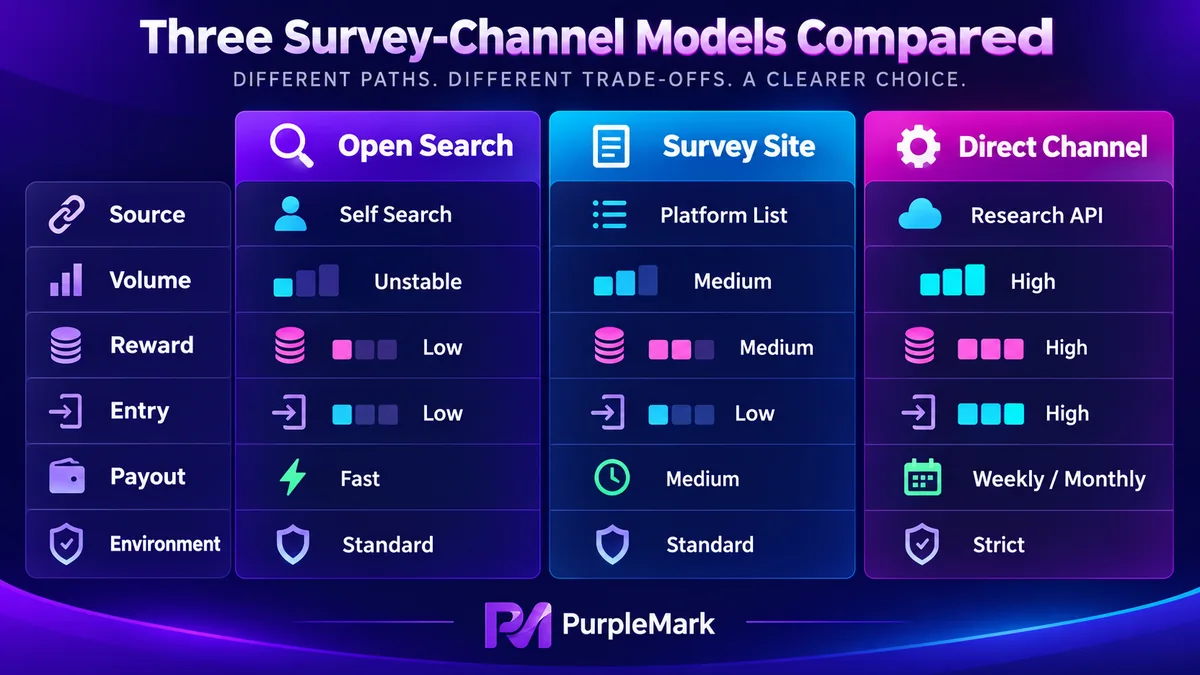
With link hunting, you search for survey links on your own, complete the ones you find, and earn a commission. It offers a lot of freedom, but the supply is unstable and depends heavily on your ability to find opportunities.
With survey sites, you register on a website that lists available surveys and select tasks from there. The supply is more stable than link hunting, but rates are usually lower because the site takes a share.
With direct channels, a platform signs contracts with overseas research companies and connects their surveys directly to its own site through an API. When you answer surveys there, the source is the research company itself. With one fewer intermediary, the opportunities are closer to first-hand inventory, and rates are usually higher than on survey sites.
| Comparison | Link hunting | Survey sites | Direct channels |
|---|---|---|---|
| Survey source | Search by yourself | Provided by the site | API connection to research companies |
| Volume | Unstable | Medium | High |
| Rate | Low | Medium | High |
| Entry barrier | Low | Low | High |
| Payout cycle | Fast | Medium | Long, often weekly or monthly |
| Environment requirements | Normal | Normal | Strict |
More surveys and higher rates come with upfront costs
The attraction of direct channels is straightforward: more surveys and higher rates. The trade-off is that you may need to pay an account-opening fee upfront, ongoing proxy traffic can create recurring costs, and the technical barrier is higher.
Another point that is easy to underestimate is how long a survey remains available. A quota lookup may show the age range, gender requirements, and remaining slots. If the quota still shows many slots but the survey can no longer be found, it usually means the task has already been taken down. High-value surveys can sometimes stay open for several days, but they are also harder to qualify for; most surveys last only a few hours. Once you identify a survey you can complete, finish it as soon as possible, because it may disappear overnight.
Why the environment requirements are stricter
Direct channels have the strictest account-environment requirements of the three models. Before answering, multiple windows may be used to test surveys, and the platform must see those windows as different users. If ten windows have identical fingerprints or share the same outbound address, the pattern can be detected quickly and the account may be banned.
Isolation needs to cover two layers at the same time: at the network layer, proxies make each window use a different outbound address; at the device layer, each window needs different browser characteristics. Only when both layers are separated will the platform see different users on different devices. In scenarios that require multiple isolated environments to run in parallel, PurpleMark provides the ability to keep each account paired with its own environment.
How to judge whether a channel is worth using
Several indicators can help. First is channel quality, meaning whether the survey source is traceable. If a channel cannot clearly explain which research company provides its tasks, do not invest too much time in it. Second is the effective completion rate: the proportion of tested surveys that can actually be completed. Third is the payout cycle, because weekly and monthly settlement affect cash flow very differently. Fourth is survey freshness. If the same survey keeps appearing across multiple channels, supply in that direction may already be saturated.
The final point is compliance. Most survey platforms enforce one account per person. Registering multiple accounts on the same platform violates the rules and can lead to account bans and withheld balances. A compliant way to expand is to keep one account on each of several different platforms, complete each profile carefully, and improve qualification rates rather than relying on more accounts to take more tasks.
Final thoughts
The core idea of a direct channel is to connect directly to research-company surveys through an API, but it is not an easy path. Upfront costs, environment requirements, and payout cycles all need to be considered together. In the long run, returns depend on whether channel quality, effective completion rate, payout timing, and compliant operations can all work together.
This article only analyzes channel types and earning structures. It does not recommend any specific channel or promise earnings. Please follow the terms of use of each platform.


