
A common reason a TikTok account matrix fails is not too few accounts, but a lack of structure before new accounts are opened. Define the matrix goal first, then assign each account a role and clear content boundaries, and only then decide the order and pace of expansion. Sequence matters more than account count.
Many teams start building an account matrix by registering a batch of accounts. They test directions as they go and divide responsibilities while hiring. A few months later, a common pattern appears: several accounts are posting increasingly similar content and competing for the same audience; when asked what each account is responsible for, no one can give a clear answer.
The word “matrix” is easy to interpret as simply running more accounts. The real obstacle is usually not the number of accounts, but whether three things were clarified before opening them: how the accounts are tiered, how content is divided, and in what order new accounts should be added.
First decide what the matrix is supposed to achieve
The goal of the matrix determines how accounts should be divided. Broadly, there are two goals: expanding influence and driving conversions directly.
For influence, accounts can be split by content direction: one focuses on educational content, one on unboxings, one on story-led soft placements, and one on authentic reviews. For conversion, accounts can be split by marketing stage: new-product promotion, usage tutorials, special offers, and livestream warm-ups.
Both approaches point to the same requirement: every account needs a clear content boundary and target audience. Once those boundaries overlap, the accounts start diverting traffic from one another. The matrix may look busy, but in practice it often performs worse than a few clearly positioned accounts.
Three account tiers, each with its own job
Once the structure is in place, accounts naturally fall into three categories.
Core accounts are responsible for validating the model: whether the format, publishing rhythm, and topic selection are consistently effective for this type of content. If this step has not been proven, every additional account is simply copying an unverified assumption.
Vertical accounts are responsible for covering narrower niches. The core account validates the direction, while vertical accounts break it down for more specific audiences to see which branch can gain traction.
Traffic accounts handle campaigns and temporary traffic, such as major promotions, livestreams, and new-product launches. Their job is to route traffic between touchpoints; they do not need to maintain long-term content cultivation.
Once the responsibilities of the three account types are written down clearly, naming rules, tagging systems, and publishing cadence can be standardized at the same time. New accounts and handovers can then follow the same rules without renegotiating everything each time.
The order and pace of account expansion
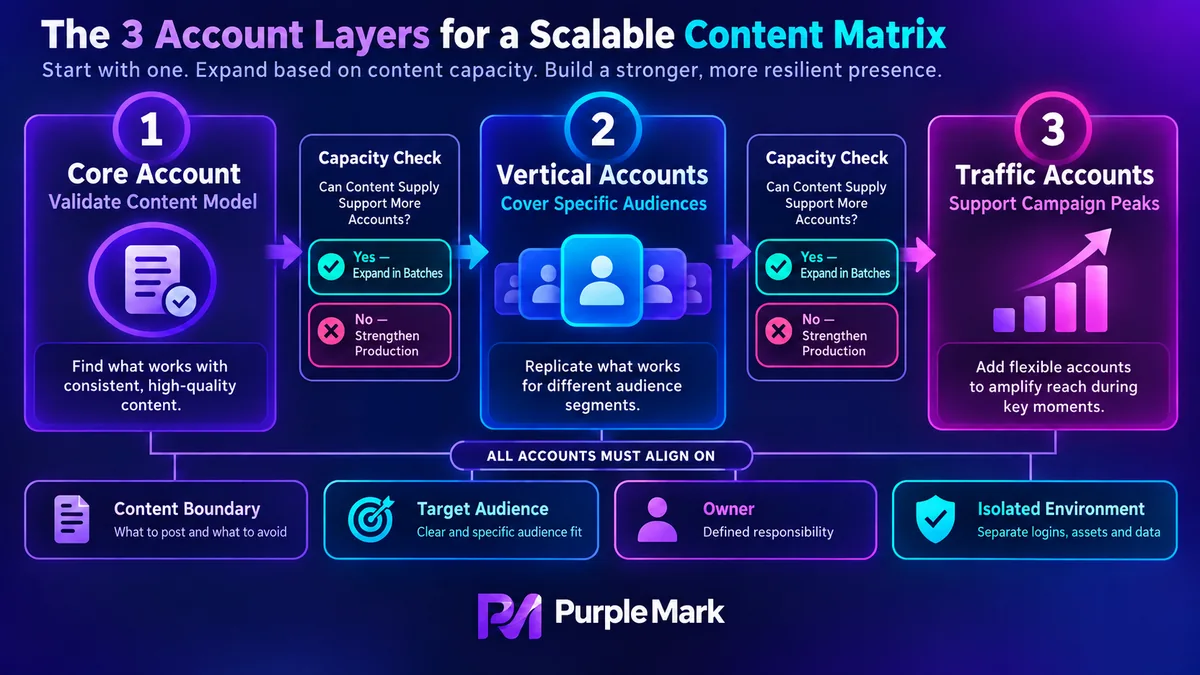
In terms of order, first fully validate the core account, then roll out vertical accounts, and only then add traffic accounts. Doing it in reverse means a batch of accounts are all waiting for the same conclusion, and none of them gets it.
In terms of pace, add accounts in batches and pause after each batch to review a round of data. Before adding accounts, ask one question: can the current content supply support them? When it cannot, more accounts mean less production capacity for each one, and overall performance can fall instead. The real bottleneck is content capacity, not the account quota.
As account count grows, the operating environment becomes a separate issue
When the number of accounts increases, the challenge shifts from content to management. Platforms do not determine whether accounts are related based only on network addresses. Repeatedly logging into multiple accounts on the same computer, or having multiple accounts share the same browser environment for long periods, can accumulate signals such as cookies, cache, and WebGL characteristics. The more accounts there are, the harder these relationships become to untangle.
If one account problem affects a whole cluster, the matrix has little resilience to risk. A common approach in this kind of scenario is to run each account in an independent browser environment, bind it to its corresponding network exit, and keep a one-to-one mapping between account, environment, and responsible person. Tools such as PurpleMark provide this kind of environment-isolation capability, while also allowing team members’ operating permissions to be separated by role.
Three lines not to cross
Do not use tools to register accounts in bulk. Platform user agreements generally restrict automated registration, and accounts created this way are not sustainable; once they are banned, everything can be lost at once.
Do not have your own accounts like, comment on, or artificially boost one another. When multiple account environments are linked and behavior patterns are consistent, they can be connected easily, and platforms are better at identifying this pattern than many people assume.
Do not repost other people’s content. A matrix requires volume, but reposting brings copyright risk and account penalties. Differentiation should come from angle and format.
Whether a matrix can work comes down to sequence: first a validated content model, then a tiered account structure, then enough content capacity to sustain it, and only then more accounts. Reverse that order, and the usual outcome is many accounts with none of them producing results.
The above is for operational-method explanation only and does not constitute a revenue guarantee. Follow TikTok’s Community Guidelines and avoid any manipulative behavior or content reposting.


