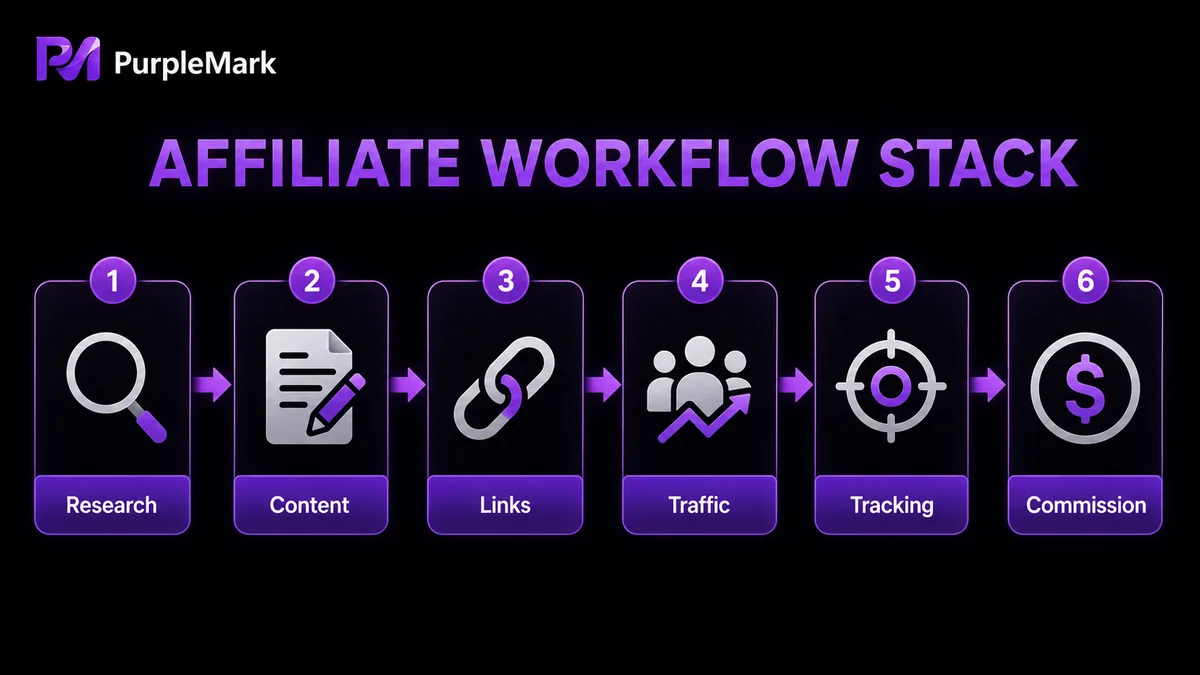
Affiliate marketing involves a complete chain from choosing products and creating content to placing links and earning commissions. The right tools can save significant time. This guide reviews common tools and selection ideas for content creation, link management, user conversion, and data analysis.
Affiliate marketing involves a long chain of work: choosing topics, creating content, placing links, tracking data, following up on conversions, and finally receiving commissions. Doing everything manually is slow and error-prone. This guide organizes useful tool categories and selection ideas around four stages: “content production → link management → user conversion → data monitoring.”
1. Content production and topic planning
Keywords and topic ideas: For cross-border content, tools such as Ahrefs and SEMrush can help uncover high-search-volume keywords in multilingual markets and analyze competitors’ content structures. AnswerThePublic presents questions in a visual map and can help you find “How to” topics people may search for.
AI content and polishing: You can use ChatGPT to create a first draft, then use DeepL and Grammarly for multilingual polishing and grammar checks. Jasper and Copy.ai also provide templates for ad copy and review-style content. Any AI-generated content should still be manually checked for factual accuracy and authenticity in spoken or promotional claims.
Collaboration and scheduling: Zapier, Notion, and Trello can connect the workflow from “content generation → editorial calendar → scheduling,” while Canva is useful for quickly creating hero images and other visual assets. For teams, kanban boards can help avoid duplicate topics.
2. Affiliate link management and distribution
Automatic link insertion: Skimlinks and Sovrn can deploy code on a site to recognize brand terms and automatically insert affiliate links, making them suitable for blogs and review sites seeking passive monetization.
Short links and routing: Pretty Links, bit.ly, and similar tools shorten long URLs and can support routing visitors to different landing pages by region.
Link health checks: Tools such as LinkChecker can batch-check whether affiliate links are broken or redirect incorrectly, helping avoid wasted traffic and platform flags for invalid links.
3. User outreach and conversion follow-up
Email automation: Klaviyo, ActiveCampaign, Mailchimp, and similar tools can trigger personalized emails based on user behavior, such as clicking a link or adding an item to cart without purchasing. They are common choices for e-commerce affiliate conversion and also support A/B testing for subject lines and content.
Communication and scheduling: Streak can manage partnership negotiation stages inside your inbox, while Calendly lets partners book available time slots themselves, reducing back-and-forth coordination.
Social media outreach: Aggregator pages such as Beacon and Linktree can place multiple affiliate links on a profile page or in a video bio, directing fragmented traffic to conversion entry points. ManyChat can build automated replies in Messenger and trigger messages based on keywords.
4. Data monitoring and analysis
Cross-channel dashboards: Google Data Studio (Looker Studio) + Supermetrics, Funnel.io, and similar tools can consolidate data from affiliate platforms, GA4, and advertising systems into performance dashboards and compare attribution across channels.
Alerts and monitoring: You can use Zapier + Slack to set alerts for abnormal changes in key metrics. More technical users can also use monitoring tools to track link visits and bounce behavior.
How to work more efficiently when managing multiple affiliate platform accounts
Affiliate marketers often register with several affiliate platforms, such as ShareASale, CJ, and Amazon Associates, while also using multiple social media accounts to drive traffic. As the number of accounts grows, switching logins and checking data becomes cumbersome, and it is easy to mix up commission dashboards across platforms.
If you need to maintain “multiple affiliate platforms + multiple social media accounts” at the same time, you can manage each platform account in a separate browser environment. In the PurpleMark web workspace, create separate browser environments for each affiliate platform and social account, bind the corresponding login, configure the proxy, and group environments by business use. Open the matching environment whenever you need a specific dashboard to reduce wrong-account logins and accidental actions. Window Sync can also perform the same login or operation across multiple environments, which is useful for teams that need to maintain several accounts consistently. When needed, open the PurpleMark web version and group the account environments for each platform first.
Summary
The key to improving affiliate marketing efficiency is not piling up tools, but choosing a small, focused combination for your own workflow: keyword tools for topic planning, AI + human review for content, management tools for links, and dashboards for data. Marketers operating across multiple platforms and accounts can further improve efficiency by organizing account environments and responsibilities, leaving more time for content that actually generates commissions. Tools and policies change quickly, so always refer to each tool’s official documentation when making a selection.
Frequently asked questions
Do affiliate marketing beginners need to buy a lot of tools? No. Start by validating your workflow with free or low-cost tools, then add more only when necessary. Tools should save time at specific stages; more is not always better.
Can AI-generated affiliate content be used as-is? Direct publishing is not recommended. AI drafts can improve efficiency, but facts should be checked manually and real experience should be added to avoid machine-translated or low-quality content. This affects both conversion and compliance.
Is it risky to operate multiple affiliate platform accounts? Affiliate platforms generally require verified identities and compliant use, so multi-account operations should not violate platform rules. The priority is to properly manage login environments and permissions across different platforms, rather than using deceptive methods to evade platform risk controls.


