
Affiliate networks are not one ranking you can compare side by side. Four cooperation models differ in approval, payouts, attribution windows, and suitable traffic; choosing the wrong type can misdirect months of work.
Search for the best affiliate platforms and you will find countless top-ten lists. Yet after reading them, it can still be unclear which one to choose. The reason is simple: these platforms belong to different cooperation models and suit very different kinds of publishers. Until the type is clear, comparing commission rates means little.
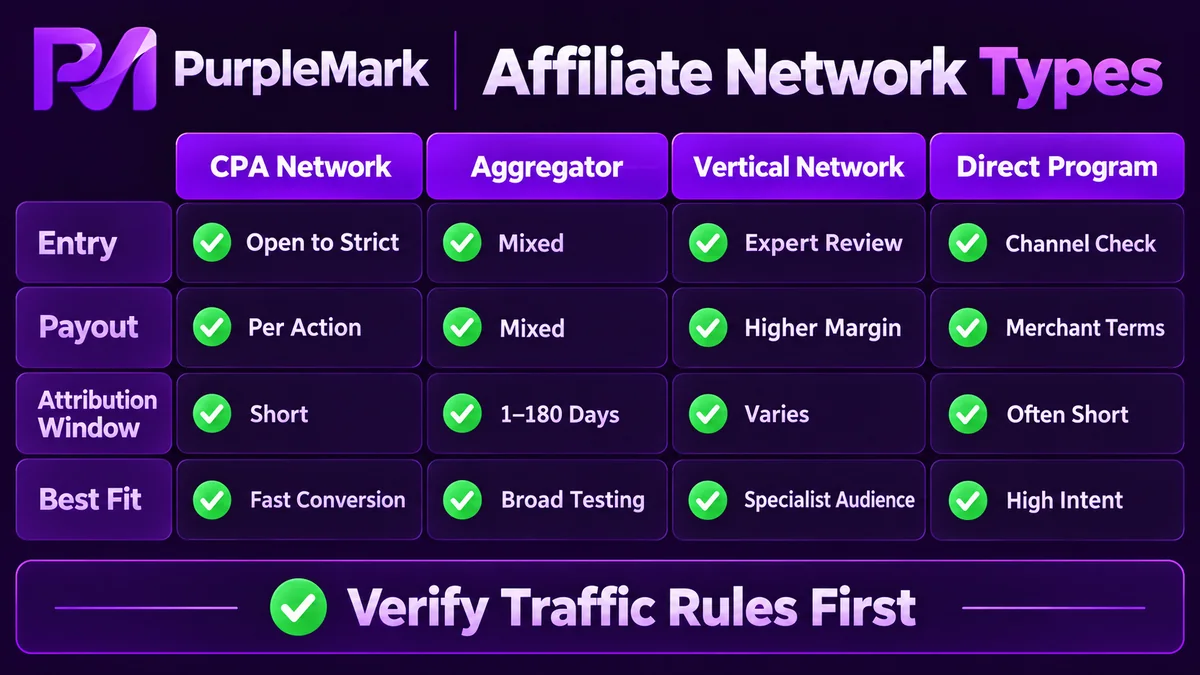
CPA networks: pay only for results
Advertisers place offers in the network and state the payout model upfront, usually a single model such as CPA (per conversion), CPL (per lead), or CPI (per install). Publishers accept the terms, get a tracking link, and start promoting.
Entry requirements vary widely. Some networks allow open registration, while others require an interview, historical campaign data, or channel revenue records. Tracking is based on conversion events, and attribution windows are often relatively short, so slow-moving traffic has less chance to convert within the window. These networks fit traffic that can scale and follows a short conversion path, such as comparison sites, deal content, and utility-driven referrals.
Check the traffic-source rules for every offer in advance. Within the same network, Offer A may allow social media traffic while Offer B explicitly bans it; violations often lead directly to withheld commissions.
Aggregator networks: many advertisers in one dashboard
This type acts as an intermediary. Sign once and the dashboard can expose programs across many categories and regions. Commission models are mixed as well: CPS, CPA, and recurring commissions may all appear, leaving you to choose.
For publishers, the upside is breadth of choice; the trade-off is that screening work shifts to you. Each advertiser sets its own attribution window, so one dashboard may contain programs ranging from 24 hours to 180 days, while payout thresholds can vary from a few dozen dollars to well over one hundred.
The key question is not how many offers exist, but whether advertiser brands can be verified and whether refund and complaint rates are acceptable. Program quality varies most visibly in this category, so payout reliability needs independent verification.
Vertical networks: expertise is the advantage
These networks focus on one industry. Travel, finance, software, and health each have specialist networks. Because the category requires expertise, advertisers are often willing to pay more for well-matched traffic, so commission rates are usually higher than on generalist networks. In digital products, commissions of 50%–75% are common, some exceed 80%, and some programs pay recurring commissions for as long as the customer keeps renewing.
The cost is stricter audience fit. An account with mismatched content may get many clicks and still convert poorly. Approval reviews also look more closely at channel expertise, so general-traffic sites often fail to qualify for popular programs.
This model suits publishers who already have content depth in a specific vertical. The more focused the audience and content, the greater the advantage.
Merchant-run programs: contract directly with the advertiser
In a merchant-run affiliate program, you apply directly to the merchant and the merchant pays the commission. The product range is limited to that merchant's own products, and policies are controlled by one party, making changes relatively predictable and often more stable than in an aggregator network.
Entry barriers are generally lower, though the merchant may require a verifiable promotion channel. The real constraint is the attribution window: consumer products often use a short window such as 24 hours. If the customer does not buy that day, the commission can be lost, which makes long-decision-cycle products harder to monetize. These programs work better for channels with a clear content focus, a defined product category, and the ability to capture immediate purchase intent.
What actually matters when comparing the four types
| What to compare | What to check |
|---|---|
| Access | Whether your channel type is accepted, how long review takes, and whether you can reapply after rejection |
| Payouts | Minimum payout threshold, payment cycle, and support for your preferred payout method |
| Tracking | Attribution-window length, multi-touch support, and what happens after cookies expire |
| Program quality | Whether the advertiser can be verified and what refund and complaint rates look like |
| Support and response | Whether you can reach a specific person when a payout dispute occurs |
The last item is the easiest to overlook, but it determines whether you have somewhere to resolve a dispute. A high commission and a long attribution window matter less if nobody responds when something goes wrong.
Three common mistakes
Looking only at the commission rate. High commissions often come with high refunds or low conversion rates. What matters is actual revenue per thousand clicks, not the headline percentage.
Assuming more offers are always better. More programs mean more time spent screening. For an individual publisher, going deep on a few stable programs is often better than spreading effort across many.
Ignoring compliance rules. Every program states which promotion methods are allowed or prohibited, including permitted channels and disallowed traffic sources. Breaking the rules can lead to withheld commissions or account suspension, often with little room for appeal, so read the terms before you start.
Two points when running several channels at once
Affiliate marketers often run multiple channels at the same time: a review site, a social media account, and a video account. Each channel account should operate independently. Mixing them in one environment can create linkage signals, so a problem on one channel may affect the others. Using a separate browser environment for each account is a common way to manage this layer, and environment isolation is exactly the kind of capability PurpleMark provides.
The other point is tracking links. Use different tracking identifiers for different placements and channels so you can tell where conversions come from. That is the basis for adjusting content later.
Running multiple accounts is legitimate only when each account has its own operational purpose and content direction. Bulk-copying the same content across multiple accounts can fall under platform spam enforcement, regardless of the technical setup.
First identify which model an affiliate network belongs to, then compare commissions. Reverse that order and you can spend months in the place that only looks most profitable.


