
Whether registration can be fully automated depends on three platform requirements: traceable real identity, one-account-per-user principles, and compliant behavior. This article explains where automation is blocked, what can be affected after enforcement, and which registration tasks can still be automated.
There has been no shortage of discussion about letting AI Agents take over account registration. Technically, filling forms, clicking buttons, reading emails, and entering verification codes are all straightforward. What really determines whether this can be done is not the technology, but the three requirements platforms impose during registration.
What platforms actually require at registration
The first is a real identity that can be traced. The phone number and email entered during registration are not mere formalities; they are the foundation of the account. They must receive verification messages, remain under long-term control, and help recover the account whenever an unusual verification check occurs later. The actions that must be completed by a real person at the end of registration have a clear purpose: confirming that a living person is in front of the screen. Using synthetic or falsified biometric traits to pass that step amounts to providing false identity information and, in many jurisdictions, goes beyond merely violating platform terms. This is a hard boundary, not something to discuss bypassing.
The second is one real user corresponding to one account. Platform account models are built around real human users. Multiple accounts must either fit an officially permitted model, such as business accounts or team seats, or use an official testing sandbox. Bulk registration conflicts with that model itself.
The third is lawful and compliant behavior. Terms on major platforms commonly restrict three things: using automation tools for bulk registration, registering with false information, and using technical means to evade verification mechanisms. These constraints are independent of technical capability. Being able to build something and being allowed to do it are separate judgments, and permission comes first.
Where automation gets blocked
Human verification is the most direct barrier. Its purpose is to confirm real-person participation, which directly conflicts with the goal of end-to-end automation. The existence of that step already indicates that the process is not suitable for a machine to complete from start to finish.
Even if that step were skipped, profile data and account history create another obstacle. Bulk-registered profiles are often generated from the same templates, have similar structures, are created within a narrow time window, and have no usage history. They do not look like accounts that developed gradually over time.
Then come environment and behavior. One fact is easy to underestimate: when multiple accounts are registered around the same time, use similar profile data, and are operated from the same environment, they naturally share a set of characteristics. Registration times cluster together, profile data comes from one template, device fingerprints and network exits match, and post-registration action paths are highly similar. These are not signs that parameters need finer tuning; they are properties of bulk behavior itself. Platforms do not need especially advanced techniques to detect them. Multiple accounts registered at the same time on the same device are already a signal.
When one workflow fails, what else is affected
The loss is rarely limited to a single account. Accounts created in the same batch are often handled together. More troublesome are the linked consequences: associated phone numbers, emails, and payment details may be added to risk lists, so later attempts to register a normal account on the same platform with the same information may receive extra scrutiny. If shops or advertising accounts are attached, a freeze can also affect funds and settlement. Time spent building account history and content can be wiped out as well.
Associations can also spread sideways. If accounts share payment details, profile information, or the same environment, one problem can cause the others to be linked. This often explains why several seemingly unrelated accounts run into trouble at the same time.
What can be automated
None of this means automation has no value. Its value is in replacing repetitive manual work.
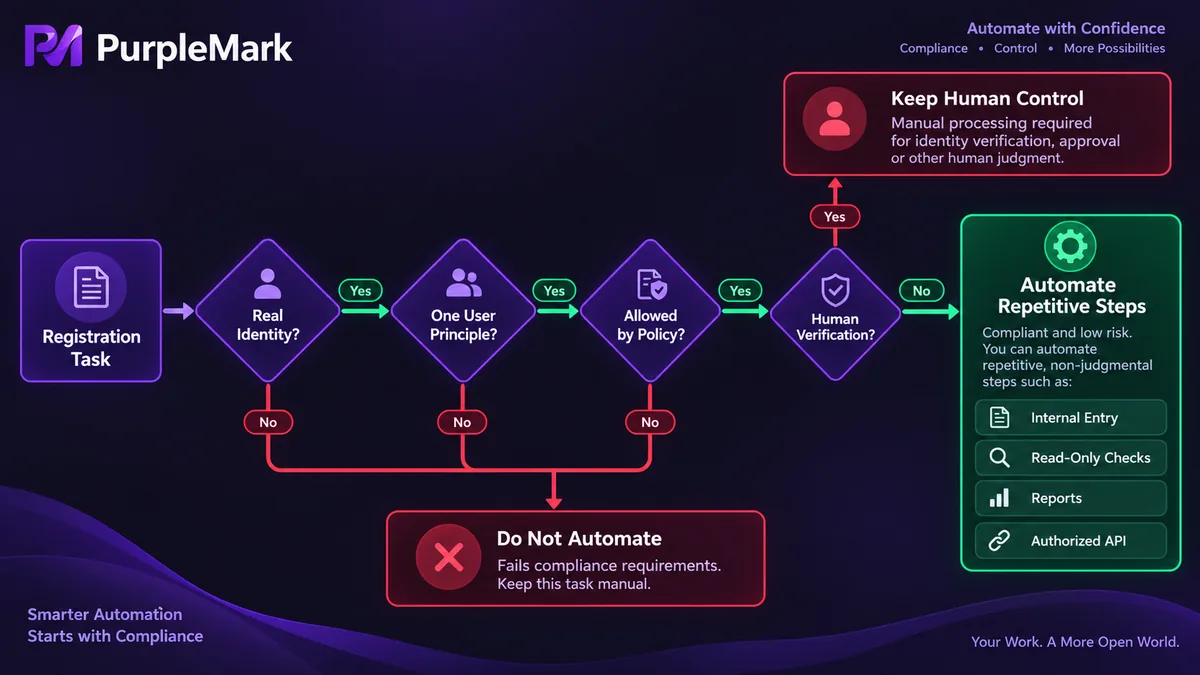
Tasks that are usually appropriate include bulk entry and format conversion inside your own systems, read-only scheduled checks and monitoring, batch generation of reports and assets, and data collection that is explicitly authorized and supported by platform APIs. The common factor is that the target is within your control or the authorization is clear, and the process does not involve evading platform mechanisms.
A different category is unsuitable: any end-to-end process that includes human verification, bulk registration explicitly prohibited by platform terms, and any practice intended to bypass verification.
The decision order is short. First ask whether the process contains a step that must be completed by a real person. If it does, it is not suitable for end-to-end automation. Then ask whether platform rules allow it. If not, stronger technology does not change the answer. Only when both checks pass is development worth considering.
If the real need is multiple accounts
First distinguish what kind of need you actually have.
If you need accounts for different markets, the proper approach is for each account to operate from the start in the network and device environment of its target region, rather than registering them in bulk first and trying to build history later. If you need multiple accounts for product testing, use officially permitted testing routes or sandbox environments provided by service providers. If you need to operate a long-term account portfolio, each account should have its own positioning, content, and operator, as well as an independent and stable operating environment. At the environment-isolation layer, PurpleMark provides the ability to run each account in its own separate environment.
None of these three needs is the same as bulk registration. Bulk registration directly conflicts with the platform account model; that is structural and cannot be solved by adjusting parameters.
This is an analysis of rules and boundaries, not operational advice. Refer to the platform's terms of service and local law for the specific requirements.


