
Before letting an AI Agent operate websites, verify the environment-to-Agent chain with four test layers: single-step smoke tests, multi-step tasks, concurrency stress tests, and fault injection, each with its own key metrics.
Passing once in a demo environment is not the same as having a chain that can be used reliably every day.
To judge reliability, split the testing: validate the environment at the environment layer, validate the Agent at the Agent layer, and then check whether the two remain stable when connected.
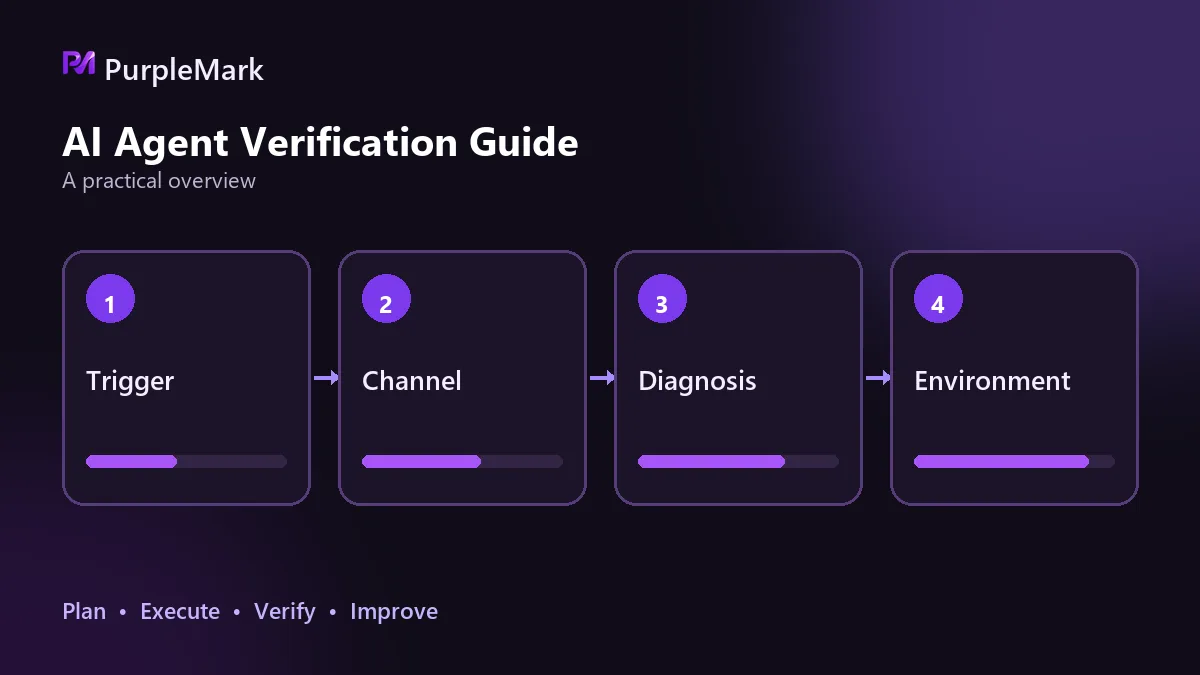
Single-step smoke test: run four actions separately
A smoke test should do only four things, one at a time rather than as a chain: open a specified page; locate an element on the page; click it; retrieve that element's text. If all four pass, the basics of connectivity, sessions, and element access are working.
Keeping the test to four isolated actions narrows the failure surface. If opening the page fails, the likely issue is network egress or access permission. If the page opens but the element cannot be located, the page may not have finished loading or the locator may depend too heavily on the current layout. If the element is found but cannot be clicked, check whether it is covered or inside an iframe. If the returned text is empty, confirm that you are reading rendered content rather than the initial HTML.
Watch three numbers: single-step success rate, single-step latency, and the distribution of error types. These should already be stable during smoke testing. If single-step success fluctuates around only 80–90%, later tests are not meaningful.
Multi-step tasks: branches matter more than step count
Chain the four actions into a real task, such as filling out a form, paging through results, filtering by conditions, and writing the result back locally. More steps are only a quantitative increase; the real difficulty is branching: prompts may appear, target elements may disappear, pages may redirect themselves, or a verification step may require human confirmation.
The metric here is task completion rate, not step success rate. After a failure, whether the Agent can adjust its path and recognize when to stop and report the problem clearly matters more than simply reaching the end.
Another easily overlooked number is the count of human interventions. If the same task is run twenty times, how often intervention was needed and where each run got stuck can reveal the maturity of the chain better than the overall completion rate.
Concurrency and fault injection
After a single chain is stable, add concurrency. Start multiple environments at the same time with the same kind of task and observe whether environments interfere with one another and whether the failure rate worsens as concurrency rises. Failures at this stage are often caused not by Agent logic but by pressure on resources or sessions.
Fault injection is one of the most commonly skipped tests and one of the most necessary. Deliberately create timeouts, disappearing elements, expired sessions, and CAPTCHAs, then observe the response: after a timeout, does a retry succeed or does the process hang; after session expiry, does the chain report a clear error or continue using invalid credentials?
Track three metrics: the failure-rate curve under concurrency, recovery success rate after a fault, and the extra latency caused by a single fault. A low recovery success rate means the chain works only when conditions are favorable.
Validate the environment layer separately
The tests above run within one environment, but when multiple environments are used together, the environment layer needs its own validation. Each environment should start independently, hold its own session and cache, and bind to its own egress IP.
Teams operating multiple accounts often manage environments per account. Tools such as PurpleMark provide environment isolation so each account has an independent runtime space. During testing, start several environments concurrently and confirm that Cookies, caches, and egress paths do not leak across them.
For this layer, watch three numbers: environment startup success rate, data cross-talk between environments (normally zero), and whether a session can continue after an environment is rebuilt.
How to attribute failures
When the chain breaks, a common mistake is to edit the Agent script immediately. A better order is to confirm that the environment can start and that the session has not expired, then check network egress and nodes, and only after that suspect the Agent's element location and task planning. Reversing this order leads to repeated changes in the wrong place.
The four actions in the single-step smoke test are also an attribution tool. After any failure, rerun those four actions independently and see which link breaks first. Most of the time, that step reveals the answer.


