
Amazon account-linking decisions look for overlap across registration details, device and browser characteristics, network egress, payments and payouts, and product and operating behavior. Multi-store operations need a separate setup for every category, because sharing in any one area can undermine isolation.
Running several Amazon stores at the same time is difficult not only when one store has a problem, but when similarities between stores connect them into a single network. Amazon does not determine account links from one factor alone. It compares many signals together, and the more of them that overlap, the more the activity looks like it comes from the same operator.
These signals can broadly be grouped into five categories: registration details, device and browser characteristics, network egress, payments and payouts, and product and operating behavior. For multi-store operations, each of these five categories needs to be independent rather than cleaning up only one of them.
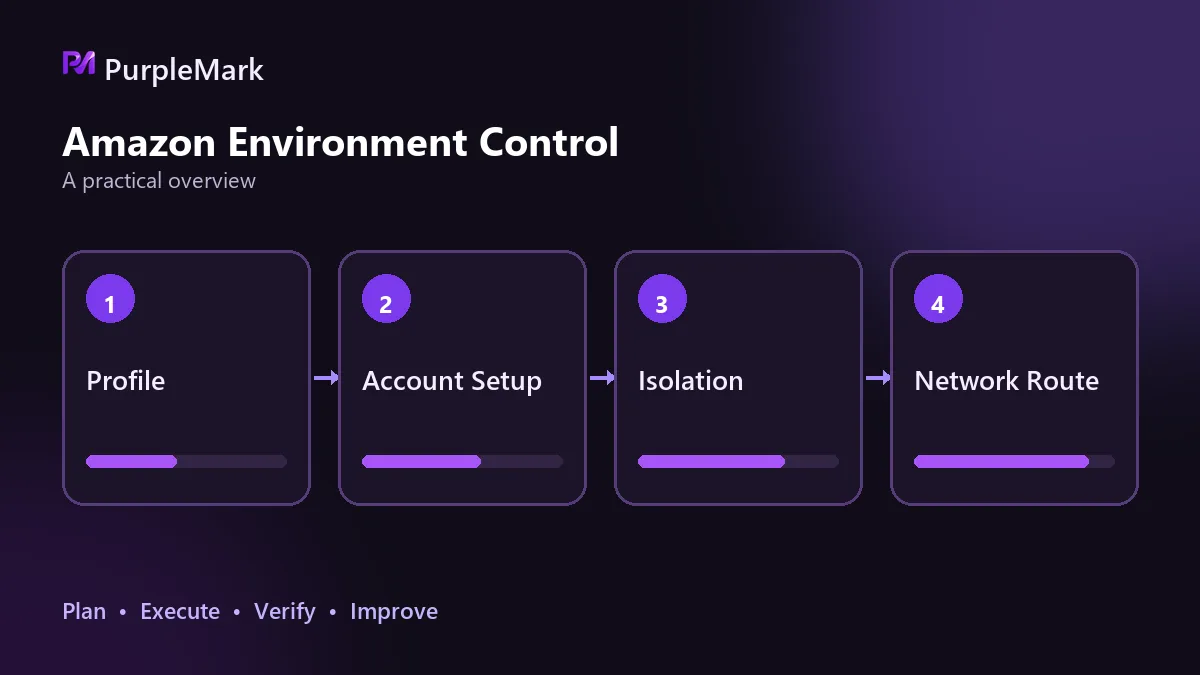
Linking decisions depend on overlapping signals
The platform continuously collects data during registration, login, and day-to-day operation. A single data point often proves little: two companies in the same city having employees log in is normal by itself. But the situation changes when the email address, phone number, payout account, device parameters, and egress address all match at the same time.
That is why preventing account association is not about finding a hidden setting. The focus is making sure the five categories of information do not intersect. Sharing in any one category can cancel out the isolation work done elsewhere.
Registration details are the easiest layer to overlook
This layer is entered manually, so it is also the easiest to copy casually. Email addresses, phone numbers, contact details, return addresses, and store-entity information should each map one-to-one to a store.
A common mistake is using one phone number to receive verification codes for several stores. In the system, that phone number becomes the thread connecting the stores and can reveal the relationship even earlier than the egress address. Using exactly the same return address has a similar effect.
Devices and browsers leave traces
Cookies, cache, local storage, canvas and graphics rendering, font lists, resolution, and hardware parameters can all be recorded.
Consistency also matters. The time zone and language reported by the browser should fit the egress region configured for that store. Parameters that are individually separate but contradict one another still form an unnatural combination. Repeatedly switching among several store backends in the same browser is also hard to separate at the characteristic level, even if the data is cleared every time.
Network egress cannot be treated casually
Sharing one network egress across multiple stores is one of the most direct account-linking signals. Frequent changes in egress region and repeated use of similar address ranges from the same provider can also be considered.
Egress quality matters as well. Data-center address ranges generally have a lower reputation than residential ranges. If a batch of stores all use this type of address, that can create another shared characteristic.
Payments and payouts can tie two entities together
Payout accounts should correspond to the store entity and should not overlap with other stores. The same principle applies to the payment method used for fees.
This layer is important because it carries both entity information and the direction of funds. If two stores use the same card or payout account, the platform sees more than similar technical characteristics; it may also see signs that the operating entities are the same.
Overlap in product information and operating rhythm
The same set of product images appearing in multiple stores, copied description paragraphs, or identical internal SKU coding rules can all create obvious duplicate patterns. At a minimum, the main parts of images and descriptions should be reworked.
Behavioral signals are even more granular: login periods, listing cadence, response cadence, and the times orders are processed. If several stores repeatedly do the same things at the same times, the pattern is easy to spot. Stores reviewing or recommending one another creates an association structure by themselves, and the cost can be greater than expected.
Multiple stores need a complete isolation system
Keeping all five categories independent is too much to rely on memory alone. Once operations grow beyond a small scale, tool-level support is needed: group environments by store, save login state and fingerprint parameters independently in each environment, and assign team permissions by store. PurpleMark's multi-account environment capabilities are designed for scenarios like this.
A few specific questions
Can several stores use the same business license? This is a platform-policy question. Requirements can vary by marketplace and over time, so the current platform policy should be treated as authoritative.
Is changing the egress address enough? No. The network is only one of the five categories; the environment and account information also need to remain independent.
Can stores ship goods to one another? Be very cautious. Crossovers in shipping addresses and logistics information can also be used as account-linking signals.
In practice, there is no shortcut to preventing account association. The core requirement is to keep all five dimensions independent at the same time. A comparison table is useful: put one dimension in each row and one store in each column, then verify cell by cell that every setup is separate. That is far more reliable than relying on memory.


