
When sellers control buyer accounts to place orders and leave reviews for their own products, platforms treat it as prohibited review manipulation. This article explains how inauthentic reviews may be identified, what can happen after enforcement, and legitimate ways to build reviews.
Many sellers hit the same obstacle during a cold start: a new product goes live with no reviews, conversion stays low, and waiting for genuine reviews feels too slow. When patience runs out, some consider creating or controlling buyer accounts to place orders and leave reviews. In the industry, this is often referred to as Amazon review manipulation or self-managed buyer accounts.
This approach deserves a clear explanation because it does not sit in a gray area. It runs into several of the platform rules that are stated most explicitly.
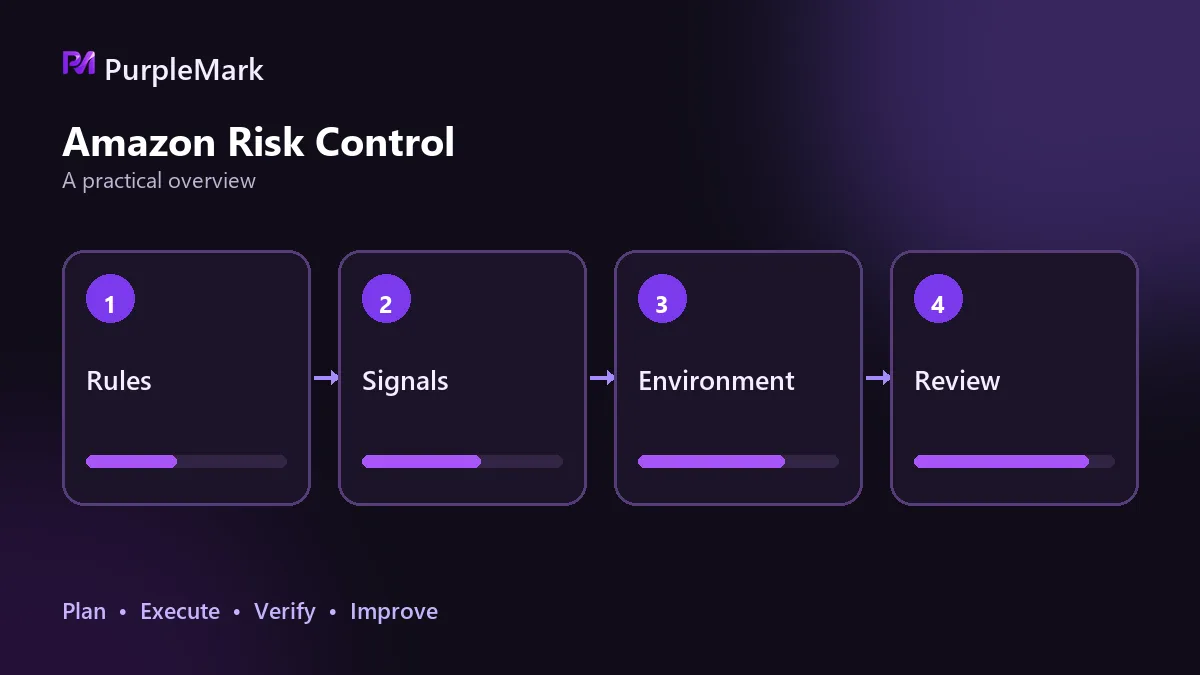
How the platform judges whether a review is inauthentic
It is difficult for a platform to draw a conclusion from one isolated action. What matters is the combination of signals.
Abnormal purchase behavior is one of the easiest things to detect. A normal buyer may search, compare prices, read several pages of reviews, and spend some time before ordering. If an account has no browsing trail and goes straight to a product to place an order, that path is itself a signal. Shipping addresses can also create problems: multiple buyer accounts pointing to the same address or the same small area can form an obvious cluster.
Similarity in review patterns is just as noticeable. If a group of accounts leaves reviews on the same set of products within the same period, using similar wording, similar lengths, concentrated ratings, and even similar photo styles, those features together say far more than any single parameter.
Account linkage is the third issue and the hardest to avoid. The platform has extensive seller-side information. If seller and buyer accounts overlap in payment methods, shipping addresses, device environments, or network exits, a linkage can be established. In other words, those accounts may not look independent to the platform even if no action has been taken yet.
What can happen after the activity is identified
Enforcement usually affects three layers, and they can happen together.
The lightest layer concerns the reviews themselves: related reviews may be removed. The loss may look small, but the number and rating distribution on the product page will change, and conversion supported by those reviews may fall.
The second layer concerns buyer accounts. Accounts may be restricted from reviewing or ordering, and serious cases may lead to deactivation. If those accounts were being used for other purposes, those uses can disappear as well.
The third layer affects the seller account. This is the step many people fail to account for: linked seller accounts may face restricted selling privileges or reduced product visibility, and serious cases can affect all products under the account. One enforcement action can therefore affect far more than a single review; it can disrupt a period of business performance.
There is another layer that is easy to overlook: these actions can leave a record on the account. If another anomaly appears later, the historical record may be considered too.
Environment isolation cannot resolve contradictions in behavior
A common claim about this practice is that independent environments, separate networks, and separate fingerprints can make the accounts look like real users.
Separate environments can indeed prevent some device-level attributes from overlapping. That is technically possible. But it only addresses the device side and cannot explain behavioral contradictions: Why does an account first appear only when it is ready to buy, with no prior browsing? Why do several apparently unrelated users purchase within such a narrow time window? Why do their reviews read as if they were written by the same person?
Platforms evaluate combinations of behavioral patterns like these, not just one parameter that can be changed in isolation.
There is also a cost tradeoff. The less is spent on environment isolation, the higher the linkage risk may be; the more is spent, the closer the cost gets to paying for compliant services directly. It is not inherently a money-saving approach.
Compliant ways to build reviews
There are ways to accumulate reviews without taking on these risks.
Platforms provide their own tools. There is often an in-platform review-request option that lets sellers invite buyers to leave feedback after an order is completed. Some platforms also run official review programs in which new products are provided to eligible users, who independently decide what to write, with the resulting review carrying a label. Two boundaries matter when using such channels: do not attach any form of benefit or exchange, and do not specify or steer the content of the review.
After-sales service is also worth investing in. Shipping updates, usage instructions after delivery, and proactive problem resolution are not violations in themselves and can genuinely lead to some authentic reviews. Many buyers do not leave reviews not because they refuse to, but because they forget.
The product itself is the foundation. Look at the areas where negative reviews concentrate—packaging, manuals, friction in using a feature, missing accessories—and improve what can be improved. Once those issues are fixed, reviews can change on their own without artificial intervention.
Reviews are an outcome
When product quality is stable, descriptions are accurate, and logistics are reliable, reviews can accumulate gradually. Conversely, if the product has real flaws, additional manipulation only postpones the problem. Genuine users will still leave negative reviews, and dealing with the issue later will cost more.
At its core, platform risk control looks for patterns that are overly regular and controllable. With reviews, there is only one dependable way to make them look natural: let them be genuinely natural.


