
Amazon generally allows one seller account per seller. A second account may be permitted only when there is a legitimate business need and approval. The real challenge in multi-store operations is keeping account data, environments, networks, and day-to-day actions genuinely separate.
To scale their business, many sellers consider operating multiple Amazon stores at the same time. The first hurdle is not technology but Amazon's account policy: whether you can open another account, and how many accounts you may run, is decided by the platform.
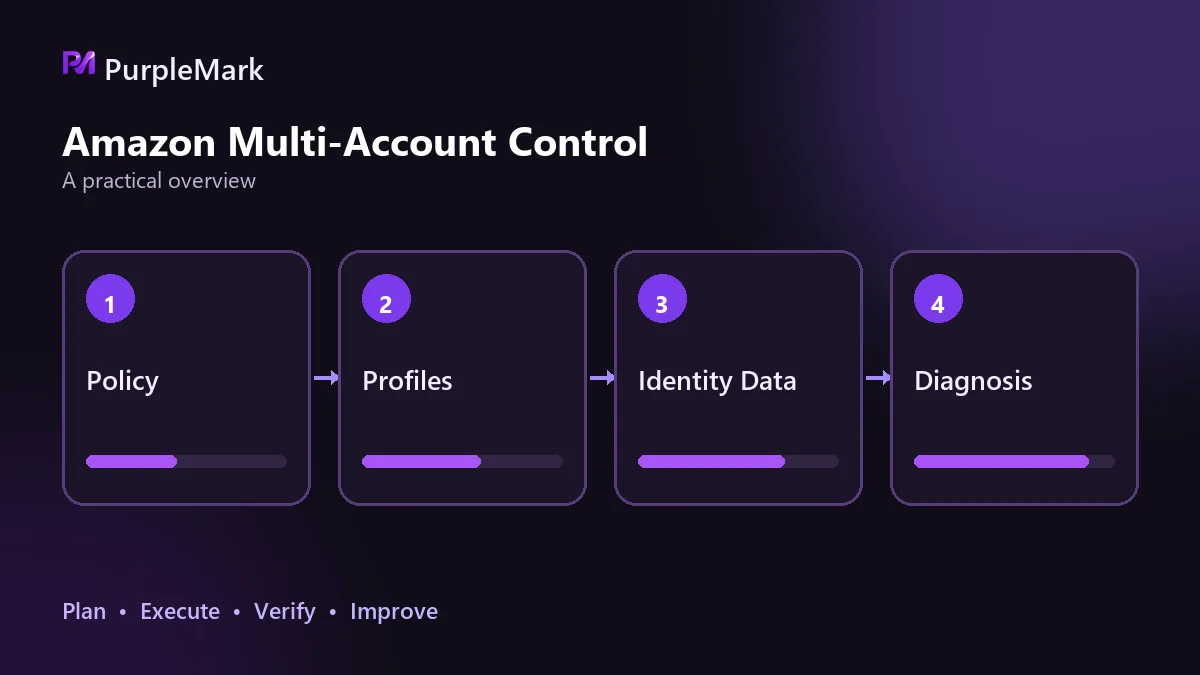
When does policy allow a second account?
Amazon's default rule is straightforward: one seller, one account. A second account may be approved only when the business structure truly requires separate operations. Amazon has cited two typical situations: you own multiple brands and each brand is operated as a separate business unit; or you manufacture products for two independent companies and need to manage their products separately.
Put simply, wanting to grow is not enough. The business itself must need to be separated. If you open multiple accounts without approval, or if one approved account violates selling policies or the Seller Code of Conduct, other accounts may also be affected—from suspension to permanent deactivation.
To judge where you stand, ask three questions: Does the business really require separate entities? Has approval been obtained and documented? Have the accounts been kept separate from beginning to end? If even one answer is no, later technical work will not solve the underlying problem.
What signals are used to detect account linkage?
Even when the compliance requirement is met, managing multiple accounts is still difficult. Amazon can compare multiple groups of signals to determine whether accounts are related rather than relying on a single field.
- Identity data: Do legal entities, registered addresses, phone numbers, or email addresses overlap?
- Financial data: Are bank accounts, payout methods, or credit cards shared?
- Network data: Do IP addresses and their histories, as well as exit regions, match the markets claimed by the accounts?
- Environment data: Browser fingerprints, including UA, time zone, language, fonts, resolution, cookies, and local storage.
- Behavioral data: How often devices are switched and whether operation times are so regular that they do not resemble normal human use.
A common misconception is that giving each store a different IP makes it safe. In practice, highly similar fingerprints, rotating logins in the same browser, or cross-contaminated cookies can still trigger linkage detection. Automated monitoring looks at overall consistency, not one isolated variable.
Isolation must cover data, environments, and responsibilities
Separating account data and finances is the baseline. Different accounts should use different legal entities, bank accounts, and contact details, and payout channels should not be shared. If this layer is not separated, later environment tuning is only a workaround.
Environment isolation should follow one account, one environment, one exit point. Each account needs an independent browser environment and proxy, with cookies, cache, local storage, and fingerprint parameters kept separate. The exit region should match the market served by that account. As the number of accounts grows, manually switching windows and checking proxies becomes error-prone. Multi-account environment tools such as PurpleMark bind proxies, start pages, and fingerprint settings to a specific environment, keep one environment fixed to one account, separate use cases with groups, restrict store access through member permissions, and preserve change records.
Division of responsibility is the most easily overlooked part. Problems in multi-store operations often come from people rather than the environment: one person may switch between two stores on the same computer and browser, or one person may hold backend access to every store. A better approach is to assign responsibility by store or brand, grant only the permissions needed, and route cross-store actions through approval or at least leave an audit trail. Then, if one account does have a problem, the potential impact remains contained.
Performance and inventory should also be monitored separately. Account health is assessed independently, and order defect rate, cancellation rate, late shipment rate, and refund rate can all affect account status. Track each store's key metrics separately so problems in one account do not spread through shared processes. The same applies to logistics and after-sales service: shipping information, return addresses, and customer-service email accounts should correspond to the relevant account to avoid mix-ups.
Frequently asked questions
Can the same person's information be used to register two accounts? The risk is high. Amazon can cross-check legal entity information, payout methods, and contact details, and these overlaps are among the most direct linkage signals.
After approval, can two stores share one environment? It is not recommended. Account-level compliance does not mean environments and exit points can be shared; technical linkage risks still remain.
What is the hardest part of multi-account operations? It is not opening the accounts. It is maintaining long-term separation between accounts, keeping each environment clean, and making every action traceable.
Closing thoughts
The sequence for Amazon multi-account operations is policy first, isolation second, monitoring third. If the policy requirement is not met, technical measures only amplify risk. Once policy requirements are met, the remaining task is to separate account data, environments, people, and operational data cleanly. Tools can reduce management cost and error rates, but they cannot change Amazon's rules for account structures.


