
If an SMS verification code does not arrive, do not rush to switch devices. Testing shows the problem is more often tied to the phone number, the exit region, and the way the registration is performed. Check carrier and signal, filtering and spam folders, number status, binding and quantity limits, and cross-region receiving restrictions in order.
On the same platform and with the same registration process, some people pass on the first try while others get stuck at the verification-code step and have to repeat it. The first reaction is often to change the device or browser, but testing points in the opposite direction: whether the code arrives has relatively little to do with the device or browser and much more to do with the phone number itself, the region of the registration exit, and the pace of the process.
Troubleshooting should therefore start with the layer closest to the phone number and move outward one layer at a time.
First confirm that the phone-number side is working
The most basic layer is the carrier and signal. Put the SIM card in another phone, or use the same SIM to receive another SMS first. This helps determine whether the number cannot receive messages at all or whether only messages from this platform fail to arrive. Until this layer is ruled out, later conclusions are not reliable.
Next, check filtering. Built-in SMS blocking, carrier-side spam filtering, and third-party security apps can all send verification codes to a blocked list or spam folder. Platforms use different sender ranges, and some messages can be caught by keyword rules. Reviewing the blocked-message list is much more useful than repeatedly tapping resend.
The number itself may also have a status issue. If it was previously involved in policy violations on the platform or has been flagged, the platform may simply stop sending to it, which appears as a code that never arrives. A clear test is to switch to a number that has never been used before; if the code arrives immediately, the original number is the likely cause.
Then check whether the number and exit region match
Cross-region receiving restrictions are the most important layer in this chain. If the phone number and the registration exit are in different regions, delivery can be affected significantly. In testing, when the two regions did not match, the chance of successful registration was only around half, and in about 20% of cases no verification code arrived at all.
There are less extreme cases as well. IP ranges from most providers can receive codes and complete registration normally, while some dedicated residential exits may not trigger phone verification during registration. But not seeing a verification prompt does not mean there is no risk. If a phone number is not bound immediately after registration, logging in again the next day may still trigger verification.
When region detection differs, follow the platform's result
One detail is easy to miss: because IP geolocation databases differ, the region automatically identified by the platform may not match the actual region of the number. This happened during testing—the number was clearly from one region, but the platform identified it as a completely different one. Manually changing the result back to the expected region caused the code not to arrive; following the platform's detected region allowed registration to complete successfully.
A region mismatch affects the success rate, but not absolutely. When the platform's detected region differs from what you expect, configuring the environment according to the platform's result is more practical than forcing a correction.
Number bindings and quantity limits
Two limits deserve separate attention. The first is binding: one email address or phone number usually corresponds to only one account. A number that is already bound cannot be reused for registration, so there is no workaround at this step; use another number.
The second is the quantity limit, which is related to the exit. Registering too many accounts through the same exit can lead to account blocks or cause already-created accounts to be asked for security verification. The practical test is whether switching to a clean exit immediately restores normal behavior. If so, separate the environments instead of continuing to retry through the same exit.
Three checks on the exit side
When examining the exit itself, check three things: whether its region matches the phone number; whether it is a stable, dedicated exit rather than one that has been flagged, region-restricted, or heavily shared; and whether the exit changes during registration. The first two affect how the platform sees the environment, while the third determines whether the environment itself is consistent.
Registering many accounts in the same browser environment is also a common trigger. Giving each account its own environment and its own exit is more useful than repeatedly clearing the cache.
Account details and operating pace
Usernames and passwords should look reasonable. In testing, manually entering a long string of repeated letters as a password was rejected directly by the platform—information that clearly does not look like something a real person would use is itself a signal. The same applies to pace: repeated submissions in a short period, or immediately starting bulk follows or direct messages after registration, can cancel out the consistency benefits from the earlier layers.
Follow the sequence instead of trying random changes
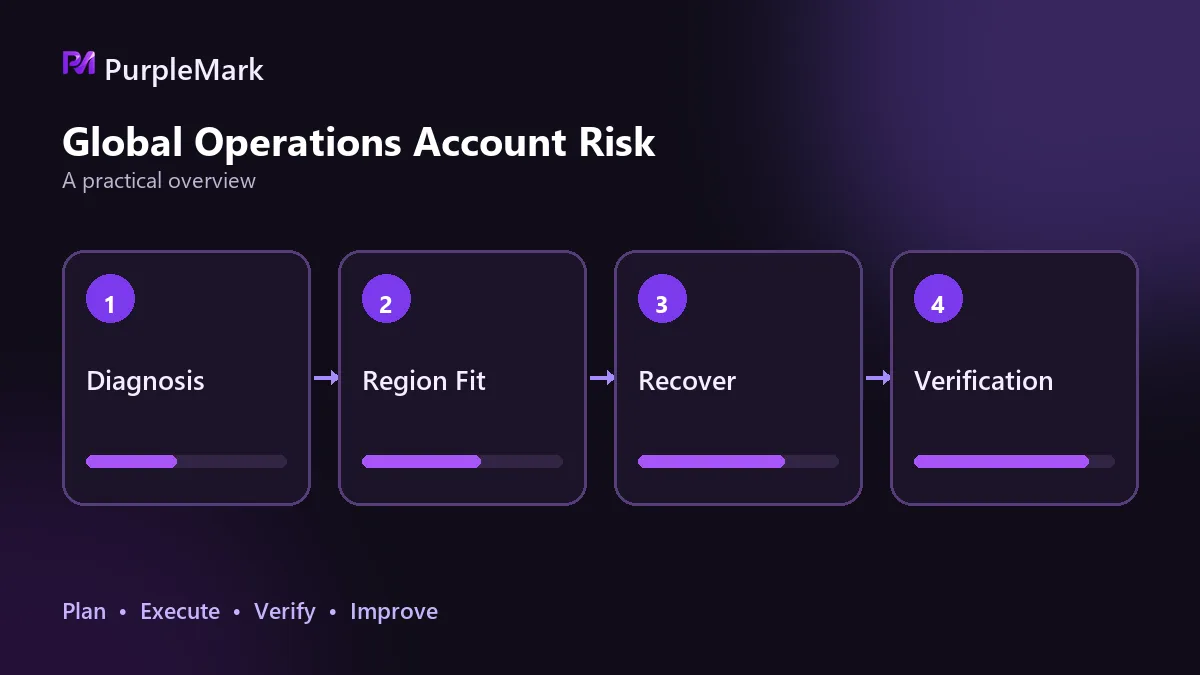
Putting these layers together creates a clear troubleshooting path: first confirm that the number can receive SMS normally, then check whether the number and exit regions match. Next, check whether the exit is clean and stable, whether the number or email has already been bound to another account, and how many accounts have been registered through the same exit. Finally, review whether the account details look natural and whether the actions are happening too quickly. If region detection differs, follow the platform's result first.
The worst approach is random trial and error—changing something just to see what happens. Every changed condition adds another variable, until it becomes impossible to tell where the problem is. Change only one item at a time and observe the result; that is usually faster.
One final prerequisite cannot be skipped: the number must be genuine and available for long-term use. If the number comes from an unknown source and can be reclaimed at any time, all of the troubleshooting above loses its value.


