
After a store is suspended, first identify whether the issue concerns performance, authenticity, account linkage, or a policy violation, then prepare the matching evidence chain and plan of action, including what to do after a rejection.
Suspension notices are usually only a few paragraphs long, but their wording largely determines what you need to prepare next. Even when the result is the same—an account suspension—the evidence needed for a performance issue is almost entirely different from what is needed for an authenticity complaint.
The appeal logic on both platforms is similar: explain the cause of the violation, provide evidence of corrective action, and present a prevention plan. Many appeals fail at the first step because the cause is misdiagnosed; even a complete set of documents will not help if it does not address the actual issue.
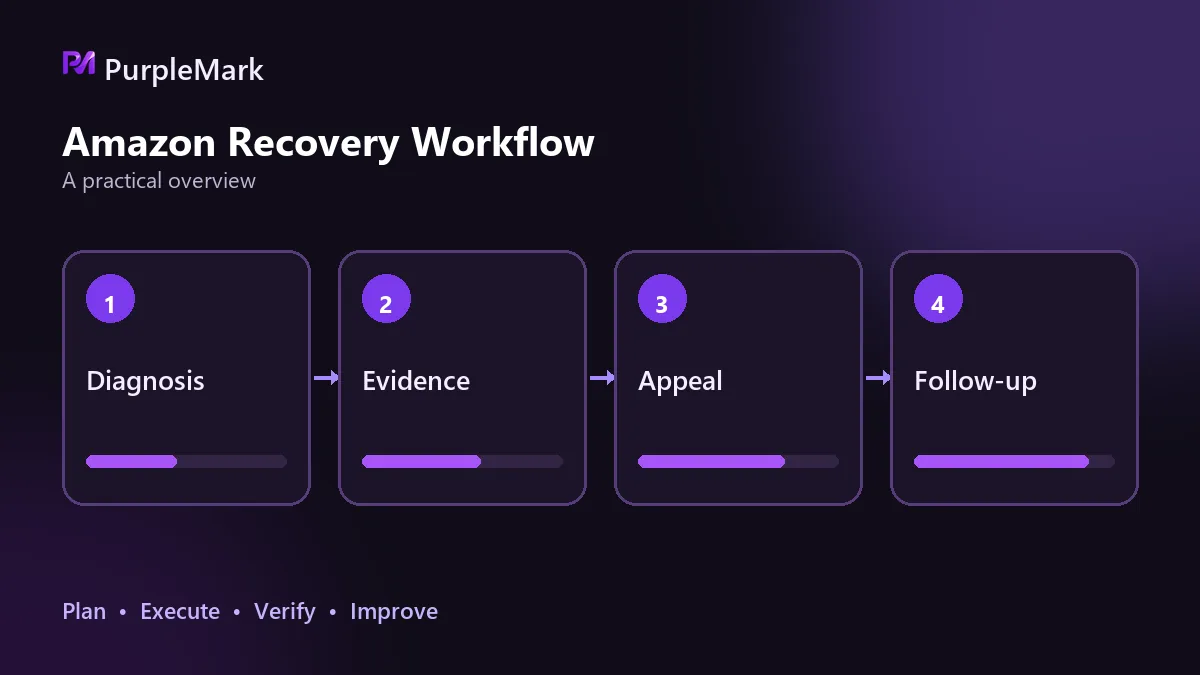
Most causes fall into four categories
Performance metrics are the easiest category to identify. Amazon watches metrics such as order defect rate, late shipment rate, and cancellation rate, while Walmart places more emphasis on OTD, or on-time delivery. The notice usually names the metric that failed and often includes the measurement period. This points to an ongoing service-quality problem rather than a one-off mistake.
Authenticity complaints mean the platform is questioning the product itself or its source. Missing brand authorization, mismatched test reports, or buyer complaints alleging counterfeit goods all fall into this category. Reviews have become noticeably stricter over the past two years. Since July 2025, Amazon has accepted only test reports from laboratories on its approved list, so a laboratory used in the past may no longer qualify. The goal of this type of appeal is to prove the lawful source of the goods, not to explain customer-service attitudes.
Account linkage is the most difficult of the four categories. The notice may say that the account is linked to another account or connected to an account that has already been restricted. Platforms can now look back through historical operating records, so practices such as sharing manufacturer qualifications or test reports across multiple stores can also be detected together.
Policy violations cover a broader range of issues: variation abuse, Listing descriptions that do not match the actual product, missing category approval, or entry into prohibited categories. Walmart is especially direct about description-to-product mismatches; discrepancies in images, specifications, or free-gift information may all be included.
The evidence chain must be genuine, relevant, and complete
More documents are not necessarily better. Each item should correspond to the problem identified in the notice. Business licenses, legal-representative identification, purchase invoices, supply agreements, brand authorizations, and test reports establish the business entity and source of goods. Order records, logistics documents, and customer-service communications show that the operating activities actually occurred. Screenshots showing removal of a noncompliant Listing and agreements signed with a new logistics provider demonstrate that corrective actions have been implemented.
Of the three requirements, relevance is the easiest to overlook. Submitting a pile of documents unrelated to the issue makes it harder for reviewers to see the connection and forces them to spend more time figuring out what you are responding to. Authenticity is the baseline: once unverifiable materials are discovered, the matter can become more complicated than a simple suspension.
Plan of action: the root cause cannot simply be “oversight”
This document usually needs to answer four questions: what happened, why it happened, what has already been done, and how it will be prevented in the future. The third and fourth points matter most and are also the easiest to write too vaguely.
The root-cause section should be specific about the process and time period. For example, saying that late shipments were concentrated in several peak-season weeks because the previous logistics provider was overloaded is much more useful than saying “we will strengthen management.” The corrective action should be equally concrete: which new provider was contracted, whether delivery-time requirements were added to its performance assessment, and what warehouse cut-off time is now used. The prevention mechanism should then explain how these measures will continue over the long term and who is responsible for following up.
After writing it, review it once more: if the same statement could apply to any store, it probably will not do much to help restore yours.
After a rejection, do not submit the same thing again
Repeatedly submitting an appeal with the same content usually does not change the result and may affect later handling. A more reliable approach is to first understand which part of the rejection was not accepted—insufficient evidence, unresolved responsibility, or an inadequate explanation of corrective action—then add new supporting material before resubmitting.
If multiple accounts are suspended at the same time, filing highly similar appeals for each one can reinforce the conclusion that the accounts belong to the same operator. The registration information, operating entity, and fund flow for each account should be explained separately; simply changing words in a template has little value.
Also leave enough time. Appeals usually have deadlines, so start organizing materials on the day the notice arrives rather than waiting until the last moment when documents may still be missing.
Actions during suspension that can make the problem worse
Registering a new account during a suspension in order to continue operating is considered an attempt to evade platform enforcement. If the accounts are linked, the action may extend to the new account and make recovery of the original store more difficult.
First take stock of funds and inventory and determine how long the business can sustain the interruption, because this affects the pace of later negotiations and appeals. Do not stop routine compliance work: if metrics are abnormal, change logistics providers; proactively contact buyers to resolve complaints; and prevent additional issues from accumulating.
Keeping multiple-account environments separate is one of the easiest items to overlook. If several stores are operated from the same device and network, the risk of linkage rises significantly, while linkage appeals are already among the hardest to resolve. Fingerprint browsers such as PurpleMark can assign each account a fixed, independent browser environment and network exit so that identifiable overlaps do not occur between accounts.
Conclusion
At its core, an appeal uses evidence to show that the problem has been resolved: identify the cause accurately, provide evidence that matches it, and describe corrective measures clearly. An easier approach is to prevent the store from reaching that point in the first place—maintaining metrics, qualifications, and operating environments day to day is more effective than any appeal technique.


