
There is no universal best option for cross-border payments. The right choice depends on how the payment channel fits your business. This guide breaks down fees, currency and market coverage, settlement cycles, compliance documents, and platform-account compatibility, then explains how to evaluate high-frequency small payments versus low-frequency large payments.
The challenge in cross-border collections is not finding one “best” channel, but matching the channel to the business. What you sell, who you sell to, the amount of each transaction, and how often you settle funds can all change the answer.
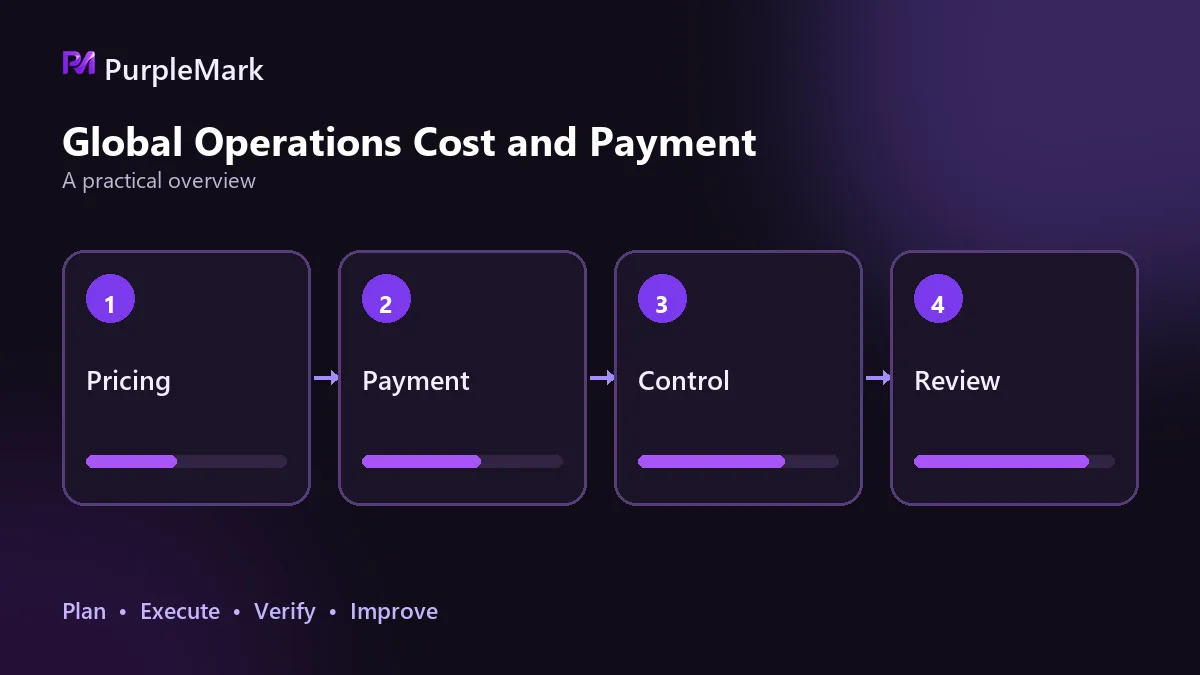
Break down the fee structure
When comparing channels, most people focus on the headline rate—the fraction deducted from each transaction. It is easy to find, but it is often not the largest part of the real cost.
The real cost is often hidden in three places: the exchange-rate markup during currency conversion, fixed withdrawal or transfer fees, and intermediary fees when funds move across accounts. Exchange-rate markups are especially easy to miss: a low headline rate can still leave you with noticeably less if one or two extra percentage points are lost on FX. Do not compare one fee in isolation. Map the full path from the buyer’s payment to money you can finally use, mark the charge at every step, and add them up to get the true cost.
If your business receives multiple currencies, settling directly in the corresponding currency can avoid an extra conversion back to your domestic currency and then out again, saving that part of the cost.
Make sure you can receive—and move—the money
Supported currencies and regions determine whether a channel is usable at all. There is little room for compromise here: insufficient coverage can mean some orders simply cannot be settled.
Another factor is whether the provider offers local receiving accounts or local payment methods in your target market. Local options can improve payment success rates and buyer trust, especially for cards and local bank transfers.
Settlement timing is closely related. How often funds are settled, how many days they take to arrive, and whether withdrawals have a minimum amount all affect cash flow directly. Sellers that hold inventory are especially sensitive: one extra week in transit can delay the next purchasing cycle.
Eligibility, risk controls, and account linking
Providers differ significantly in their requirements for business entities, registration locations, and supporting documents. KYC is only the starting point. Whether transaction volume matches the stated business model and whether trade documents such as orders, shipping records, and contracts line up often determines how smoothly a review proceeds. Confirm first that you can provide these materials. Inconsistent information is a common trigger for risk checks, so company details, receiving accounts, and store information should be kept aligned.
Another easy-to-miss question is whether the payment channel is compatible with the platform you operate on. A channel for e-commerce marketplace settlements, a channel for acquiring payments on an independent site, and a multi-currency account for treasury management and transfers may accept different types of funds. Configure marketplace settlement, independent-site acquiring, and outbound payments separately so each tool has a clear role.
Small, frequent payments and large, infrequent payments follow different logic
When you have many orders, low transaction values, and dispersed customers, prioritize coverage and onboarding thresholds: can you get started quickly, are enough payment methods and regions supported, and do funds arrive on time? In this case, the per-transaction fee percentage matters greatly.
For businesses with fewer but larger transactions, the priority shifts to stable security and compliance. If a large payment is held for review or requires extra documentation, the delay and communication cost can far exceed a small fee saving. These businesses benefit more from channels with transparent risk-control logic and predictable review standards, or even from traditional routes such as bank wire transfers when certainty matters more.
Most merchants ultimately use more than one channel. A common setup is the platform’s built-in option for marketplace orders, a broader-coverage channel for an independent site, and a multi-currency account for moving funds. More channels are not automatically better; the important thing is to give each one a clear role.
Environment issues with multiple accounts
Multiple stores and markets usually mean multiple receiving accounts are online at the same time. Account data and login environments should therefore remain separate: one account should use one consistent set of entity information and one stable network exit, while team access should be assigned by member and logged. Repeatedly switching among different receiving accounts in the same browser environment can trigger security verification and may also be treated as account association.
Teams that need to maintain several receiving accounts can use PurpleMark’s multi-account environment features to keep each account’s login state separate while managing them centrally, avoiding problems caused by a shared environment.
Frequently asked questions
Is a lower fee always better? Not necessarily. Add exchange-rate markup, withdrawal fees, and chargeback fees to the total cost before deciding whether the rate is worthwhile.
Do small businesses need a dedicated payment service provider? With low order volume, a platform’s built-in option or an all-in-one solution is often simpler. Once volume becomes stable, you can reassess whether a specialist channel’s fee structure makes economic sense.
Is a multi-currency account essential? If you operate across several countries or currencies, it is often difficult to avoid and can reduce the number of conversions. If you serve only one market in one currency, the extra management layer may not be necessary.
Can multiple receiving accounts be treated as associated? They can be if login environments are shared or information overlaps. The standard approach is to keep account data and environments separate.


