
Many people treat multi-platform onboarding as a simple registration task, only to discover later that account environments, proxies, Cookies, and team collaboration are the real challenges. This article reviews the onboarding basics for major cross-border platforms and explains why an account workspace should be set up before you start opening stores.
Many newcomers to cross-border e-commerce focus first on “which platform is easier and how to sign up.” But after two or three months of actual operations, they often realize that the pace of the business is shaped less by registration itself and more by how multiple platform accounts are managed, who creates them, who accesses them, and whether activities across platforms can affect one another.
This article reviews the basic onboarding requirements for several major cross-border platforms, including Shopee, Amazon, and eBay, and then focuses separately on the “account workspace” as a prerequisite so you can avoid chaos from day one.
Shopee: a major C2C platform in Southeast Asia
Platform characteristics: Shopee has broad coverage in Southeast Asia and has long ranked among the leading shopping apps by downloads. It supports multiple languages and currencies, while social features such as Shopee LIVE encourage content-driven marketing.
Onboarding essentials:
- Business qualifications: Shopee does not currently support individual seller registration. A company business license from mainland China or Hong Kong is required.
- Product compliance: Products must comply with both domestic export policies and the import requirements of the destination country.
- Transaction history: Screenshots showing overall store order turnover or fund flow data for the most recent three months.
- Onboarding channels: Apply through the official website, at an investment-promotion event, through an official onboarding QQ group, or by official email.
Once the materials are ready, Shopee's registration process is relatively standardized. However, how many sites one company can open and whether it can operate in multiple regions in parallel depend on the specific recruitment policy.
Amazon: relatively clear requirements for global selling
Platform characteristics: Amazon operates across many marketplaces and has a large user base, making it one of the first choices for many cross-border sellers.
Onboarding essentials:
- Business qualifications: Amazon Global Selling currently does not support individual applications; a company business license is required.
- Core documents: Business license of the legal entity, front and back of the legal representative's ID, a company bill or personal bill of the legal representative (mandatory for the US marketplace; currently not required for European/Japanese marketplaces), a VISA credit card, and an overseas receiving account.
- Onboarding channels: Use a registration link sent by an account manager or an officially recognized self-service registration channel.
Amazon manages store quality and account association relatively strictly. It is better to plan account-environment separation before onboarding rather than trying to fix association problems after they occur.
eBay: supports both individuals and businesses
Platform characteristics: eBay is a long-established B2C retail platform with deep ties to Chinese sellers and also supports C2C transactions.
Onboarding essentials:
- Individuals and businesses are both supported.
- Core documents: Valid business and tax information for business sellers, a PayPal account linked and verified with the eBay seller account, a dual-currency credit card (VISA / MasterCard), cross-border verification documents (ID, recent photo, proof of address), and a commonly accepted international email such as hotmail / gmail / 163.
- Onboarding channel: Apply through the official seller acquisition team.
Cross-border verification can take longer, so prepare proof of address and other documents before starting the process.
AliExpress and other platforms
AliExpress, Wish, Lazada, and TikTok Shop are also frequently considered. Their onboarding rules differ significantly: some require business qualifications, some require category-specific qualifications, and some ask for store transaction history. A common baseline is usually an “internationally accepted email + dual-currency credit card + independent business or personal identity.”
A step that comes before onboarding: the account workspace
Many beginners start with a “register first, figure out the rest later” approach. Once operations begin, they often run into scenarios such as:
- Logging into multiple platform accounts from the same computer or IP — platforms may associate the accounts, increasing suspension risk.
- Mixing Cookies and local data across different platform accounts — an abnormal login state in one account may affect others.
- When a teammate takes over, nobody knows who originally created which account — account lists are scattered across different browsers and spreadsheets.
- When several platforms are operated at once, each one depends on different environment parameters such as time zone, region, payment method, and shipping address, which are easy to maintain incorrectly by hand.
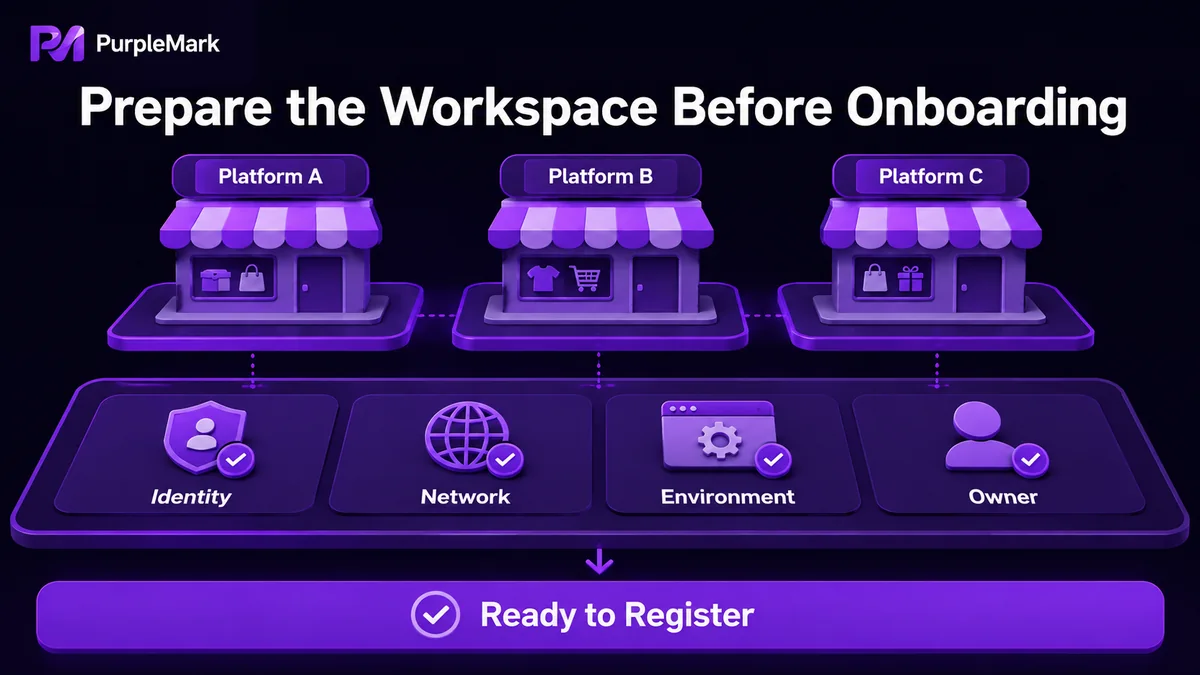
The solution is not simply to “add more tools,” but to centralize account-related work in one workspace. PurpleMark's web version, for example, provides this kind of workspace:
- Centralized environment management: Each account gets an independent browser environment. Operating system, Chromium kernel version, UA, language, time zone, geolocation, fonts, WebGL, WebRTC, and other parameters can be configured in one place, while environment lists can be grouped by business.
- Separate proxy management: Different platform accounts can use different proxies, with exit IP, time zone, and geolocation configured together.
- Team collaboration: Members, roles, permission groups, and operation logs make it clear who is using which account.
- Data recovery safeguards: The recycle bin retains mistakenly deleted browser environments and proxies for 30 days; operation logs record login, environment management, proxy management, and other activities.
- Apps and automation: The app center centralizes browser extensions, while RPA and Local API allow batch tasks to run in standardized environments.
These capabilities run in parallel with the onboarding process: prepare the account workspace first, then register accounts according to each platform's requirements. The two steps work better together.
Practical recommendations before you start
- Choose your target platforms and marketplaces first, then prepare business/personal documents to avoid duplicating document preparation.
- Place multi-platform accounts in separate environments from day one; this is much cheaper than fixing issues after they appear.
- Keep the account workspace separate from everyday tools: maintain account environments only in the workspace, while browser extensions and bookmarks can be managed through the app center.
- Set permissions as soon as the team joins: member roles + permission groups should ensure new colleagues can see only the environments they are responsible for.
- Keep every action traceable: operation logs and the recycle bin are critical when you need to identify what happened.
If you are still evaluating an account workspace, you can open the PurpleMark web version and create one environment, then configure the time zone, geolocation, proxy, and other basic parameters for your first account as the “infrastructure” for future multi-platform onboarding. If you need the local browser component, install it later from the download page.
Frequently asked questions
Does Shopee always require business qualifications? Yes. Shopee currently does not support individual onboarding and requires a mainland China or Hong Kong business license.
Does Amazon always require a US bill? A company bill or the legal representative's personal bill is mandatory for the US marketplace. European and Japanese marketplaces currently do not require this document.
Is eBay cross-border verification complicated? Cross-border verification requires an ID, a recent photo, proof of address, and other materials. The proof of address should match the registered address. Preparing these documents in advance can save time.
Should accounts on different platforms use separate environments? It is strongly recommended. Logging into multiple platform accounts from the same browser or IP is one of the common signals platforms may use when assessing account association.


