
Dropshipping is often described as a way to run an online store without holding inventory, but beginners usually want to know one thing first: which platform should they use? This guide compares common dropshipping platforms by supplier region, product type, and sales channel, so you can start with lower costs and manage multiple stores more systematically.
Dropshipping has been talked about a lot in recent years. Some people see it as a low-barrier side business with no inventory, while others have run into costly problems. Whether it is still worth doing and which platform to start with are usually the first questions beginners face.
Rather than repeating the basics of what dropshipping is, this guide lays out the main platform types and helps you choose based on sourcing needs, target market, and sales channel. It also covers an issue that many people overlook but that can create serious trouble for multi-store operations: account association risk across stores.
Understand the cost structure of dropshipping first
Before choosing a platform, be clear about one thing: dropshipping does not mean you have nothing to manage. It means outsourcing capital-heavy tasks such as inventory, packing, and logistics to suppliers so you can focus on product selection and traffic acquisition.
The cost structure is straightforward:
- What you save: you do not need to stock large quantities upfront, so startup capital pressure is lower; suppliers ship directly, so you do not need to build your own warehousing operation.
- What you take on: you have less control over product quality and delivery speed. Your margin comes from the difference between wholesale and retail prices, so product selection and paid traffic can directly determine profitability.
Whether dropshipping works for you therefore depends less on the model itself and more on whether you can find products with enough margin and relatively low after-sales risk, plus whether you have a stable source of traffic.
More platforms are not always better: sort them by these three dimensions
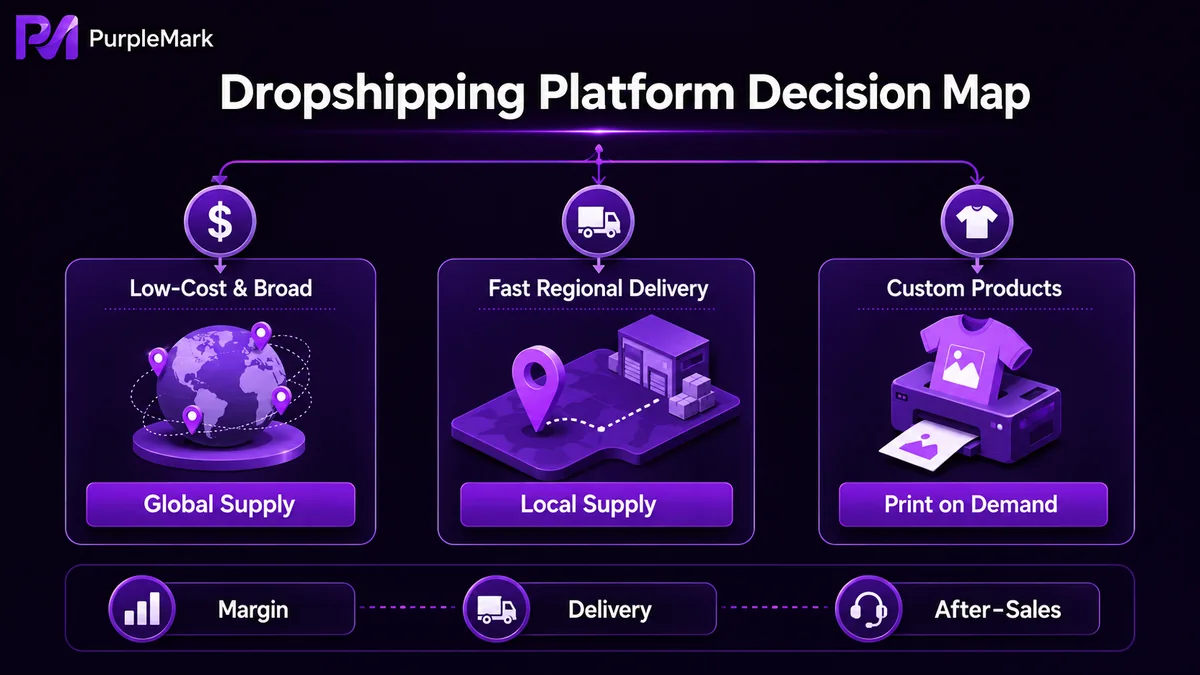
There are many dropshipping platforms, but if you classify them by supplier location, suitable product type, and connected sales channels, they largely fall into three groups:
General sourcing + integrated dropshipping
These platforms combine product sourcing with supplier connections and are suitable for beginners who do not want to maintain too many accounts at once:
- AliExpress: choose products directly on AliExpress, list them in your store, then purchase for direct shipment after an order comes in. It has a wide catalog and a low entry barrier, making it useful for learning the basics.
- CJ Dropshipping: focuses on end-to-end dropshipping, covering sourcing, packing, logistics, and warehousing. It suits sellers who want a more managed workflow.
- Doba: a long-established US platform operating since 2002 that connects suppliers and retailers, making it useful for sellers who prefer US and European sourcing.
Prioritize local US and European suppliers
If you mainly sell to the US or Europe and care about delivery speed, you may prefer suppliers located closer to customers:
- Spocket: focuses on US and European suppliers and can offer better delivery times for those markets, with flexible subscription options.
- SaleHoo: provides wholesale and dropshipping supplier access with a broad range of products.
- Dropified: supports dropshipping from the US and Europe and can connect with channels such as Shopify, AliExpress, Amazon, and eBay.
- Sellvia: sources from US manufacturers and is better suited to products where origin and quality positioning matter.
Specific categories / creative customization
If your products belong to a clear category, choosing a specialized platform can be more efficient:
- Printify: focuses on print-on-demand products and works well for custom T-shirts, mugs, phone cases, and similar items.
- Modalyst: helps sellers connect US, European, and AliExpress suppliers to their own stores more quickly.
- Wholesale2B: is geared toward importing products in bulk into multiple sales channels, similar to connecting one product source to several marketplaces.
- Inventory Source: focuses on order management and inventory synchronization, which is useful for sellers already operating at scale and managing multiple suppliers.
- FindNiche: strictly speaking, it is a product research tool that analyzes AliExpress and Shopify data to help you judge which products may be worth testing.
In short: choose AliExpress-style platforms for low-cost, broad-category testing; Spocket/SaleHoo-style platforms for US and European delivery speed; and Printify/Modalyst-style platforms for customized products. Do not register everywhere at once. Get one primary platform working first, then expand.
Starting with low costs: do not focus only on “no inventory”
If dropshipping saves you the cost of holding stock, your time and attention need to go elsewhere—mainly into three areas:
- Do not pick products only by instinct: use product research data to evaluate trends and margin potential instead of relying on guesses.
- Validate in small steps: test with a limited number of SKUs first, then scale after you have data, rather than committing resources to unproven products.
- Calculate logistics and after-sales costs carefully: delivery-time differences between platforms can directly affect negative-review rates, so test supplier fulfillment stability in advance.
The easiest pitfall to miss: account association in multi-store operations
Many dropshipping sellers use a multi-store model—operating several stores and listing more products to increase traffic opportunities. The idea itself is understandable, but beginners often overlook one major issue: once stores are associated by a platform, problems with one store can potentially affect the others.
How does association happen? It is not always because you intentionally sign into the same account. It can happen when you repeatedly operate several stores on the same computer and in the same browser environment. Platforms may evaluate device fingerprints, browser fingerprints, Cookies, network egress, and other signals when determining whether accounts are related.
For legitimate multi-store operations, each store should therefore have a clean, independent, and separate operating environment. This is where browser-profile isolation tools can be useful: each store can use its own browser fingerprint and local data so environments do not get mixed together.
If you manage dropshipping stores across multiple platforms, PurpleMark can provide separate browser fingerprints, Cookies, and local storage for each authorized account. It also lets teams organize store accounts, proxies, and workspaces by account, which can reduce accidental cross-use on the same device. Account grouping, team permissions, and activity records can also make collaboration easier for teams managing many legitimate stores.
Reminder: environment isolation can help with operational separation, but compliance comes first. Whether multiple stores are allowed and how they may be opened depends on each platform's official policies. Do not create accounts that the platform does not permit simply to bypass review rules.
Conclusion
Dropshipping is still a relatively accessible way to start in cross-border e-commerce, but the difficulty has shifted from whether you hold inventory to product selection, traffic, and compliant operations. Do not chase every platform at once. Pick one main platform based on supplier region and product category, then build solid store-management foundations—including proper separation of authorized account environments—from the beginning.


