
Multi-store backends need simultaneous logins, prices and inventory must be checked across platforms, competitor pages need data collection, teams need permissions, and ad dashboards need parallel management. Here is what environment isolation solves in these situations and what can happen without it.
One store, one computer, and one person managing it: a normal browser is completely enough. Problems start when the number of accounts and collaborators grow at the same time: several backends need to stay logged in, data needs to be checked every day, colleagues need access to the accounts they handle, but passwords cannot be shared with the whole team.
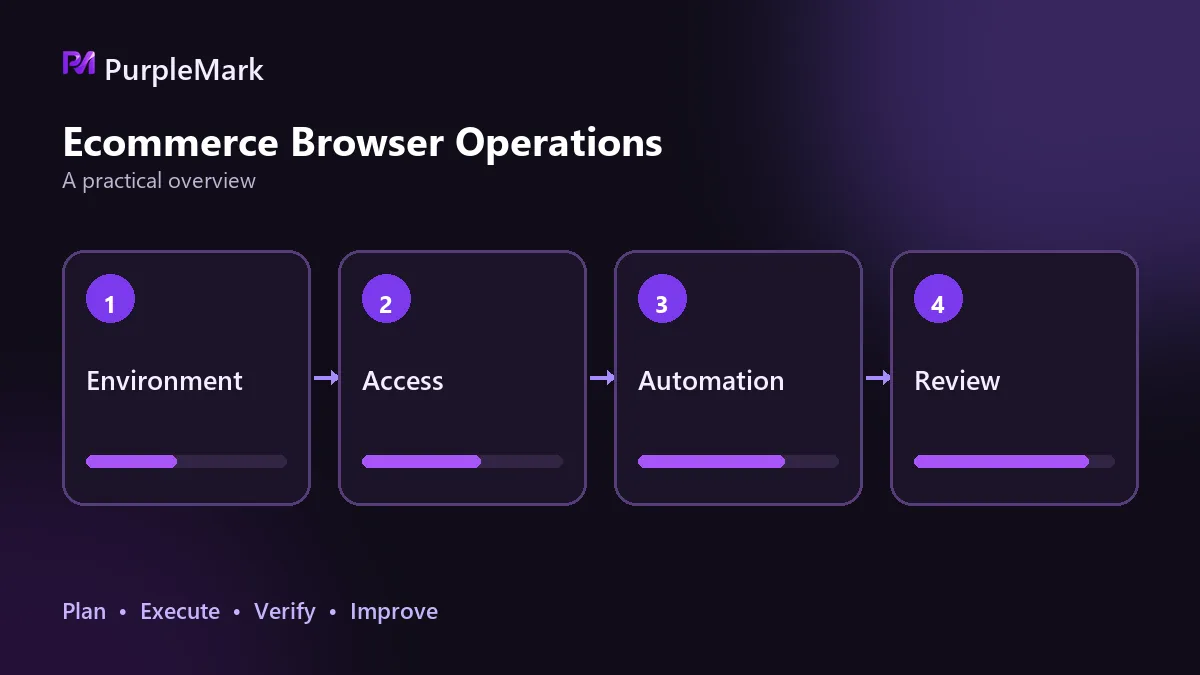
First understand what is being isolated
Platforms judge whether two accounts belong to the same operator by looking at a combination of signals—browser fingerprint, network egress, device information, and traces in local storage. The problem with a normal browser is that multiple accounts in the same browser share the same core parameters, the same local storage, and the same cache paths. Switching accounts only clears the login state; the underlying characteristics do not change.
Environment isolation gives each account an independent virtual browser environment: separate fingerprint parameters, separate cookies and local storage, and a separately configured network egress. From the platform's perspective, the visits come from different devices, networks, and regions.
A common misconception is that changing the IP is enough. Incomplete isolation can be worse than no isolation because it creates a false sense of safety. Tools such as PurpleMark are designed to keep these isolation relationships fixed—once account counts and team size grow, manually remembering every parameter is not realistic.
Multiple store backends need to stay logged in
When operating several stores or sites, teams often need multiple backends open at once: checking orders in one, changing prices in another, and watching a third during a campaign. With a normal browser, most people open several windows or repeatedly switch accounts. Login states interfere with one another, and over time this can lead to cross-login issues and sessions dropping.
With environment isolation, each backend remains logged in inside its own environment without affecting the others. By contrast, repeatedly signing several store backends in and out of the same browser creates overlapping login traces from the platform's point of view. If multiple stores are judged to be associated, they may be handled together rather than only the store you thought had a problem.
Daily checks for prices and inventory
Prices, inventory, and campaign status across multiple platforms usually need to be checked at least once a day; some teams check several times. Doing this manually, page by page, becomes difficult as account counts grow and omissions become more likely.
Installing data-collection extensions in each environment, or running scripts on a fixed schedule, can improve efficiency. Frequency is a separate issue: repeatedly scraping at a high rate from the same egress IP looks no different from a crawler to the target site. The usual progression is more CAPTCHAs and then an IP block. The pace should resemble normal browsing, and when there are many accounts, the activity should be distributed across their respective egress connections.
Collecting data from competitor pages
Product research, pricing, and creative reference all require looking at competitors. Repeated or bulk visits to the same page can appear as automated behavior to the target site. Spreading collection across different environments and egress connections, while keeping the pace steady, is much more stable.
The collected data also needs a durable place to live. If it exists only in one person's browser storage, it can disappear when that person leaves or their computer is replaced.
Permissions in team collaboration
One person managing three accounts and three people managing thirty accounts are completely different levels of complexity. The real problems are very concrete: a new colleague needs to take over several accounts, but you cannot give them every password; when someone leaves, access must be revoked immediately; and if an operational mistake happens, you need to know who did what and when.
Assigning account ranges by role is simpler. Members open the environments they are responsible for and do not need to know the passwords. By contrast, passing passwords around in group chats makes accountability difficult when something goes wrong, and accounts being taken away by insiders is also a common form of loss.
Parallel management of advertising backends
Advertising backends are often separated by account and region. The same ad account may also need two people to review data and adjust budgets separately, so simultaneous-login needs are even more common than with store backends.
When each environment is permanently mapped one-to-one to an account, the account's identity remains stable. Using one egress today, another tomorrow, and then a direct connection the day after for convenience introduces changes. Advertising backends are usually more sensitive to unusual logins than store backends, and budgets, audiences, pixels, and other assets are tied to those accounts.
When you can skip it for now
If you operate only one account, there is nothing to isolate and a normal browser is enough. If an account has little accumulated value—for example, an auxiliary account used only to view data or research information—it may not justify building a full system around it. If the team is just one person and account operations do not need to be separated, permission management offers little value.
A direct test is enough: if the account were banned tomorrow, would the loss be merely registering a new one, or rebuilding several months of work? In the first case there is no need to rush. In the second, isolation becomes a necessary investment.
It does not bring traffic
Tools of this kind do not create traffic or improve conversion. They do one thing: keep accounts from interfering with one another. That is exactly one of the easiest parts of multi-account operations to lose control of—and one of the areas where the consequences can be the most serious.


