
Facebook marketing works in sequence: stabilize accounts and Pages first, build trust through content and communities, then use ads to scale and feed performance data back into the next round. This guide organizes the key actions and checkpoints into four layers.
Facebook is both a social space and a base for brands and e-commerce. The difficulty is not that any single action is especially hard, but that several parts constrain one another: if an account has a problem, content and advertising can both stop; if a Page is restricted, the ad account may also be affected. That is why the framework below follows dependency order rather than a feature checklist.
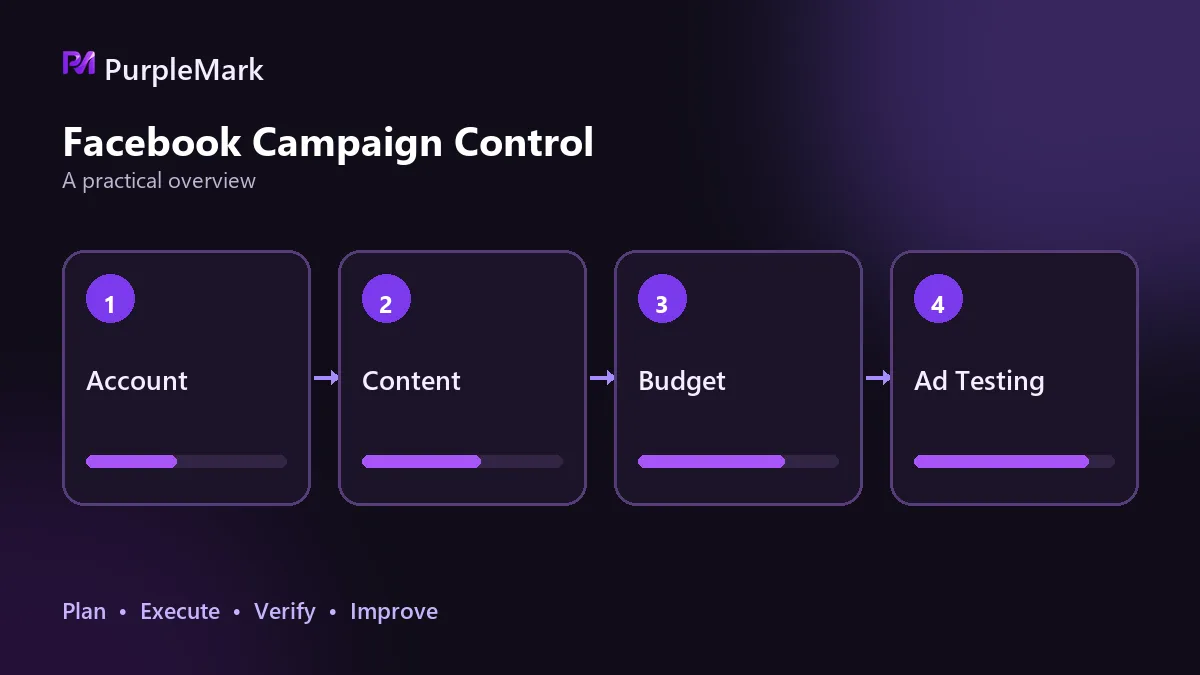
Step 1: Stabilize the account and Page first
Use real information and enter it correctly from the start, with a valid email address and phone number attached. Ad accounts and Pages are high-value assets, so enable two-factor authentication and protect the login email separately as well.
Keep the login environment stable. Frequently changing devices or network exits, or letting multiple accounts share the same environment, can trigger security prompts. A safer practice is to give each account a fixed browser environment and network exit.
The Page is the entry point for advertising. Its positioning should be clear: one Page should focus on one topic, with complete product information and contact details. Assets between the Page and ad account are linked, so a problem on one side can affect the other.
If an account or Page is restricted, first read the specific policy involved and then submit a targeted appeal; broad statements are usually ineffective. This step is complete when profile details no longer need repeated changes, the Page has basic content, and no verification has been triggered for several consecutive weeks.
Content and community: accumulate trust
Publishing consistency matters more than short bursts. Stable updates are more likely to maintain ongoing reach, while one viral post rarely carries an entire Page. Interaction also comes before hard selling: comments, answers to questions, and customer examples tend to build more trust, while direct product pushes often perform worse.
Communities are long-term assets. Groups can retain core users, but group rules must be respected; flooding a group with hard ads is a quick way to be removed. There is another common boundary: the platform places clear limits on high-frequency friend requests and bulk private messages, so being discovered through useful content is more sustainable than aggressively adding people.
Two signs show that this step is working: spontaneous discussions start appearing in the comments, and people in private messages ask about specific products rather than asking who you are.
Customer development: four routes for different situations
Groups work well when demand is concentrated and discussion is active. Enter first to provide value, then talk about promotion; reverse the order and people are unlikely to engage. Marketplace has a geographic dimension and suits local demand. The quality of the title and first image determines whether people click, while response speed affects whether the conversation turns into a sale.
Keyword search is more proactive. Build an industry keyword list first, filter prospects once, and then start conversations; this improves efficiency considerably. Ad audiences are the only route that can scale systematically, but they should first be tested in layers with small budgets, with more money added only to stable combinations.
Advertising: increase budget in stages
Stage one is to define the objective clearly. Brand awareness, traffic, and conversions require different creatives and bidding approaches. An account with a vague objective cannot produce comparable data.
Stage two is layered audience testing. Run core audiences, interest expansion, and lookalike audiences separately instead of opening everything at once. Within the same audience, creative differences usually affect results more than small bid adjustments, so creative iteration should come first.
Stage three is where budget increases begin, tilted toward combinations with stable performance. Conversion tracking must be accurate; when the data is wrong, optimization moves in the wrong direction and gets worse with each adjustment. Before launch, check each item: can the promise be fulfilled, do the landing page and the ad say the same thing, and does the offer touch any restricted category?
Data feedback and the optimization loop
Once ads are running, review performance data regularly and look at three things: which creatives perform consistently with which audiences, where costs are getting stuck, and which combinations only happened to perform well once. The optimization loop uses those findings to adjust the next round of creatives and budgets instead of changing bids every day.
As the number of accounts grows, management costs rise sharply. Brand portfolios, multi-market testing, and multiple product lines all increase account count, and the environment becomes the easiest place for problems to appear: multiple accounts take turns logging into the same browser, allowing cookies and local storage to contaminate one another; several accounts share one network exit and may be treated as the same operator; when several team members work together, everyone must remember which configuration belongs to which account. The standardized approach is one independent environment and one independent network exit per account, with the exit region matching the account's positioning. At larger scale, multi-account environment tools such as PurpleMark can place environments, proxies, account information, and member permissions in one workspace, making operating boundaries and change records traceable.
Keep the boundary clear: environment isolation only prevents technical interference between accounts. The platform's rules on account numbers and identity still come first.
Frequently asked questions
How soon can a new account start advertising? It is better to build a normal activity history first. Starting immediately with a large ad spend can be judged as abnormal behavior.
Will a restricted Page affect the ad account? It can. The assets are linked, so a problem with one may affect the other.
Can one person manage multiple ad accounts? The platform sets limits on quantity. Accounts should be used independently, and shared environments or payment details should be avoided.
Final thoughts
The four layers of Facebook marketing have a clear order: accounts and environments are the foundation, content and communities are the source of trust, advertising and customer development are the amplifiers, and data feedback determines where the next round should go. If the order is reversed, time saved early is often paid back twice over later.


