
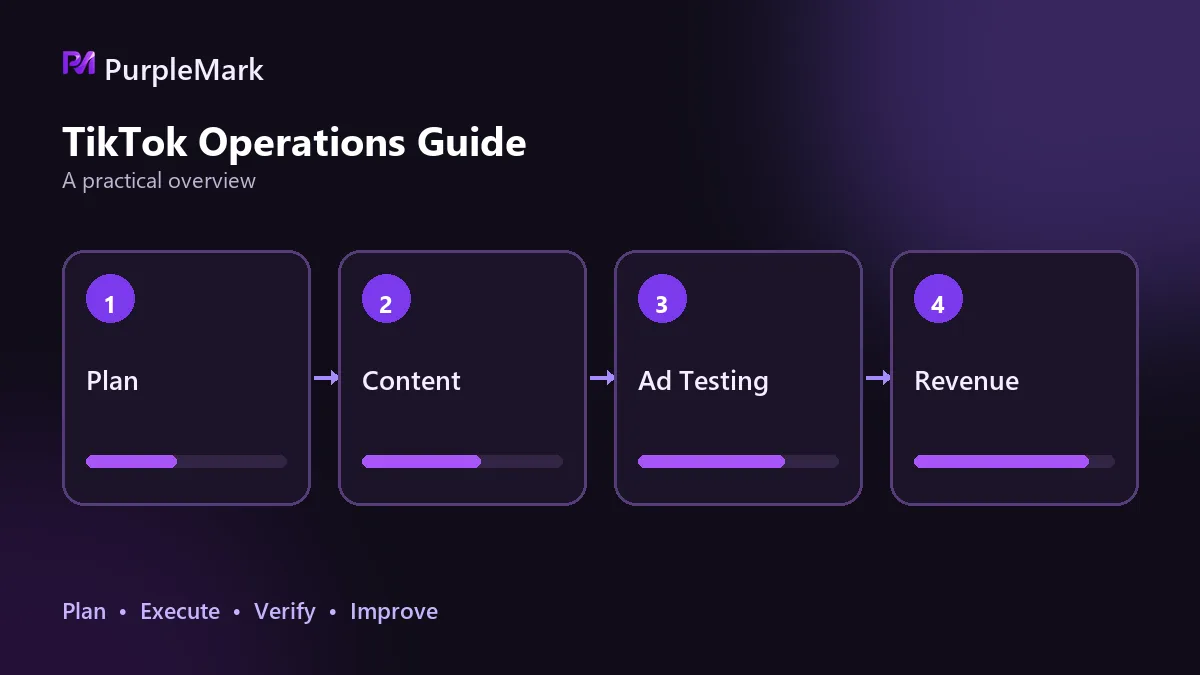
TikTok operations work best when dependencies come before checklists: establish the account and positioning, prove the content rhythm, scale validated content with ads, and monetize last. Each stage has clear signs that show when it is ready to move forward.
TikTok operations can look like a long chain: registration, account protection, account warm-up, content, advertising, and monetization all have their own details. But once the dependencies are clear, order matters more than individual actions: if the previous step is unfinished, doing the next one is wasted effort.
Stage 1: Account and positioning
Your registration method should match the target market. A phone number, email address, or third-party account can all work; the key is to enter the profile information correctly the first time. Repeated profile changes can reduce account trust.
Positioning is best decided at registration. When one account focuses on one niche, viewers can form a clear expectation and the algorithm can more easily match the account with the right audience.
The login environment affects how long the account can remain stable. The login region should match the market the content targets; avoid repeatedly switching devices or network exits within a short period; and do not crowd multiple accounts onto the same exit.
Do not cross compliance lines: do not register with someone else’s identity information, do not mass-register accounts for rule-breaking purposes, and do not buy accounts from unknown sources. These practices can lead to entire groups of accounts being removed.
This stage is complete when the profile is stable, the login environment is fixed, the account opens normally without abnormal warnings, and the content is consistent with the primary market.
Stage 2: Content matrix and growth rhythm
The foundation is one account, one direction; only then does a matrix make sense. A matrix does not mean copying the same content to ten accounts. It means covering different topic angles and usage scenarios within the same overall direction.
Keep publishing consistent. Accounts that update steadily are more likely to receive ongoing recommendations. For short videos, success is concentrated in the first three seconds: if the opening fails to hold attention, viewers will not stay to see how good the rest is.
Interaction is a signal of account health, including normal views, likes, comments, and saves. But do not treat bulk automated interaction as an account-warming method. It is easy to detect, violates platform terms, and the risk is far out of proportion to the benefit. In reviews, focus on completion rate, click-through rate, and conversion rate, then adjust topics and structure accordingly.
The signal to move on is when all three of these appear together: at least one piece of content has a completion rate clearly above the account average; spontaneous discussion appears in the comments; and you can roughly predict which topic types are likely to perform.
Stage 3: Scale with advertising
Advertising should come only after the content has been proven. If the content direction has not been validated, ads merely scale the waste.
First decide whether the objective is reach, traffic, or conversion, because each calls for different creative and bidding approaches. Test audience segments separately in several groups instead of launching to everyone at once. Within the same audience, creative differences usually affect results more than small bid adjustments. Use a small budget to confirm the direction first, then add spend to combinations that perform consistently.
The completion signal is this: the same creative can still produce stable conversions when switched to another audience group. That is when increasing the budget becomes safer.
Stage 4: Monetization
There are roughly four monetization paths: after meeting platform thresholds, earn creator incentives based on views and watch time; add product links or a showcase to content and earn commission on sales; answer questions through real-time live interaction, which often converts more efficiently than short videos; and take brand partnerships after the account has built a stable audience.
In sequence, prove the content first and think about monetization afterward, not the other way around. Monetization also constrains content choices: brand partnerships can limit topic freedom, while affiliate sales require space for links to be planned in advance.
The signal is that income no longer depends on a single viral post but appears steadily alongside content production.
Design the environment before scaling to multiple accounts
When you expand from one account to several across different markets, categories, or test directions, management complexity rises suddenly. Three common problems are: rotating several accounts in one browser and contaminating cookies; sharing one proxy exit across multiple accounts and being identified as the same operator; and team members keeping account configurations in their heads, causing mistakes during handoffs.
A standardized approach is to map each account one-to-one with its environment and network exit. Switching environments should mean switching the whole configuration, with operation logs available to trace changes.
Boundary reminder: environment isolation solves technical interference between accounts. Platform rules on account numbers and identity still come first.
Common questions
Content first or ads first? Content first. If the direction has not been proven, ads only scale the waste.
How many accounts can one person operate? It depends on content production capacity. First get one account to a stable output rhythm, then consider expanding.
Is a separate environment mandatory? Not for a single account. Once multiple accounts run in parallel, isolating environments and network exits becomes essential.
Remember the order more than the actions
Account and positioning lay the foundation, content rhythm proves the direction, advertising scales what has already been validated, and monetization comes last. Do not reverse the four-step order. As soon as the account count exceeds one, design environment management in advance rather than patching it after problems appear.


