
Problems during Facebook account warm-up usually come from a few clear risk signals rather than doing too little: repeatedly changing profile details, adding many friends quickly, posting mostly external links, frequently changing login environments, or linking one payment method to multiple accounts. Each can lead to different consequences.
Account warm-up is often treated like a checklist that must be completed, but it is better understood as a map of risk zones. Whether an account stays stable often depends less on how many positive actions you take than on whether you perform several obviously non-human actions in a short period.
Beginners tend to run into five main pitfalls.
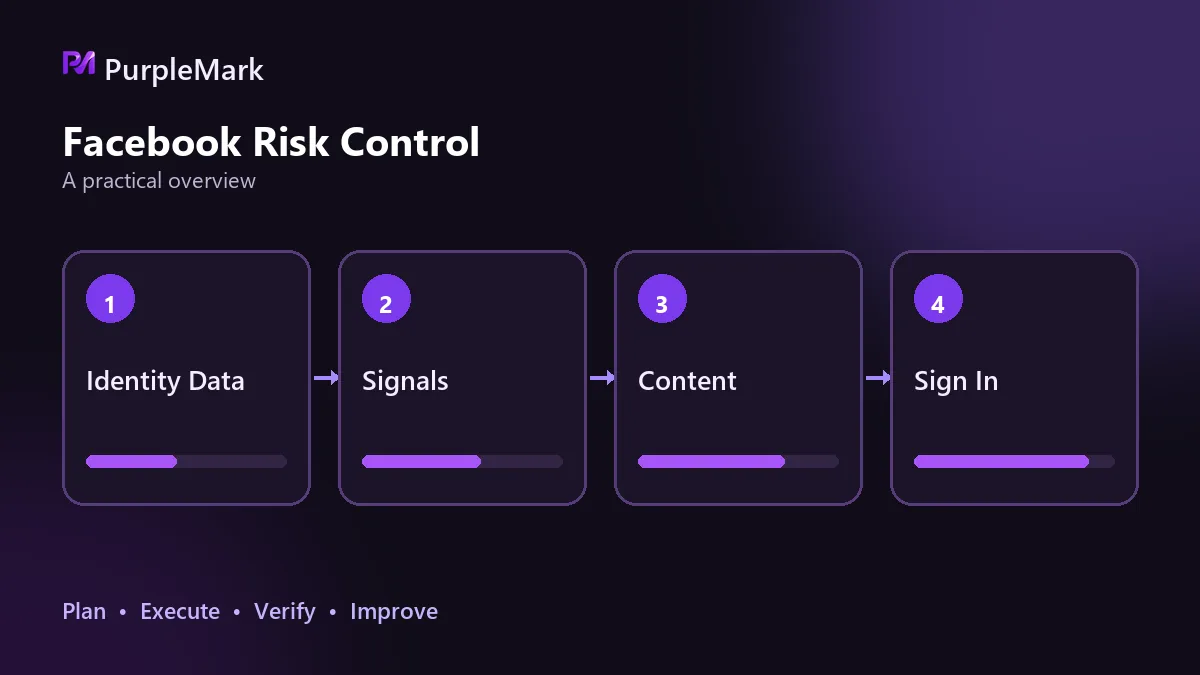
Repeatedly changing account details, especially on new accounts
Changing the password, profile details, or linked email immediately after registration is one of the easiest mistakes for beginners to make, and it is also one of the actions systems watch most closely. For a new account, a useful reference is to wait until at least 3 days after registration before making these changes.
Email matters too. If you still cannot receive verification codes during the first 10 days after registration, repeatedly troubleshooting the same mailbox may be less useful than switching to an overseas email service that receives messages reliably. Keeping the same login environment on the same device for at least half a month is a basic way to make the account appear stable.
The usual consequences are an extra verification step or being placed in a group of accounts that require closer monitoring.
Adding many friends and joining groups in a short time
A new account can add friends and join groups, but only in small amounts. Adding dozens of strangers in one day or joining more than ten groups at once is a typical abnormal pattern that the system can easily interpret as prohibited marketing activity.
The consequences are fairly direct: friend-adding may be restricted, group invitations may fail, or the account may enter a review process. It becomes more troublesome if someone reports the account, because that can further affect the account's overall rating.
Posting content that is almost entirely external links
If nearly everything an account posts is a promotional or external link, with no personal photos or ordinary day-to-day content, it looks like a standard marketing account to other people. Such accounts are much more likely to be reported than normal accounts, and trust in the account can keep declining after reports are filed.
A more natural approach is to use the account normally for a period first: browse, interact, and post some everyday content, then gradually introduce business-related material.
Constantly changing the login environment
A device fingerprint is the way a system identifies a device through hardware and software characteristics such as the operating system, browser type, resolution, and plugins. Repeatedly logging multiple accounts into the same environment, or having several accounts share exactly the same device fingerprint, can cause the system to treat those accounts as strongly linked.
Changing IP addresses can have the same effect. Logging in from one region today and another region tomorrow may be interpreted as account sharing or account theft. The consequences are not limited to one account: once accounts are judged to be linked, other accounts in the same batch may be handled together.
Linking one payment method to multiple accounts
Payment information carries information about the entity and the flow of funds. Linking the same payment method to multiple accounts effectively creates a clear connection between them. That connection is harder to explain away than shared device characteristics.
Once one account runs into a problem, the chance that the other accounts will also be reviewed rises noticeably, and advertising accounts are especially easy to affect.
What the consequences usually look like
By severity, the outcomes can be roughly divided into three levels. The lightest is a request for additional verification or a temporary restriction on certain features. The middle level is an account-use restriction that requires an appeal. The most severe is a ban, and accounts in the same environment or using the same pool of resources may also be restricted at the same time.
There is no fixed threshold between these levels. Repeated triggers can push the account toward more serious measures.
Reference values for pacing
During the new-account stage, you can keep logins to 2-3 times per week, with each session no longer than 30 minutes, and avoid making changes immediately after logging in. After 10 days of stable use, enable two-factor authentication and, if conditions allow, link a phone number. These two steps provide the most noticeable improvement in the account's security level.
Once the account enters normal use, the focus shifts from pacing to checking the environment: make sure nobody has casually logged into the account from another environment and confirm that the outbound address has not changed. This is especially easy to get wrong in team collaboration; one mistaken operation can be enough to link two accounts.
Frequently asked questions
How long should an account be warmed up? There is no universal standard. Instead of watching the number of days, pay attention to whether the environment is clean, the account information is internally consistent, and the behavior looks natural.
Can a new account add friends? Yes, but control the number and pace, and prioritize people you already know.
Can multiple accounts share the same group of friends? It is not recommended. Overlapping friend networks create an obvious association structure between accounts.
Are old accounts automatically safe? No. Older accounts may have greater tolerance, but a sudden burst of friend requests, heavy posting, or cross-region logins can still trigger risk controls, and the losses are often greater.


