
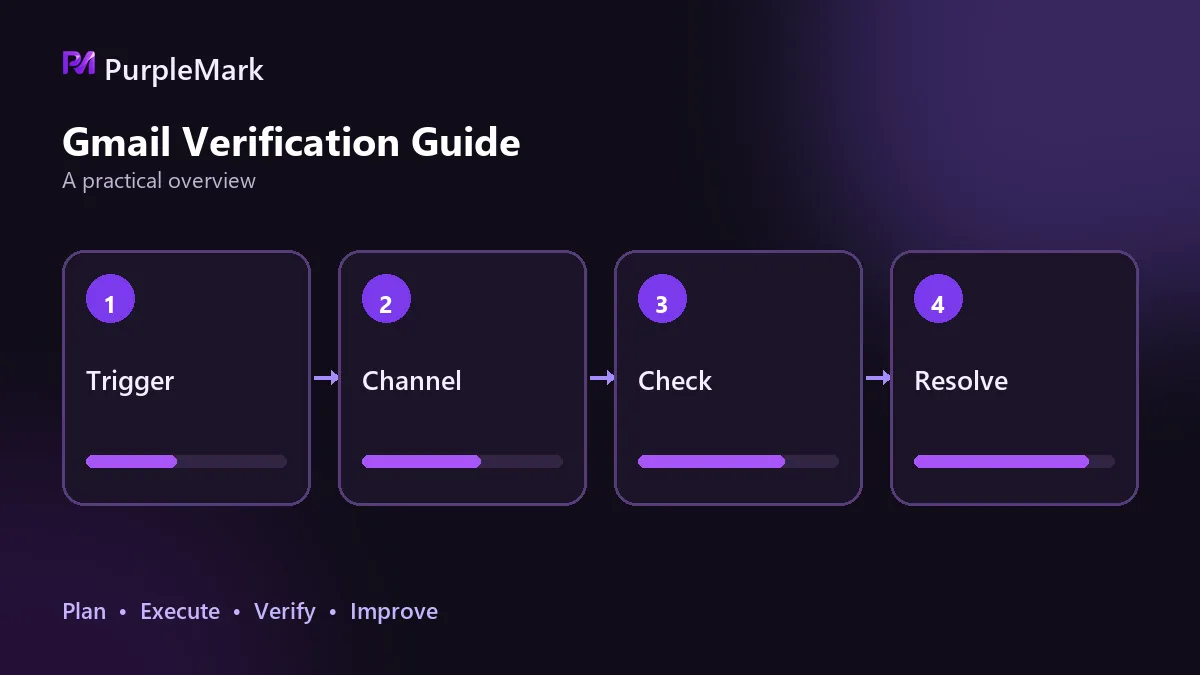
Troubleshoot Gmail phone verification in four layers: too many accounts tied to the number, carrier SMS delivery, cross-region receiving limits, and verification-attempt limits. Each layer includes checks you can perform yourself and legitimate ways to proceed.
Gmail phone verification failures rarely have just one cause. A number may already be tied to too many accounts, SMS messages may be blocked by the carrier or filtering software, the number's region may not match the current signup region, or the same number may have been tried too many times in a short period. These situations can produce the same on-screen message even though the correct response is different. Instead of looking for a universal bypass, first determine which layer is causing the problem; each one has evidence you can check yourself.
First, identify what the page is actually asking for
Google's account-creation flow is not identical for every user. According to Google's official guidance, a phone number is information that can be added and verified, but during account creation or sign-in, phone verification may sometimes be required to confirm that the operator is a real person. If the page offers a skip option, follow it. If the page explicitly requires a phone number, QR code, or another verification method, follow the page. Base your decision on the buttons and wording shown there, not on someone else's experience post.
Layer 1: Has this number already been tied to too many accounts?
Google's official help pages are clear that when a message says a phone number cannot be used for verification, one important reason may be that the number has already been used to create many accounts. Google limits how many times one phone number can be used for account creation, and its recommended solution is to use another number that can receive verification codes normally.
You can check this layer yourself. Use the same number in Google's account-recovery or security-settings flow and see whether the system can still recognize it and send a code. You can also switch to voice verification at the verification step and see whether that is rejected as well. If both SMS and voice are rejected, the problem is most likely a number-level restriction rather than the network environment.
One expectation often causes confusion here: deleting accounts that were previously created with the number does not necessarily restore the historical verification allowance immediately. Records associated with the number and the accounts themselves are separate things.
Layer 2: Is the SMS path being blocked somewhere?
Official guidance is to wait a few minutes if the SMS does not arrive, because carrier or network congestion can cause delays, and some flows also offer voice verification. A practical checking order is: confirm the number was entered correctly; verify that the phone can receive SMS normally by requesting a code from another service; check whether system or third-party filtering software has blocked Google's sending number; and check whether the carrier has recently had SMS delays. The carrier's message log is the most direct evidence: if the message appears there, it reached the carrier side; if there is no record, it did not.
No matter where you are in the troubleshooting process, do not keep hammering the resend button. The denser the requests, the harder later diagnosis becomes.
Layer 3: Cross-region receiving and number origin
Using a number from one region to register an account positioned in another region, or trying to receive codes on a foreign number while connected through a local network, can result in missing messages. Some numbers have limited receiving coverage, some carriers restrict international SMS routes, and some virtual numbers do not support certain types of service messages. Again, the right evidence is the carrier log and carrier status, not repeated resends.
This layer also raises a long-term issue. In Google services, a phone number serves both account-security and recovery functions. If the Gmail account will be used for long-term business, use a number you can control over time whenever possible. A temporary number leaves your recovery channel somewhere you may lose access to at any moment.
Layer 4: Have you used up the verification attempts?
Repeatedly requesting codes or resubmitting registration in a short period makes later troubleshooting harder and can keep triggering additional verification. The evidence for this layer is your own activity log: how many times the same number was tried that day, how far apart the attempts were, and whether the page message changed from a specific reason to a generic rejection. If the page has started rejecting attempts uniformly, stop for a while, confirm the number status and network environment, and then run through the full process again. Do not keep trying after a dozen failed attempts.
Follow this order for legitimate handling
If the page offers a skip option, use it. If it offers a recovery email, enter one you can keep long term. If phone verification is required, use a number you control long term. If the number is reported as unavailable, follow the official recommendation and switch numbers. If the code does not arrive, wait a few minutes, then check the carrier log and use voice verification if necessary.
If something unusual happens on desktop, you can re-enter the account-creation flow through another official Google entry point or try the Gmail app on a phone. Mobile is simply another official route; it does not guarantee that verification will be waived, and the page requirements still decide what you must do. Before registration, keep the network stable, avoid switching devices or entry points midway, and keep the browser language and system time zone aligned with the egress region. None of this guarantees a bypass, but it can reduce unnecessary interference.
If you manage multiple Gmail accounts long term
Changing only the IP is usually not enough. A normal browser has several stable characteristics that can expose links between sessions: fingerprint parameters such as Canvas, WebGL, fonts, and plugins remain highly consistent; cookies and LocalStorage retain historical state; WebRTC may reveal the real address; time zone or language may not match the egress IP; and repeated registrations from one device may be grouped together. Google's decision is based on the credibility of the overall environment, not only on the IP.
In this situation, a more suitable setup is to give each account an independent browser environment, bind each environment to its own proxy, align language and time zone with the egress region, and disable WebRTC leakage of the real address. One account, one environment is the foundation for this kind of operation. PurpleMark maintains fingerprints, cookies, and cache separately for each environment so it can be reused consistently over the long term and multiple accounts do not affect one another inside the same browser.
Common questions
Is a phone number always required for registration? Not necessarily; follow what the current page shows. Google does not publish one universal number, but it does state that there are limits on how many accounts can be created with one phone number.
Is there a method that skips verification 100% of the time? No. Treating an IP change or fingerprint change as guaranteed to work will often leave you stuck at the same message.
What if a QR code appears? Scan it with your phone and complete the steps shown. If the QR code expires or verification fails, restart the registration flow to generate a new one.
Can I retry immediately after registration fails? Repeated retries are not recommended. First confirm the exact error message, then check the number, SMS path, browser, and network one by one.
Troubleshoot layer by layer, keep evidence you can verify, and follow the official handling path. This sequence can be reused repeatedly without relying on luck.


