
Slow Instagram growth is often a positioning and content-structure problem rather than a posting-volume problem. This guide covers account positioning, content pillars, the roles of Reels and feed posts, posting and engagement cadence, hashtag boundaries, and what to adjust when growth stalls.
When an Instagram account struggles to gain followers, the problem is usually not that it posts too little. More often, people who visit the profile cannot quickly understand what the account is about. Until positioning, content structure, and cadence are clear, posting more often only magnifies the problem.
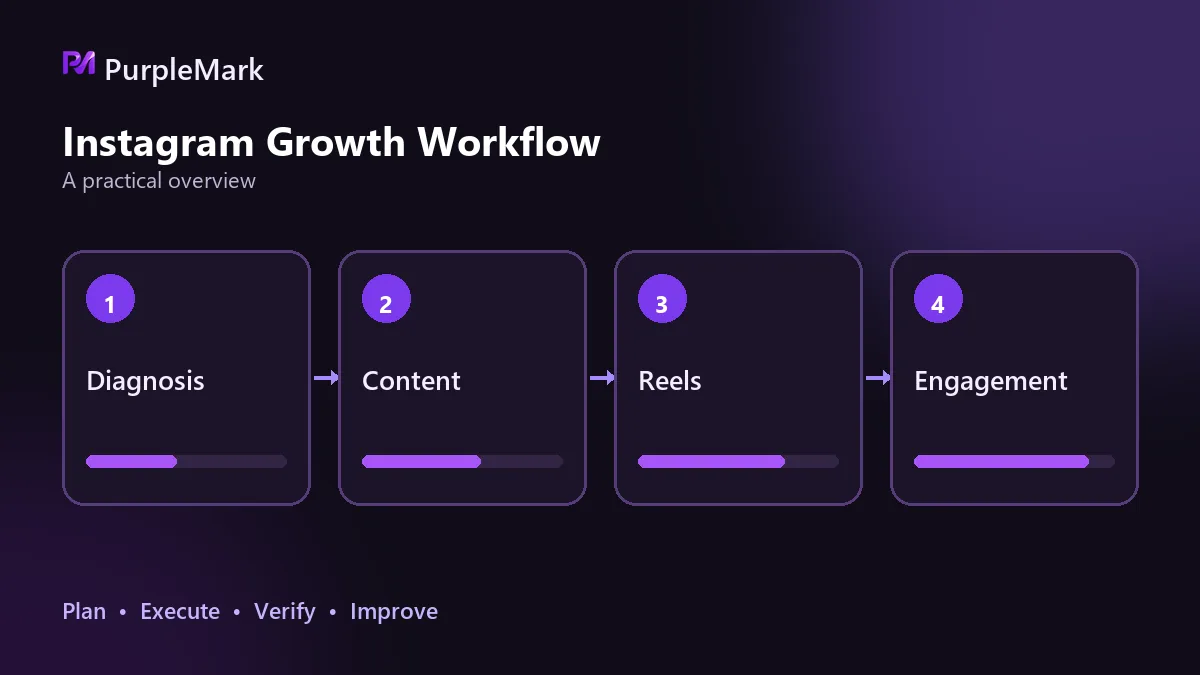
Work Backward from Three Positioning Questions
Who does this account serve, what problem does it solve for them, and how is it different from accounts they already follow? The answers do not need to become a polished sentence in the bio, but they should translate into concrete choices: which profile photo to use, what belongs in the content grid, and what the first line of the bio should say.
Bio space is limited, so make three things clear: who you are, what value you provide, and what the visitor should do next. Keep the visual language consistent as well. A stable palette and style make the profile itself a signal of professionalism.
Highlights and location tags are also worth using. Highlights give new visitors a topic-based path through your content, while location tags can surface the account in local search, which is especially useful for businesses serving a specific area.
How to Define Content Pillars
Content pillars mean grouping what you publish into three or four recurring themes, each with a different job. One pillar can build awareness by explaining common mistakes in the field; another can provide proof through cases, before-and-after comparisons, and user feedback; another can show everyday life through behind-the-scenes moments, the team, or casual shots; and another can drive conversion by explaining how a product is used and purchased.
Once the pillars are clear, topic selection is less likely to drift and you do not have to invent something to post every day. Adjust the mix to the account's stage: newer accounts can emphasize awareness content that can be searched and saved, then increase proof-oriented content after building a base.
Reels and Feed Posts Handle Different Jobs
The three main formats have different reach mechanics. Reels are recommendation-driven and are one of the few entry points that can reach non-followers. Image posts and carousels mainly accumulate on the profile and shape the first impression when someone visits. Stories disappear after twenty-four hours and are well suited to everyday interaction, polls, and time-limited information.
A practical mix is therefore: use Reels to attract new people, posts and carousels to build the profile, and Stories to maintain relationships. Publishing only static feed content and skipping short video means giving up the largest source of organic reach. Carousels are particularly suitable for steps, comparisons, and checklists that reward longer viewing, and their save rate is generally higher than that of a single image.
For quality, the opening seconds of a short video heavily influence completion rate, while the first image of a feed post influences clicks. The underlying principle is specificity: clearly describing the situation and the problem to solve is more likely to earn saves and shares than vaguely recommending something good.
What Posting and Engagement Cadence to Keep
There is no universal posting frequency. A common rule of thumb is one to two feed posts per day while keeping Stories active; more can dilute quality and tire followers. A more practical approach is to study your own data, identify when followers are active, compare publishing habits in your niche, and then keep a stable schedule.
Time zones matter too. If the audience spans several regions, schedule around the main market rather than your own time zone. Holidays and local events can also shift when people are active.
For engagement, accounts that thoughtfully reply to comments and direct messages tend to generate stronger activity signals. Proactively leaving informative comments where the target audience already gathers is more useful than simply liking posts. Polls and question stickers in Stories can raise participation and are among the lowest-cost ways to maintain relationships.
How Far to Go with Hashtags and Topics
The purpose of hashtags is to match people with content, not to maximize quantity. Broad platform-wide terms can produce more exposure but reach a less specific audience; smaller niche terms have narrower reach but better precision. One workable approach is to build your own hashtag list, organize it by content pillar, select relevant terms for each post, and periodically use performance data to see which ones still bring engagement.
Hashtags in Reels and Stories work the same way: use terms that accurately describe the topic. The same applies to location and topic tags—fewer, more precise tags are preferable.
When Growth Stalls
First distinguish a traffic problem from a conversion problem. If views and reach are normal but follower growth is flat, viewers are not being persuaded to follow, so the issue is likely the profile or the content proposition. If reach itself has fallen, the posting cadence, format mix, or topic selection may have drifted outside the audience's interests.
Adjustments can start in a few places: review which content types generated the most follows and allocate more resources there; check whether the bio and Highlights still clearly explain who you are; stabilize posting frequency instead of changing it sharply; and reassess whether the hashtag set needs refreshing.
Cross-collaboration and user-generated content are also standard tactics. Brands or accounts with overlapping audiences can appear in each other's content, or you can curate and repost users' experiences while crediting the original creator. Both can introduce the account to new people, provided the content itself is worth passing along.
Avoid buying followers or participating in engagement exchanges. Fake followers do not convert, and they lower engagement rates; platforms can use those signals to reduce recommendation weight, making the account harder to grow over time.
A multi-account setup is common, but two points matter: the number of accounts and the identities behind them must stay within platform rules; and different accounts should not share the same browser environment and the same network exit, because device information, IP addresses, and fingerprints are signals platforms use to identify associations. In team workflows, give each account an independent environment and network exit so Cookies, local storage, and fingerprint parameters remain isolated. As the account count grows, use groups to separate purposes and member permissions to limit who can operate each account; multi-account environment tools such as PurpleMark are designed to manage this layer. Platform rules always come first.
Frequently Asked Questions
How long does it take a new account to gain traction? It depends on positioning and content, so there is no fixed timetable. Clear positioning, consistent publishing, and Reels for discovery are a relatively direct path. Do you need Reels? If the goal is follower growth, they are generally necessary. Are more hashtags always better? No. Relevance matters more than quantity, and irrelevant tags can reduce the match between the content and the audience.


