
A certification mark shows that an organization has established privacy management processes; it does not mean your use of data is compliant. Here is how ISO/IEC 27701 relates to 27001, what a PIMS covers, and how to interpret this signal when choosing a tool.
When choosing a tool, you will often see a row of badges in a website footer: ISO 27001, ISO 27701, SOC 2. Most people glance at them and move on because they are hard to interpret and their practical value is unclear. But if you plan to place account data, customer information, and operating configurations on a platform, these badges are among the few things you can verify before paying.
ISO/IEC 27701 deserves a closer look. It belongs to the same family as the better-known 27001, but it addresses a different concern. Many misunderstandings start there.
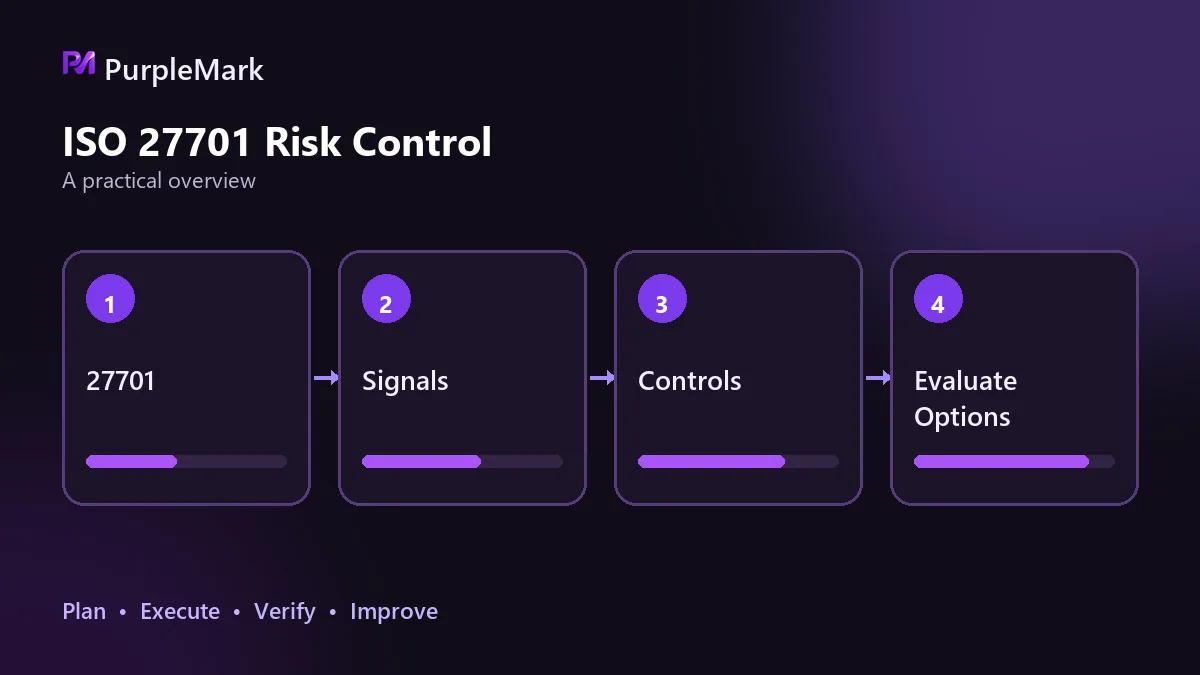
27701 extends 27001 toward privacy
27001 addresses information security: preventing data loss and access by unauthorized people, with detailed controls described in 27002. 27701 is not a separate framework from scratch. It adds a layer to that framework for personal information: what fields are collected, why they are used, how long they are retained, who can access them, and how requests from data subjects are handled.
The standard sets requirements for organizations acting as controllers and processors of personal information and also provides supporting guidance. In management terms, this becomes a PIMS, or Privacy Information Management System: someone is accountable, definitions are documented, and processes are actually operating.
Its relationship with laws such as the GDPR is often described incorrectly. A standard is not a law, and certification does not exempt an organization from regulatory accountability. However, the clauses in 27701 do align with the GDPR-style accountability approach. Records of lawfulness, responses to data-subject rights, restrictions on cross-border transfers, and incident-notification paths all have corresponding management requirements in the standard. Certification therefore usually means that parts of regulatory accountability that an organization must be able to demonstrate have been turned into auditable day-to-day processes.
27701 cannot be obtained on its own. It requires an existing 27001 management system that is then extended. If you see 27701, you can generally infer that 27001 is already in place as well.
Certification means an operating mechanism is being audited
Certification is not just a certificate on paper. It is an audit of a mechanism that is actually running.
The practical elements include written boundaries for processing personal information: what is collected, for what purpose, how long it is kept, and who can access it, with actual practice matching the documentation; regular privacy risk assessments and a defined response path when incidents occur; and transparency for users about how their data is used, with channels to exercise rights such as access, correction, and deletion. Certification also expires and must be reviewed regularly. Passing once does not grant a permanent badge.
In everyday use, these mechanisms roughly translate into three things: account data is not casually linked or shared externally, access permissions are controlled, and abnormal access leaves an audit trail.
Certification does not mean your use is compliant
This point matters more than the previous ones and is also the easiest to misread.
Certification shows that an organization has established a management system. It does not prove that the product will never have an incident. Any system can be compromised, and certification does not change that. It also says nothing about product quality; a tool with 27701 certification can still have mediocre features.
A more common misunderstanding concerns scope. A certificate states which businesses, legal entities, and data-center regions it covers. The scope may include one product line rather than every service. If the part you actually use falls outside the scope, the certificate has no practical meaning for your use case.
The remaining responsibility is yours. A compliant tool does not automatically make the way you use it compliant. Where personal information is stored, what you do with it, and whether the necessary authorization has been obtained remain your responsibility; that responsibility does not transfer to the service provider just because it holds a certification.
How to read this signal when choosing a tool
Treat it as one screening threshold, not as the deciding reason. There are essentially four things to verify:
- Scope: which product and region the certificate covers, and whether that matches what you will actually use;
- Validity: whether it is currently valid or was obtained years ago and has since expired without renewal;
- Verifiability: many certifications can be checked in a public directory maintained by the certification body or standards organization, rather than relying only on the vendor's website;
- Business weight: if you only manage data for your own operational accounts, privacy certification may deserve less weight; if you manage identity information for customers, it matters much more.
If you are comparing several tools in the same category, you can add a separate column for independent privacy and security certifications. This is one of the few capabilities a platform cannot simply attest to on its own and must have reviewed by a third party.
In scenarios such as multi-environment account management, keeping data isolated between environments and maintaining clear permission boundaries follow the same least-necessary principle emphasized by privacy management systems. PurpleMark treats environment isolation and data isolation as core capabilities, which follows that direction.
Certification scope and validity should be verified against public information from the certification body.


