
The challenge of global social media marketing is often not content production, but keeping multiple platforms and accounts stable over time. This guide explains platform content roles, account-linking signals, cross-platform metrics, and team permissions.
For brands expanding overseas and for affiliate marketing, global social media is both a distribution channel and a place to spread links and build user relationships. What usually slows teams down is not whether the content is well written, but whether daily operations across multiple platforms and accounts can stay under control: publishing calendars become chaotic, data no longer matches, and several people sharing accounts interfere with one another.
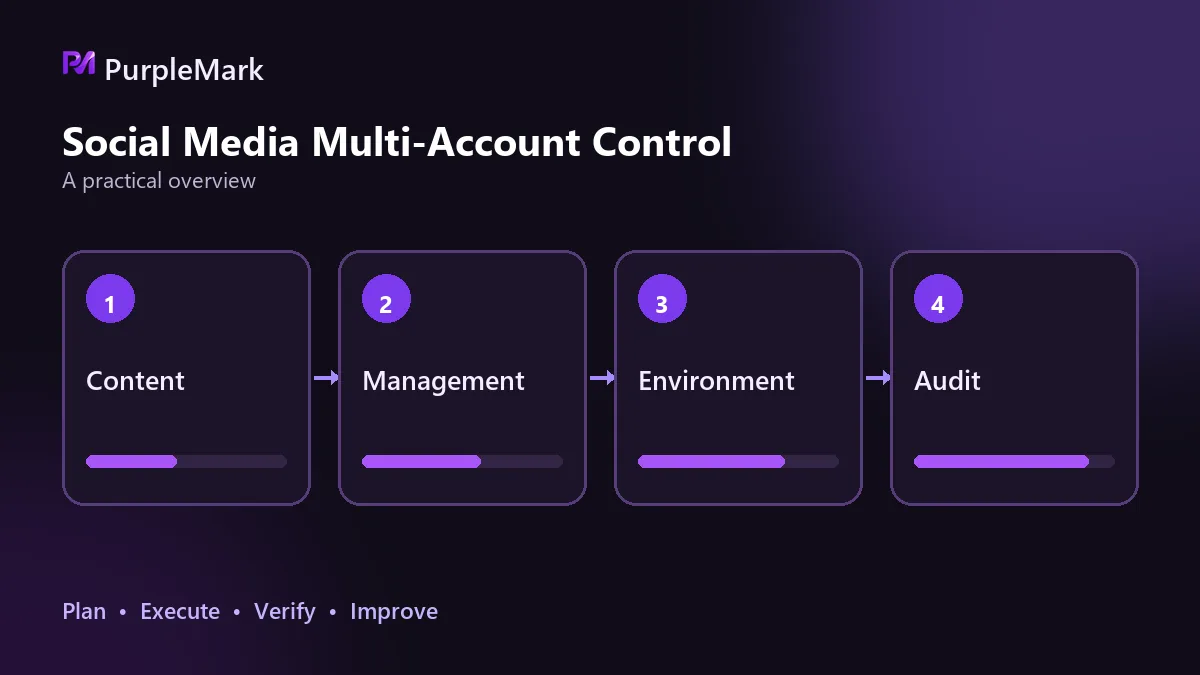
Rules for the account matrix, data, and collaboration need to be set before the content itself.
What content fits each platform
Omnichannel marketing does not mean publishing the same piece of content unchanged on every platform. Users browse each platform for different reasons. Short-video platforms work well for demos, reviews, and situational clips that people want to finish once they encounter them; their main role is reach and acquisition. Visual, editorial, and community platforms suit illustrated tutorials, user interaction, and community building, supporting relationship maintenance and conversion. Short-text platforms are useful for opinions, updates, and timely topics, helping establish industry presence and drive traffic. Long-video and content-led platforms are better for in-depth tutorials and complete demonstrations, building trust and generating long-term traffic.
Account roles should also be separated in advance. Reach accounts expand exposure, testing accounts validate topics and creative directions, and conversion accounts handle transactions. If roles are not separated and every account does the same thing, the matrix becomes multiple copies of the same content.
The hard part of matrix management is account linking
When platforms decide whether several accounts are operated by the same person, they usually combine four categories of signals. At the network level, they look at IP addresses and history, and whether the IP location matches the location claimed by the account. At the device and environment level, they examine browser fingerprints such as user agent, time zone, language, fonts, and resolution, along with reuse of cookies and local storage. At the behavioral level, they consider how often login devices change, whether activity rhythms look unnaturally regular, and whether accounts interact with one another. At the profile level, they look for overlap in linked email addresses, phone numbers, and payment information.
A common misconception is that changing the IP for every account is enough. In practice, if multiple accounts have identical fingerprints, time zones, and languages, or if people rotate logins in the same browser and contaminate cookies across accounts, linking can still be triggered and related accounts may be banned together.
Platforms also impose their own restrictions. Many overseas social networks discourage or directly prohibit one entity from operating multiple marketing accounts, and may act on all of them once they determine that the same operator controls them. Account structures therefore need to be designed around each platform's rules first. Environment isolation can reduce technical interference, but it cannot change those rules.
Handle network exits and environments as two layers
A more complete approach is to separate both layers. At the network-exit layer, use one exit per account, configure a dedicated proxy for each account, and align the exit region with the account's target market. Avoid sharing one proxy among several accounts, and avoid frequent region changes on core accounts. If an account's IP repeatedly jumps across countries or regions, a platform may question its authenticity and trigger a security alert.
At the environment layer, use one environment per account. Each account should have an independent browser environment, with cookies, cache, local storage, extension scope, and fingerprint parameters isolated from the others. As the number of accounts grows, manually switching windows and entering proxies becomes error-prone; one incorrect proxy entry can cross account boundaries. Multi-account environment tools such as PurpleMark bind proxy settings, start pages, and fingerprint parameters to an environment, map each environment to one account, and use groups to distinguish account purposes. Behavioral discipline matters too: new accounts should not immediately post at high frequency or perform concentrated interactions, and teams should avoid mechanically repeated activity patterns. Platforms may analyze mouse movement, clicks, and scrolling to distinguish real users from automated scripts.
How to compare cross-platform data
The biggest problem in cross-platform comparison is inconsistent definitions. Built-in analytics tools do not define interaction, engagement, and conversion in exactly the same way. Ranking exposure and sales in the same table produces little useful insight. A practical approach is to standardize the measurement framework first, divide metrics into reach, engagement, and conversion, and then compare the same time window and the same content type.
Use each platform's built-in analytics as the primary data source. When a more detailed path is needed, combine them with custom tracking parameters or compliant third-party tools. The goal is not to declare one platform the best, but to see how the same content direction performs differently across platforms and adjust content allocation accordingly.
Permissions for team collaboration
From day one, teams should define a fixed mapping among accounts, environments, and responsible owners, rather than letting several people share one environment or take turns logging in to the same account. Permissions should be assigned by role, separating who can view from who can edit, and environment-level activity logs should identify the person and time responsible. This is more reliable than sharing a spreadsheet. Onboarding a new owner or handing over work when someone leaves also depends on these records.
Content compliance is another boundary. Spam policies, external-link rules, and advertising disclosure requirements can directly affect account longevity. Bulk direct messages, manipulative friend requests, and coordinated mass likes are common enforcement targets. Checking requirements before publishing is more efficient than appealing afterward.
Frequently asked questions
Should different platforms use different email addresses for registration? It is advisable to separate them. Email is one of the most visible profile-level linking signals, and using the same email across multiple accounts significantly increases the chance that they will be associated.
Can accounts in the same matrix send traffic to one another? Yes, but platform limits on bulk interaction and artificial engagement still apply. Cross-account activity that is too regular can itself become an abnormal signal.


