
For cross-border multi-account operations, a stable and trustworthy network exit matters. This guide explains residential IPs versus static residential IPs, how static residential IPs can help reduce account-linking risk, handle location-based access, improve market research, and support multi-account management, plus what to evaluate when choosing a residential proxy provider.
Sellers who run multiple cross-border accounts are probably familiar with "proxy IPs," but proxy IPs come in many types, and residential IPs are one of the most commonly used. Compared with data-center IPs, residential IPs look more like ordinary real users to platforms and are generally viewed as more trustworthy. This article focuses on what residential IPs—and especially static residential IPs—are, why cross-border sellers may need them, and how to choose a reliable service.
First, distinguish residential IPs from static residential IPs
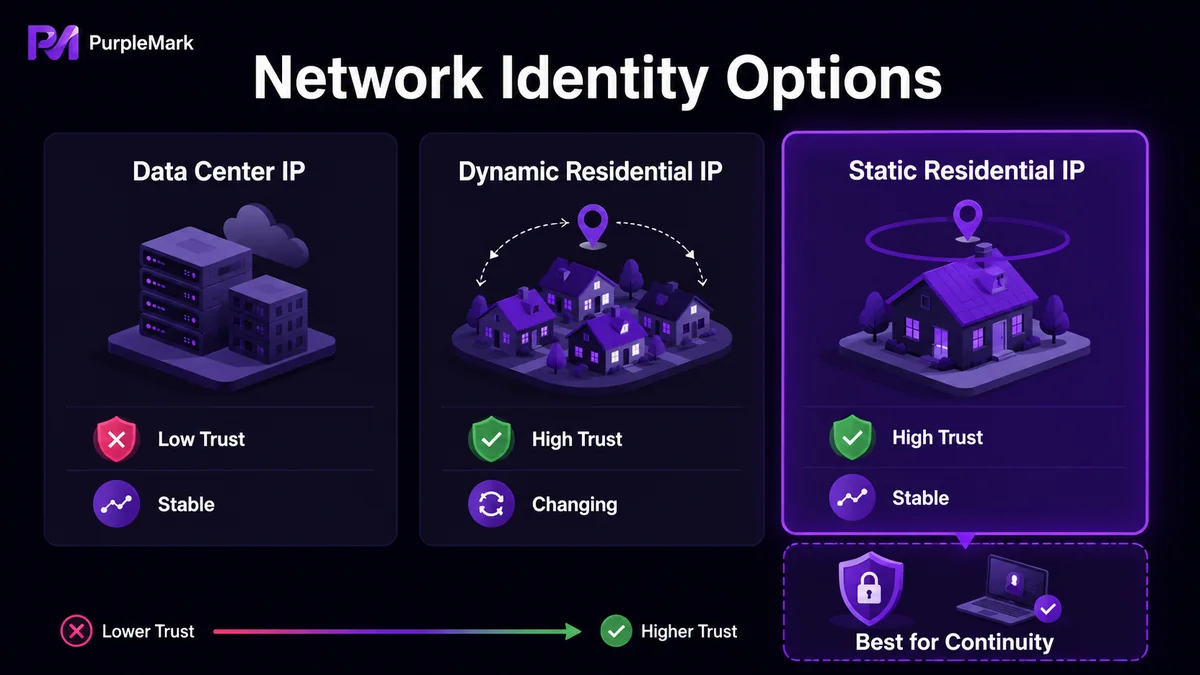
A residential IP is an IP address assigned by an internet service provider (ISP) to a household broadband user. Because it is tied to a real consumer internet connection, websites often regard it as more natural and trustworthy than a data-center IP, which can be easier to identify and block.
Static residential IP refers to a residential IP that stays unchanged for a long period and is fixed to a particular user or location, unlike a dynamic IP that changes periodically. The biggest advantage of a static IP is stability—it does not keep changing, which makes it suitable for use cases that require a consistent long-term "network identity," such as managing several accounts for cross-border e-commerce operations.
What can static residential IPs do for cross-border sellers?
Their value shows up in several practical areas:
Reduce account-linking and suspension risk. Residential IP traffic is more similar to normal consumer activity. When managing multiple authorized accounts, assigning each account its own IP can reduce the chance that platforms connect accounts purely because they share the same network exit. Keeping account environments separated also helps prevent one account's issues from affecting others.
Handle location-based access restrictions. Some social and e-commerce platforms limit access or features by region. A residential IP in the relevant market can help teams access services as a local connection when such access is permitted, so they can publish content, answer customers, and run campaigns for that market.
Improve market research and ad localization. Using a residential IP from the target market can make local competitive research, price monitoring, and consumer-experience checks more representative. Geographic IP consistency can also help teams verify how ads and localized content appear in the intended region.
Improve multi-account management efficiency. A static residential IP gives each account a stable network identity over time, which can simplify routine account management. Combined with clear account ownership and separated browser environments, teams can reduce accidental cross-use and keep operations organized.
How to choose a residential IP provider
There are many residential IP providers, so compare them across these dimensions:
- IP pool size: A larger pool gives you more address options and reduces the chance that a single IP has been heavily reused.
- Geographic coverage: Choose a provider that supports the countries or regions you actually operate in.
- Reliability and speed: Stable connections and adequate speed help prevent interruptions during normal work.
- Customer support and service quality: Responsive support matters when connection, billing, or configuration issues come up.
A good IP works best with an independent environment
A stable and trustworthy residential IP is only one part of the setup. Problems in multi-account operations are often caused not by the IP itself, but by multiple accounts sharing the same browser environment—the same Cookie data, local storage, and browser characteristics can make accounts easier to associate.
A more organized approach is to combine a stable IP with an independent browser environment: assign each account a fixed residential IP and keep its browser data, login state, and local storage separated from other accounts. This reduces accidental data mixing and makes account ownership clearer. For team collaboration, accounts can also be grouped by market or owner so everyone knows which environment they are responsible for.
Summary
The main value of a static residential IP is a stable and trustworthy network identity for legitimate multi-account operations. It can support consistent regional access, more representative local research, and cleaner account management. When choosing a provider, pay attention to IP pool size, geographic coverage, speed, reliability, and support, and pair the IP with a properly separated browser environment for long-term operational stability.


