
For new TikTok shops, cold start is the hardest stage. An account matrix broadens exposure, while product selection determines whether traffic turns into orders. This guide covers grouping, profiles and permissions, then local fit, data validation, novelty and trend checks.
For TikTok e-commerce, beginners often get stuck at the cold-start stage: without initial orders, the platform provides little recommendation traffic; without traffic, there are no orders. An account matrix is a common way to break this loop—a group of accounts distributes content separately to widen exposure, so accounts that gain traction can help lift overall orders.
Accounts are only the first step. Once traffic arrives, what you sell becomes the dividing line for conversion, so the two tasks need to be handled together: how to structure the accounts and how to choose products.
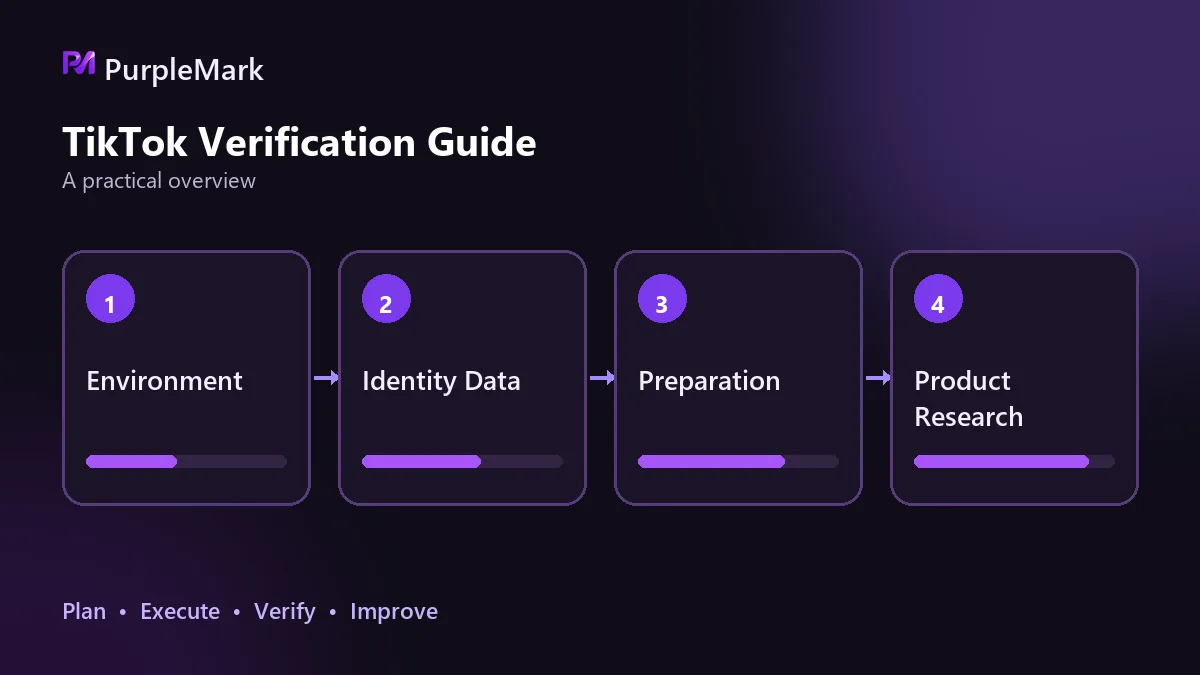
From rows of physical phones to isolated environments
When people hear “matrix,” many first picture dozens of phones lined up and operated through group-control software. That approach can work, but hardware and maintenance costs are high, and it becomes hard to sustain as the number of accounts grows.
A common approach now is to replace physical devices with isolated software environments: use cloud phones or separate browser environments to simulate an independent mobile or desktop device for each account. Each environment is paired with its own proxy IP, while language, time zone and location are aligned with the target market. Accounts no longer depend on physical hardware, and environments can be created and managed in batches.
As a result, each account appears to the platform to come from a different device and network. Content can be distributed by audience segment, and daily operations no longer require switching physical devices.
Account structure: grouping, records and permissions
The value of a matrix depends on management discipline. A usable organization should include at least four things: classify accounts by team, language and region; label each account with its positioning, content direction and owner; centrally archive phone numbers, email addresses, linked information and environment settings; and make it possible to immediately find the matching environment and credentials if an account is logged out.
A matrix is usually not maintained by one person. Collaboration needs to solve both permissions and efficiency: multiple people should be able to access the same group of accounts from their own devices, operate according to assigned roles without sharing passwords, while managers can review each account’s content and performance data and keep operation logs for traceability.
Repetitive actions such as publishing and routine activity can be handled by automated workflows, but the boundary is clear—automation should only improve efficiency and must not change the premise that activity volume should resemble normal human behavior. Excessive interactions in a single session or abnormal action frequency can instead become direct signals for risk control.
Check two prerequisites before choosing products
TikTok now has more than 1.56 billion monthly active users worldwide, and competition is intense. The difficulty in product selection is finding the overlap among strong demand, competition that is not yet saturated, and products that can be expressed well through short video.
Winning products usually have two qualities. First, they come with built-in demand: the product should solve a real problem in the target market. This can be judged from experience or verified through sales of similar products on platforms such as Shopee, Lazada and Amazon. Second, they come with built-in traffic potential: social commerce relies on creative content to attract traffic. If the same product performs poorly on TikTok, the issue is often not the product itself but the creative. You can compare how similar products are presented on Douyin in China and use that to adjust your own creative strategy.
Localized product selection
There are three practical entry points for matching the culture, buying habits and preferences of the target market.
For holidays and celebrations, look at important local occasions—for example, gift products that fit the holiday atmosphere in Western countries. For climate and environment, consider local conditions—for example, sunscreen-related products are more suitable for tropical markets such as Southeast Asia. For culture and beliefs, consider local religions and customs—for example, apparel that fits local practices in Southeast Asian markets. The more detailed the localization, the less effort consumers need to understand the product and the smoother conversion tends to be.
Four dimensions for data-based validation
Data turns intuition into trend analysis. Four common dimensions suit different types of sellers.
Potential categories are suitable for medium and large sellers. The idea is to analyze category growth rates to find market gaps. For example, filter third-level categories with more than US$10,000 in transaction value and relatively fast growth. You may find a niche with only one or two sellers; how much opportunity exists depends on what the early movers can achieve.
Hot new-product rankings are useful for judging how much demand remains to be released. Rank products launched in the past 30 days by transaction value. If a product listed for less than a month already reaches a relatively high sales value, demand may still have room to grow.
The creator dimension looks at repeatability. If a product is promoted by multiple creators and shows a high order rate, it suggests both genuine demand and strong suitability for content-driven presentation.
The advertising dimension is more suitable for large sellers. Stable traffic is more valuable than pulse-like spikes. You can filter sales videos with ad spend above a certain scale, an upward transaction trend and ROAS above 2 to identify products that can keep generating orders through paid promotion.
Data has a second use: benchmarking. Study how strong products in the same niche are operated and compare them with your own strategy. If the direction is sound, break down the store’s product and marketing strategies to see where the gap with industry benchmarks lies.
Novelty and trends
In short video and livestreaming, user attention is easy to lose, so novelty is an effective way to attract attention. One type is innovative functionality or a special effect, especially in categories where the result can be shown directly or where before-and-after contrast is strong; the visual impact itself can drive conversion. Another type is a distinctive or visually appealing appearance, such as personalized products with customizable graphics and text that satisfy the desire for uniqueness.
There are three common ways to ride trends: current events and policy, such as rising demand for biodegradable or substitute materials after a region introduces a plastic ban; pop culture, where popular films or shows can boost short-term demand for souvenirs, posters and themed apparel; and social challenges or events, where popular platform challenges can lift sales of related props.
Two risks require attention. First, trend cycles are short. These products often stay hot for only a few months, so inventory and advertising pace should be planned in advance. Second, infringement risk is high. Film and TV merchandise and products using brand marks can easily run into copyright or trademark issues, so sellers without the relevant resources and mature processes should not follow trends blindly.
How content and accounts divide the work
Once both account structure and product selection are set, the final step is matching them. Accounts with different positioning should publish content around different functions rather than copying the same video to every account. The main account handles core content and conversion, while sub-accounts split product functions by audience and use case. When a video direction works on one account, that direction can then be extended to other accounts.
Compliance baseline
The account structure should be based on real business entities and genuine operational needs, not on creating identities in bulk with false information. Content and creative materials must not be copied or stolen from others; such behavior can lead to platform penalties and copyright problems. Products must also meet the target market’s requirements for category, certification and packaging, with especially high thresholds for food, cosmetics and children’s products.
A matrix amplifies efficiency, but it also amplifies non-compliant operations.


