
For new accounts, scheduled posting, bulk engagement, and scripted replies are the worst tasks to automate. Platforms can detect these patterns through timing, activity windows, and behavior combinations. Automation is better used for off-platform work such as data organization, asset uploads, and reporting.
New accounts are the easiest to pressure into using tools. When views look weak and an account is just getting started, all kinds of automation solutions can sound reasonable. But account warm-up is not really about whether tools are used; it is about which part of the workflow is handed over.
Start with the conclusion: turning one action into bulk behavior creates the highest risk, while using tools to make work that should already be done more consistent creates the lowest risk. The same tool can produce completely different outcomes depending on how it is used.
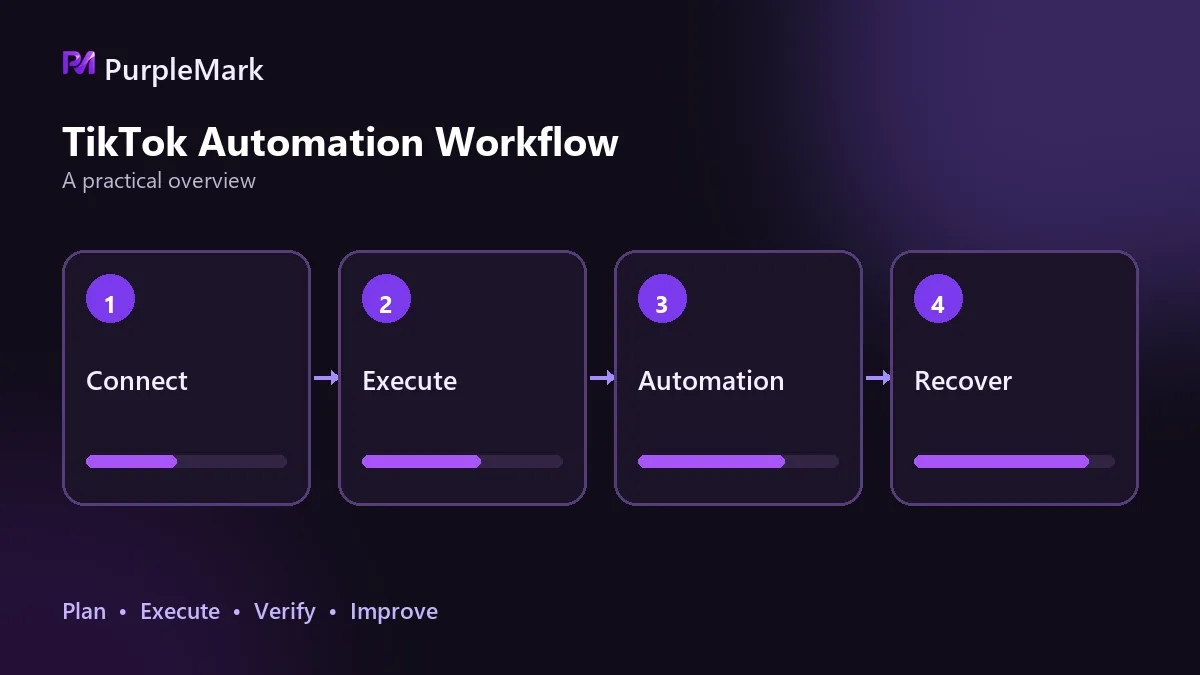
Three things that should not be delegated during the new-account stage
Scheduled posting is the most tempting. Publishing a fixed amount of content at fixed times can look like a disciplined update routine, but it also creates an unusually regular posting record. Human operators naturally vary their timing. A post may be delayed because editing is not finished, or an extra post may be inserted because of a sudden trend. Those fluctuations are part of the natural growth pattern of a new account.
Bulk engagement is an even clearer problem. Following, liking, and commenting at high volume within a short period are among the most typical signs platforms use to identify machine-like behavior. This does not create efficiency; it creates a density of actions that a person would not normally produce.
Standardized reply scripts should not be delegated either. When every comment receives the same sentence patterns, wording, and tone, the account may appear to be maintaining engagement, but its communication trail becomes unnaturally uniform. A new account has not yet developed stable signals, so this kind of consistency can attract more attention rather than less.
How mechanical behavior becomes visible
Platforms are not simply looking at whether you used a tool. They look at whether the behavior itself resembles normal human activity. Once several dimensions overlap, patterns become hard to hide.
In timing, human intervals vary while automated activity tends toward fixed, uniform gaps. In action combinations, people browse, pause, like, and swipe away in mixed sequences, while machines often perform only the target action with no transitional behavior. In time-of-day distribution, people are active mainly while awake and naturally have breaks, while machines can run continuously around the clock. There is also the relationship between accounts: if multiple accounts perform the same actions from the same environment and the same network exit, that itself becomes a correlation signal.
None of these signals is necessarily decisive on its own, but together they become difficult to explain away. Conversely, there is no setting that can completely erase them. Adjusting intervals or adding delays changes parameters, not the overall volume or density of the behavior.
Where automation is appropriate
Things become much simpler when tools are used outside the platform.
Asset uploads and content scheduling belong in this category. Centralizing a content calendar, asset library, and planned publishing times reduces human omissions rather than increasing the number of platform actions. The same applies to data organization: combining views and engagement metrics from multiple accounts into a spreadsheet makes comparison easier, while the operator still makes the decisions and no abnormal platform-side actions are generated.
Environment preparation is another suitable area. Each account should have its own browser environment, with parameters and network exits aligned with the target market. This should be standard practice from the beginning, not a repair step after an account runs into trouble. Report checks, login-status organization, and task handoffs between team members are also process-level jobs that can safely be assigned to tools.
The difference is that the results of these tasks stay inside the operating workflow and do not become actions on the platform itself.
How to judge whether a solution is worth using
Whenever you see a tool or script marketed for account warm-up, three questions are enough.
Does it amplify abnormal behavior? If its core selling point is how many follows or likes it can complete for you, there is no need to keep looking.
Does it separate behavior from a human rhythm? If execution can be precise to the second and continue without interruption all day, the risk is already visible in the parameters.
Does it comply with platform terms? Most platforms explicitly prohibit automated interaction. Breaking those rules does not buy efficiency; it can cost the account together with the followers and data already accumulated.
One related point: publishing does not always have to be manual. Using official APIs or official creator tools provided by the platform follows an approved path. Using third-party scripts to simulate client-side actions carries a very different type of risk.
What new accounts should actually focus on
A clean environment comes first. Keep one account per device, use an independent environment and network exit, and match parameters to the target region. Getting this right from the start can prevent many unexplained verification prompts later.
Natural behavior comes next. Browse content like an ordinary user, watch before swiping away, and interact only when genuinely interested rather than to complete a task. There is no universal answer for how many days a new account must be “warmed up.” In the end, weight comes from content performance, not the number of warm-up days. Controlling the pace and allowing usage signals to accumulate gradually is more stable than any script.


