
Once a TikTok account matrix is proven, the bottleneck shifts from content to management. This guide covers five priorities for scaling: account inventory, content capacity and distribution cadence, team roles and permissions, data reviews and account elimination, and the areas most likely to lose control first.
With three accounts, a matrix has a content problem; with dozens, it becomes a management problem. Even with the same content model and topic library, multiplying the account count by ten often multiplies the problems rather than the results.
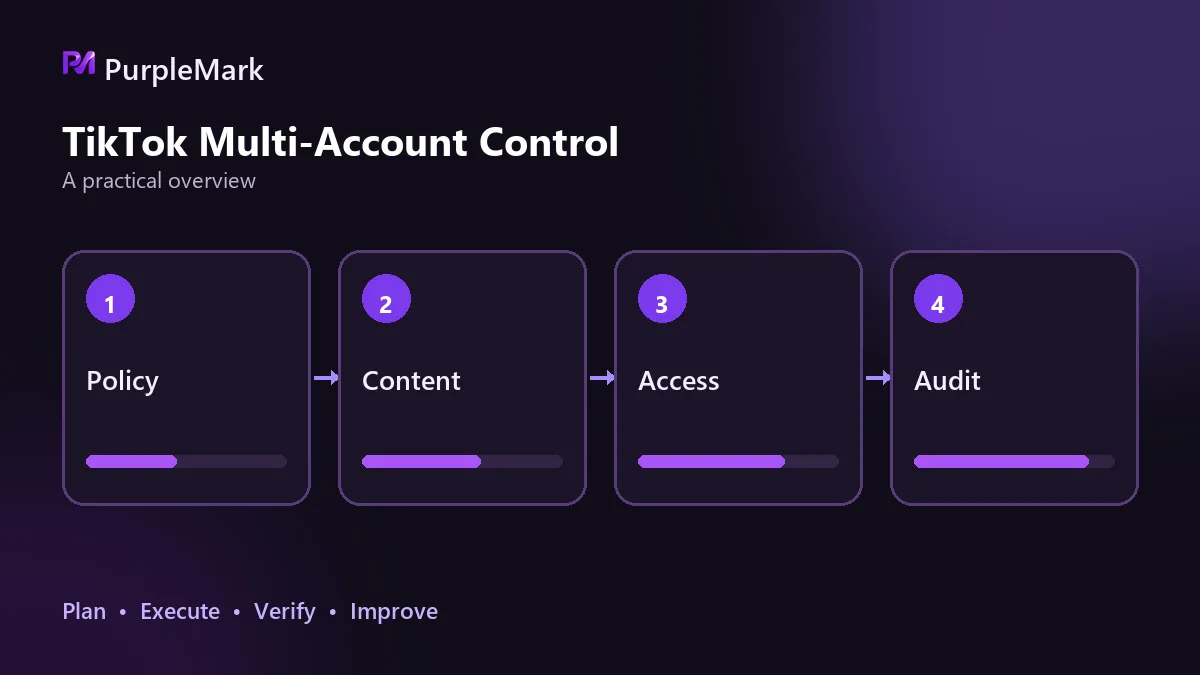
There is an order to what should be done during scaling. Build the inventory first, then set content capacity and cadence, and only after that handle permissions, reviews, and elimination.
Account inventory matters more than tools
Once the number of accounts grows, managing them from memory and chat logs will eventually cause mistakes. At minimum, keep a table that maps five fields for every account: account, environment, egress region, owner, and target market, so responsibility is visible at a glance.
Each environment must map strictly to one account. This rule is easiest to break during rapid expansion because newly created environments often have similar names. One casual login to the wrong environment can link two accounts. After batch creation, verify every environment one by one instead of waiting for a problem to investigate.
The egress region should match the account positioning and remain stable. Using a European egress for an account targeting Southeast Asia, or switching from Southeast Asia today to the Americas tomorrow, only creates abnormal records.
Content capacity is the real ceiling
Before adding accounts, confirm one thing: can the current content supply support them all? If it cannot, more accounts simply mean less production capacity per account, and overall performance can decline.
The answer is not to make everyone edit a few more videos, but to split one main content line into different formats. The original cut is one version, a short clip is another, a multi-segment compilation is another, and a key-points version is yet another. The same batch of source material can then cover more accounts, provided the formats are genuinely different. Republishing the exact same content will be treated as duplication.
Build a material buffer in advance as well. Shooting and editing should be scheduled at least one cycle ahead of publishing; otherwise, a supply gap can make several accounts stop updating at once and waste the momentum already built.
Do not make distribution cadence look uniform
Publishing the same format from a batch of accounts at the same time is one of the clearest patterns in a matrix. Stagger posts by each market's active time zone and release different formats in batches so every account develops its own publishing curve.
Interaction also needs restraint. Having your own accounts like, comment on, or boost one another may look minor, but it is one of the easiest behavior patterns to connect, especially among new accounts.
Decide in advance who manages which accounts
Once a team starts operating, cross-account handling is almost inevitable unless responsibilities are fixed. If everyone can change things and nobody has clear ownership, problems become hard to trace and the process cannot be improved.
A common approach is to grant access by market or category. Each member only handles the accounts and environments in their group, and login states are not shared between environments. Tools such as PurpleMark can group environments by member and separate permission scopes, making it much easier to hand over an entire group than to change ownership environment by environment. High-sensitivity actions, such as the first login on a new account, binding account information, or publishing the first post, should be limited to a small number of people, while others handle routine maintenance.
Keep a handover record for every batch of accounts, including who changed what and when. The goal is not to assign blame, but to locate the exact step when something goes wrong.
Review data regularly and be willing to stop accounts
Scaling only works if resources can be reclaimed. Run a review weekly or every two weeks and focus on a few metrics: median views rather than the best-performing post, completion rate, engagement rate, and follower growth or conversion.
If an account shows no improvement across two consecutive review cycles, pause publishing first, then decide whether to reposition it or drop it entirely. Pausing is cheaper than forcing it to continue, because forcing it only keeps consuming content capacity. Conversely, accounts that are working should receive more capacity, including resources freed from paused accounts.
Define elimination rules in advance rather than debating them once the team gets busy. Clear rules reduce emotional friction during execution.
The first two areas to lose control
Environment reuse comes first. A team member may log into someone else's account from an environment outside their assigned group just to save time, and a single action can connect two accounts. This happens most often during rapid account expansion.
Egress switching comes second. Login egress from mobile and web sessions can be cross-checked, and inconsistency is an anomaly. Mobile should handle high-weight actions such as uploads and initial account setup, while web handles routine maintenance; both sides must stay on the same route without switching midway.
Content duplication and cross-team operation come after that. These are chronic problems that gradually weaken the matrix, but they are less likely to cause the whole setup to fail overnight.
What good scaling looks like
The account inventory is always available, content production is planned before publishing, every team member touches only their assigned group, data is reviewed every week, and weak accounts can actually be stopped. With those practices in place, scale becomes a multiplier; without them, scale only multiplies risk.


