
Tinder has a relatively high account-ban rate among social apps, largely because its one-person-one-account model is built around phone numbers. It helps to understand how the rules are applied, which behaviors tend to trigger action, and how to appeal after a ban.
Tinder's ban rate is relatively high among social apps. Many people repeatedly register and get banned, but most miss one point: the platform is not handling a single device or email address; it is handling a group of accounts that appear to belong to the same person.
Some third-party statistics say bans increased by more than 30% over the past year, with most cases related to unusual device or network environments rather than deliberate user violations. That percentage may not be exact, but the overall direction is plausible. Instead of guessing whether a technical setup is hidden enough, it is more useful to understand the rules first.
The core rule is one unique phone number
Registration requires phone-number verification; email alone is not supported. One number can be linked to only one account, which is one of the platform's main ways to block fake accounts. The implication is straightforward: if you want another account, you need another real number that can keep receiving verification codes over time; if the number stops working, the account can get stuck at a later verification step.
There is an easy point to misread here. The terms require each account to have a unique phone number, but they do not explicitly say that one person may never have multiple accounts. Those are different issues: you may have more than one account, but if they share the same environment, the platform may still treat them as one linked group.
Devices and phone numbers are assessed together
The platform does not only check whether registration succeeded. It keeps judging whether a real person is using the account normally. The signals broadly fall into four groups: whether login devices change frequently or have conflicting device characteristics; whether login locations match the location stated in the profile; whether swipe frequency and conversation density look human; and whether profiles, photos, or opening messages show signs of templates.
When multiple accounts overlap heavily on these dimensions, the platform may handle them as a group of linked accounts. That is why problems often affect a batch of accounts rather than just one.
Bans are usually triggered by several types of behavior
Unusual logins are the most direct signal. Switching login regions in a short period or repeatedly changing the login environment can be flagged. If a profile says the user is in the United States while logins come from another continent, the platform has reason to be suspicious.
Bulk activity is another typical pattern: swiping right many times in a short period, sending the same message to many users, or using automation scripts for repetitive actions. One often-overlooked point is that the platform is noticeably less tolerant of new accounts. The same level of activity may be fine for an established account but trigger immediate restrictions on a newly registered one.
Profile violations also matter. Photos and bios that are obviously generated from templates, several accounts sharing the same images or bio, repeated personas, or restricted terms in the content can all increase the risk of enforcement.
Enforcement is not limited to outright bans. A more subtle case is reduced visibility: the account can log in normally, but the profile stops appearing in recommendations, swipes produce almost no matches, and sent messages get no replies. This kind of restriction is usually triggered by abnormal behavior, and many users do not realize at that point that the account has already been affected.
What can you do after a ban?
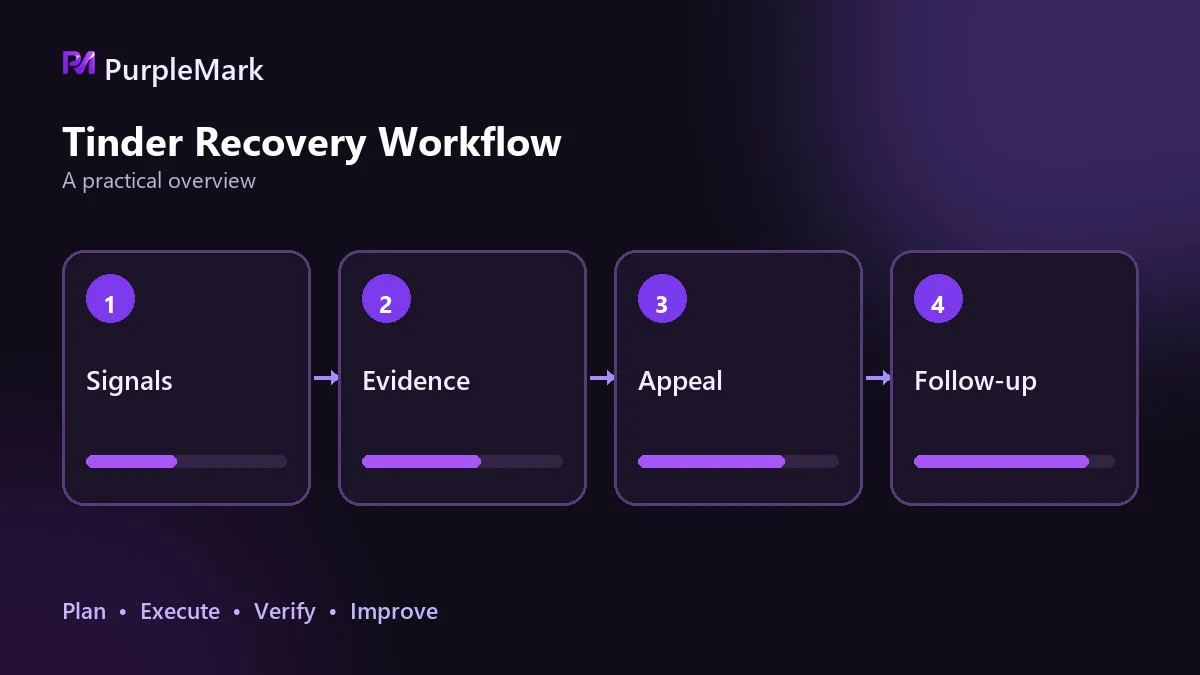
Start with the official channel. In the appeal center, choose the option for being unable to log in, then select that the account has been disabled and explain the situation clearly. Based on experience, replies take a few business days, usually three to seven days. Include the phone number linked to the account, the approximate registration time, usual login region, and information that helps show you are a real user. That is more useful than sending only a one-line claim that the ban was a mistake.
Different situations should be separated. Use the appeal process for a direct ban. For a hidden visibility restriction, the more realistic approach is to stop, return to a normal usage pattern, and wait to see whether visibility recovers. If the appeal fails, the account is effectively finished, and it is usually better to put your effort elsewhere.
There are also things not to do. Repeatedly creating new accounts in the same environment gives each new account linked characteristics from day one; starting over with another set of false profile data can lead to stronger enforcement once detected; and submitting appeals repeatedly within a short period can be treated as abuse.
Where is the boundary for multiple accounts?
Some business scenarios genuinely require multiple identities, such as product testing or overseas market research. In those cases, the goal is not to find a way to register as many accounts as possible, but to operate each one as an independent account: each account should have its own real, traceable number and profile, distinct positioning and content direction, and a separate operating environment.
Environment isolation solves the problem of keeping legitimate accounts from interfering with one another. Tools such as PurpleMark provide this layer by preventing multiple accounts on the same device from sharing login traces and device characteristics. What they cannot and do not intend to solve is bypassing the one-person-one-account rule. The rule exists and cannot simply be worked around.
This content is only an explanation of platform rules. The official user agreement prevails.


