
Batch registration and automated account farming are explicitly prohibited by platform rules. This article goes through the relevant clauses, the environment- and behaviour-level weaknesses of such accounts, the knock-on consequences after enforcement, and the compliant alternatives.
Tutorials for batch-registering accounts and running them with automation occasionally show up online, usually promising fast account growth and amplified reach. These practices are explicitly banned by platform rules, and the window in which they work is getting shorter and shorter. Rather than working out how to do it, it is more useful to look at what the rules say and why these accounts do not last.
What the rules say
X's user agreement and platform manipulation policy contain several directly relevant clauses: registering accounts in bulk or through automation is not allowed; selling, buying or renting accounts is not allowed; using multiple accounts to manufacture fake engagement and amplification is not allowed; and using unauthorised automation tools to perform follows, likes, reposts or comments is not allowed. The official API does permit a certain amount of automation — posting within rate limits, for example — but simulating human behaviour with scripts and running engagement in bulk is outside the permitted scope.
The test is not how you do it, but whether the accounts and their interactions are manufacturing inauthentic amplification.
Why these accounts do not last
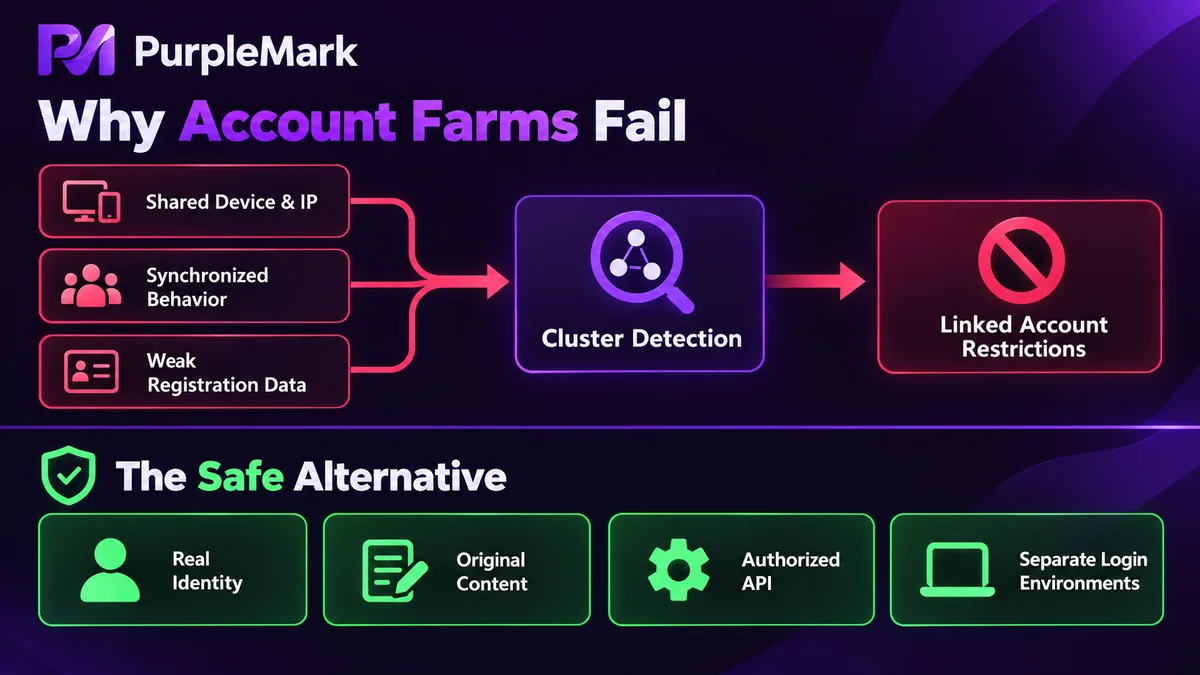
Batch-registered accounts usually show weaknesses in several places at once.
At the environment level, dozens of accounts register and log in from the same set of device characteristics, the same browser configuration and the same block of IP addresses. The platform does not need to catch any single action; putting registration time, egress attribution and device characteristics together is enough to circle the same batch. Once a block of addresses is flagged, accounts newly registered from it are restricted along with it.
At the behaviour level, the rhythm of posting and engagement is the easiest layer to spot. A normal personal account has a daily routine, topic fluctuations and gaps; batch-operated accounts tend to be active at the same time, post the same type of content and concentrate their interactions among the same set of accounts, forming a closed loop of mutual engagement that stands out clearly in the data.
The registration step itself is also tightening. Disposable verification-code platforms and virtual number ranges have been identified at scale for years, and email domain characteristics, verification pass rates and the pattern of completing a profile immediately after signing up are all factored into the assessment. Once a way of bypassing verification is identified, the whole batch fails together within a very short time.
What happens after enforcement
A mild outcome is that the account is asked to verify or is simply frozen, and the content you invested in and the followers you accumulated are wiped out at once. More troublesome is the knock-on effect: your own main account in the same environment may be restricted too, and accounts sharing the same payment method or phone number can be dragged in as well. If account trading and fake engagement are involved and used commercially, there may also be consequences beyond the platform; the EU's Digital Services Act has explicit requirements on platform manipulation and inauthentic information, and advertisers and agencies are adding related clauses to their contracts.
The worst part is that the followers and interactions of such accounts are not real to begin with — they cannot be converted into business, and once the account is banned all the earlier investment becomes a sunk cost. The room for appeal is usually small, because the determination against batch accounts is structural, not about something you got wrong in a single post.
What you can do within the rules
- One person, one account — or create accounts under a real operating entity, using your own registration details, phone number and email, never shared with others.
- Differentiate content by account positioning; do not copy the same set of assets and publish it across multiple accounts.
- If you genuinely need automation, use the platform's officially open APIs and permitted scope, keep frequency under control, and stay away from engagement scripts.
- When managing multiple accounts separately, give each one an independent, stable login environment so devices and egress are not concentrated.
- When you need to amplify reach, use platform-recognised methods such as paid promotion and partner distribution rather than account volume.
When several people on a team manage a few of their own accounts, environment isolation is just as useful: login states are stored separately and cookies are not mixed, which reduces the chance of being misjudged as linked accounts. Tools like PurpleMark provide exactly this account-level environment isolation, suited to this kind of day-to-day collaboration.
Accounts that can truly keep going long term rely on steady content output and genuine interactive relationships. Account count was never a moat — it is the first part to get cleaned up.


