
Monetizing on X goes beyond creator ad revenue sharing. This guide explains the requirements, payment limitations, and risks of artificial engagement for revenue sharing, tips and subscriptions, paid content, brand deals, and off-platform monetization.
When people think about monetizing on X (formerly Twitter), creator ad revenue sharing is often the first option that comes to mind. Its advantage is that earnings rise with traffic, and the requirements are stated plainly: subscribe to Premium, have at least 500 verified followers, reach 5 million post impressions in the past three months, maintain a clean compliance record, and complete identity verification through Stripe. All five conditions must be met; missing even one means you cannot enable it.
For most people, that makes revenue sharing more of an outcome to work toward than something they can start using today. Several other paths have much lower entry barriers, although each comes with its own limitations.
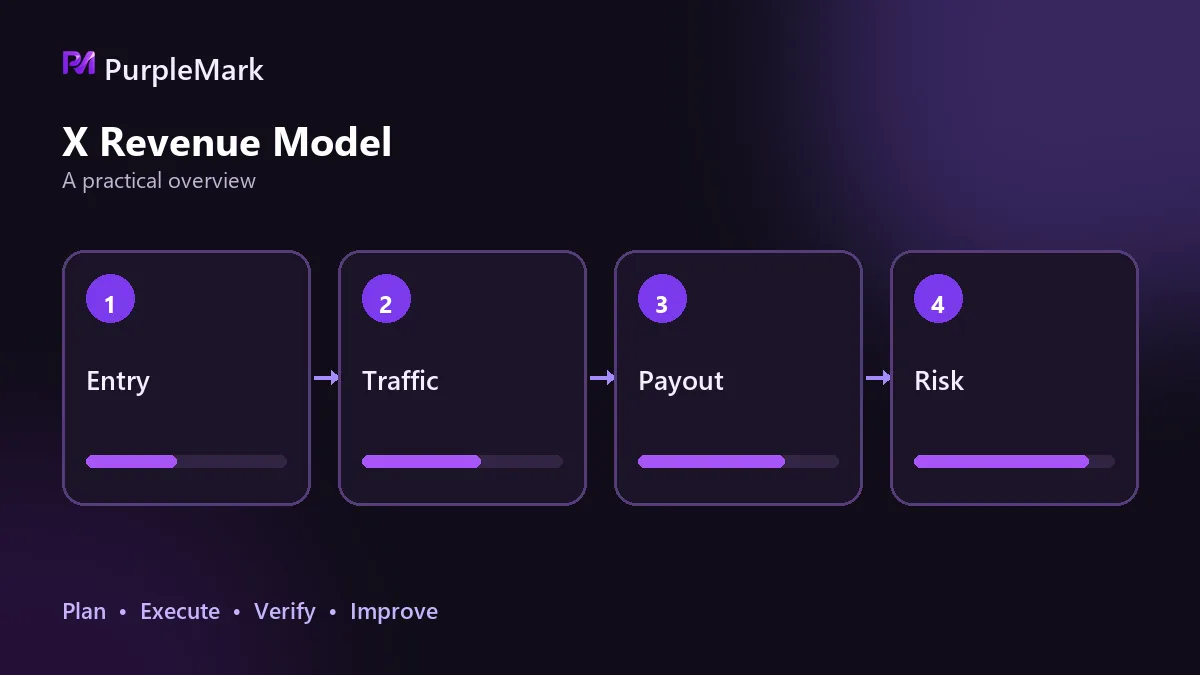
Two hidden conditions behind revenue sharing
Beyond those five requirements, revenue sharing has two easily overlooked conditions.
The first is the payout channel. Earnings need to be settled through a payment service such as Stripe. In regions the payout provider does not support, the money cannot reach you even if your follower and impression numbers qualify. Creator earnings may also be temporarily suspended in some regions while the account itself remains active. That is not a content problem; it is a settlement-chain problem.
The second is where the impressions come from. If impressions are inflated through engagement exchanges, bots, or batches of accounts boosting one another, the platform typically responds by canceling current-period earnings first, then freezing revenue-sharing eligibility, and in serious cases suspending the account outright. Advertising content on X must also disclose commercial relationships as required by the platform and local law. Failure to disclose can trigger enforcement after reports. Artificial impressions do not turn into withdrawable income, but they can cost you the account itself.
Tips and subscriptions: possible even with a small following
X Tips has the lowest entry barrier. You must be at least 18 years old, have had an active account for at least three months, maintain a complete profile (name, bio, profile photo, and header image), and connect a third-party payment processor. There is no follower-count requirement, and the platform takes no cut, so the full amount goes to you.
Paid content comes in three forms. With monthly subscriptions, paying followers unlock private posts, exclusive tutorials, unreleased materials, or community access. The platform takes 10%, and you can set the subscription price starting at $2 per month. Paid direct messages carry no platform fee and start at $2.99 per month. Paid Spaces are ticketed audio sessions priced from $5 to $100. For knowledge sharing, industry interviews, or skills training, one live session can generate direct revenue, and tips can also be enabled during the session.
All three depend on the same premise: followers must be willing to pay, and they must see enough value in exclusive content to do so. Specialist areas such as cross-border business, law, tax and finance, and careers often support higher pricing. Regional restrictions still apply, and payouts still depend on payment availability and identity verification.
Brand partnerships do not depend only on follower count
Brands evaluate accounts primarily by fit with the relevant niche. An account with 20,000 followers and real influence in a focused field may be more commercially valuable than a general-interest account with 100,000 followers, because its audience is more concentrated and conversions are easier to anticipate.
The way to attract partnership invitations is straightforward: keep publishing useful viewpoints in a consistent field until the account is recognized as a reference source there. Invitations may arrive organically, and you can also contact relevant brands directly. Sponsored content should disclose commercial relationships under platform rules and local law. That is both a compliance requirement and a way to reinforce trust. Brand budgets are usually concentrated in specific markets, so cross-region collaborations require extra attention to local advertising-disclosure rules.
Moving traffic off the platform
The three main off-platform monetization routes have the lowest entry barriers, but you must solve traffic, trust, and payments yourself.
With affiliate marketing, the key is not to turn recommendations into ad slots. Share tools you genuinely use, give honest judgments in comparisons, and explain solutions to specific problems; the link should be only one part of the solution. In contrast, posting promotional links in bulk is almost a public admission that the account is purely promotional. X users recognize marketing content quickly, and once an account is seen as a marketing account, the reach of later posts can drop noticeably.
Digital products work well when you create once and sell repeatedly over time: templates, productivity spreadsheets, ebooks, online courses, and industry reports can be listed on external platforms and linked naturally from your content.
Services offer the most direct conversion path. Consulting, writing, design, development, and investment research can all work as long as there is a clear deliverable. The account itself becomes proof of capability, and inquiries can arrive through direct messages or public interactions. People who first judge your expertise through your content before discussing a project often have greater willingness to pay than users comparing only prices on low-cost marketplaces.
What happens when an account runs into problems
Using multiple accounts on the same device, flooding the feed with hard-sell ads, and operating in an abnormal payout environment are all relatively sensitive patterns on X. Once triggered, the consequences can include reduced reach, account suspension, or frozen earnings. If you operate several accounts in different niches or regions, placing each account in a separate environment with a stable network exit can reduce the chance that one account's status affects another. Fingerprint browsers such as PurpleMark are designed for this purpose by giving each account an independent browser environment.
Choosing the order
Start by defining your field, because every monetization method depends on what the account stands for. Then test one of the fastest routes first; services and affiliate marketing are usually the quickest to start. Once trust has accumulated, add subscriptions and brand partnerships, which generally require a longer cycle. Opening too many monetization lines at once can dilute the persuasive power of every piece of content.
Follower count is an outcome, not the goal; content is the cause, and monetization is the consequence. Reverse that order, and the work only gets harder.


