
Not sure which pricing model to choose for affiliate marketing? This guide explains CPS (pay per sale), CPA (pay per action), CPL (pay per lead), and CPC (pay per click), including their definitions, typical use cases, pros and cons, plus a practical framework for choosing based on your skills and traffic.
"I post links every day, so why are my commissions still so low?" Many people who are new to affiliate marketing have the same question. The problem is often not how hard you work, but that you chose the wrong pricing model.
Even when promoting the same kind of offer, one program may only pay when a sale happens, another when someone registers, another when a user leaves contact details, and another simply when someone clicks. These four models make money in very different ways. This guide explains what CPS, CPA, CPL, and CPC mean, who each model suits, and how to choose based on your own situation.
The Four Pricing Models at a Glance
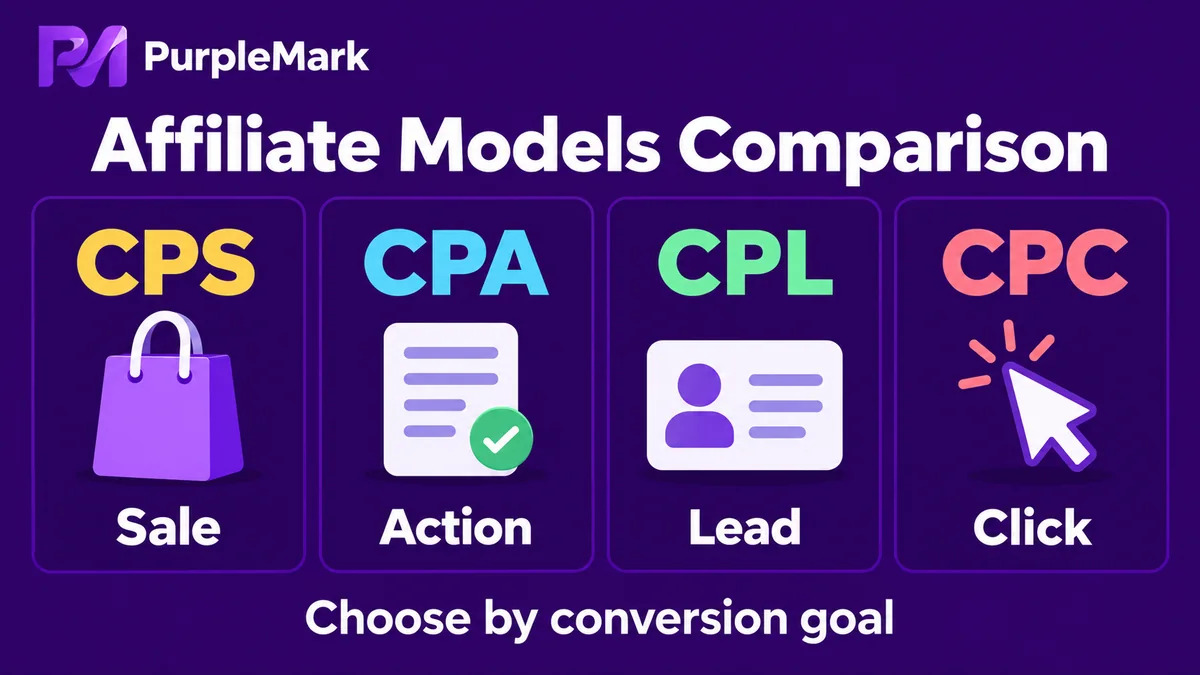
| Model | Meaning | When you get paid | Typical use cases |
|---|---|---|---|
| CPS | Cost Per Sale, pay per sale | A user completes a purchase through your link | Amazon Associates, Taobao affiliate programs |
| CPA | Cost Per Action, pay per action | A user registers/downloads/completes a survey or takes another required action | Game app downloads, Airbnb promotion |
| CPL | Cost Per Lead, pay per lead | A user leaves an email address/phone number or other contact information | Lead generation for finance, education, and similar sectors |
| CPC | Cost Per Click, pay per click | A user clicks the link | Google AdSense, traffic distribution sites |
Understanding Each Model
CPS: You get paid only after a sale. You earn a commission only when a user successfully places an order through your dedicated link.
- Pros: Earnings per conversion are usually higher, and the audience is more qualified—someone who buys clearly has real demand. Over time, you can build a track record and negotiate a better revenue share.
- Cons: The conversion cycle can be long, and results depend heavily on your product selection skills and consistent content output.
- Best for: People with solid content and marketing skills who are willing to focus deeply on a specific category.
CPA: You get paid when an action is completed. A purchase is not required. Registration, download, trial, form submission, or another defined action can count as a conversion.
- Pros: The participation threshold is lower, promotions are relatively easier to run, and the model works with many types of content.
- Cons: Payout per action is often modest, so you usually need volume.
- Best for: People who can consistently bring in large numbers of target users but are not sure those users will purchase immediately.
CPL: You get paid when a user leaves contact information. This is common in high-ticket industries that require follow-up, where advertisers are willing to pay for a sales lead that may convert later.
- Pros: Your job is to encourage users to submit their details; you do not have to close the sale. High-quality leads may also give you room to negotiate better terms.
- Cons: Traffic quality matters a lot. Low-intent, broad traffic often produces low-value or invalid leads.
- Best for: People who already have a well-defined audience and can use landing pages to collect lead information.
CPC: You get paid for a click. As long as a user clicks your ad or link, you earn revenue, regardless of whether a later conversion happens.
- Pros: No conversion pressure, the lowest barrier to entry, and it can scale quickly.
- Cons: Revenue per click is low, so meaningful income generally requires a very large number of clicks.
- Best for: People with stable and substantial sources of impressions or clicks, such as a high-traffic website.
How Should You Choose? Start with Three Questions
Instead of copying a template, ask yourself these three questions first:
1. How strong are your marketing and conversion skills? Can you accurately understand user needs and persuade users to complete the desired action, such as a purchase, registration, or lead form? If your ability is strong, deeper-conversion models such as CPS may suit you better. If you are still unsure, start with a lower-threshold model.
2. Is your traffic “large but broad” or “small but highly targeted”? Large but average-quality traffic is better suited to scale-driven models such as CPC and CPL. Highly targeted traffic with strong conversion potential is more suited to the higher upside of CPS. If your traffic is both small and low quality, focus first on improving acquisition and conversion before rushing to monetize.
3. What type of product do you want to promote? High-value products with long decision cycles and a high trust requirement, such as finance, education, or major purchases, are better suited to CPS/CPL models that support deeper conversion or lead collection. Lower-value, fast-moving products with quick decisions can also generate volume through CPA/CPC.
Some practical combinations:
- Strong marketing skills + highly targeted traffic + high-value or well-known branded products → focus on CPS to pursue higher commissions;
- Large traffic volume but average quality + new fast-moving consumer products → use CPC or CPL to monetize volume or leads;
- Strong skills but limited traffic + a new high-value product → start with CPS to open the market, build reputation, and accumulate more targeted traffic;
- Large and highly targeted traffic + well-known branded products → either CPA or CPS can work, depending on whether your main goal is registrations or completed purchases;
- Skills and traffic are both at an early stage → start with CPL (lower lead threshold) or CPC (lower click threshold) to gain experience, then move toward more advanced models.
A Few Reminders Before You Start
- Do not put all your eggs in one basket. Beginners are usually better off making one platform and one model work first, then replicating what works, rather than trying five models at the same time.
- Use real accounts that you legitimately control. Register for affiliate platforms and operate promotional accounts in accordance with platform identity and compliance rules. When managing multiple platforms or multiple accounts, tools such as PurpleMark can help separate browser environments, login sessions, and proxies for each channel, reducing environment mix-ups and accidental operations while making it clearer who is promoting which channel. The tool helps manage environments; compliance still depends on operating truthfully and properly.
- Do the math before investing. Understand the payout per conversion, settlement cycle, and advertiser reputation for each model instead of focusing only on advertised “high commissions.”
Frequently Asked Questions
Which is better, CPS or CPA? Neither is universally better. CPS offers higher earnings per transaction but is harder to convert, while CPA has a lower conversion threshold but usually pays less per action. The key is how far your traffic can move users: choose CPS if you can drive purchases, and CPA if you can reliably generate registrations or downloads.
Is CPL suitable for beginners? If you can consistently attract a targeted audience and build landing pages that collect leads effectively, CPL can be relatively beginner-friendly because you are not responsible for closing the final sale. It is a good fit for promoters who want to start with customer acquisition.
Can CPC really make money? Yes, but it depends on having enough clicks. Revenue per click is low, so the model makes sense mainly when you have a stable source of high traffic and high exposure.
How do I know which model suits me? Go back to the three questions: your marketing and conversion skills, the size and quality of your traffic, and the type and brand strength of the product. Once you understand those three factors, the right model usually becomes much clearer.
Conclusion
CPS, CPA, CPL, and CPC are not better simply because one pays more. The best model is the one that matches your skills and resources most closely: if you can close sales, go deeper with CPS; if you can drive volume, take advantage of CPA/CPC scale; if you are good at acquiring prospects, use the precision of CPL. Clarify your skills, traffic, and product first, then choose the model so your affiliate marketing does not lose momentum from the starting line.
(Compliance note: Use real, personally controlled, compliant accounts for affiliate promotion, and follow the rules of each platform and advertiser.)


