
Customer service experience affects conversion. This guide reviews Zendesk, SaleSmartly, Meiqia, Intercom, Tidio, and Freshdesk, then provides practical selection advice covering business scenarios, AI maturity, channels, compliance, and cost.
In an era where customer experience comes first, AI customer service is gradually replacing traditional support methods and becoming a key driver of service efficiency and sales conversion. From automated replies and behavior analysis to customer routing and ticket management, AI customer service systems are creating a new service model for businesses. Which systems are worth considering? This article reviews six popular international tools and provides a practical selection framework.
What Is an AI Customer Service System?
An AI customer service system is a customer support solution built on artificial intelligence technologies such as natural language processing, machine learning, and semantic recognition. It can simulate conversations with human agents, automatically answer common questions, guide users through processes, collect customer information, and even handle parts of pre-sales and after-sales workflows. Compared with traditional support, it places greater emphasis on automation, intelligence, and uninterrupted 24/7 response.
Modern AI customer service systems typically include chatbots, multi-turn conversations, automatic FAQ matching, semantic intent recognition, and customer profile integration. They are widely used in e-commerce, SaaS, cross-border trade, finance, education, and other industries. As large language models such as GPT continue to develop, use cases have expanded from Q&A to marketing conversion, customer success management, and data-driven service optimization.
6 Mainstream AI Customer Service Tools
Zendesk
A globally leading customer service and support platform serving more than 100,000 businesses. It provides a complete set of tools including AI customer service, ticketing, knowledge bases, and call centers. Its core strengths are powerful ticket workflows and AI automation, making it suitable for high-volume, multi-level, and multi-channel service operations.
- Features: Omnichannel support (email, website chat, social media, phone, SMS), Zendesk AI for automatic classification, routing, and responses, mature ticket management, knowledge base, strong extensibility, and open APIs that integrate with Slack, Shopify, Salesforce, HubSpot, and more.
- Advantages: Supports 40+ languages, strong ticket handling, enterprise-grade SLA/security/GDPR compliance, customizable modules, and a good fit for medium and large businesses.
- Disadvantages: Expensive pricing, some AI features cost extra, a relatively steep learning curve, and limited Chinese localization.
SaleSmartly
A SaaS platform focused on integrating “customer service + marketing” for independent sites, cross-border sellers, and global brands. It uses AI-driven customer engagement and data accumulation to help businesses improve conversion on overseas channels such as WhatsApp and Facebook Messenger.
- Features: Aggregated omnichannel chat (WhatsApp/Facebook/Telegram), behavior-based marketing automation, AI smart replies, a customer data platform connected with Shopify, and agent performance and ticketing tools.
- Advantages: Focused on international expansion, cost-effective, easy to use, and suitable for small and medium-sized sellers.
- Disadvantages: Limited functional depth; complex scenarios such as multi-level conversational bots and advanced CRM analytics may require third-party integrations.
Meiqia
A representative Chinese intelligent customer service solution widely used by SaaS companies, e-commerce businesses, cross-border sellers, and local service providers. It offers a one-stop service loop from customer reception to conversion.
- Features: Multi-channel access (website/app/WeChat Official Account/mini program/WeCom), seamless AI + human collaboration, behavior tracking and customer profiles, CRM integration, and optional private deployment.
- Advantages: Strong localization support in China, comprehensive functionality, stable bots, and support for standard FAQ and workflow conversations.
- Disadvantages: Higher costs for professional and flagship plans, overseas network and language support are still improving, and some configurations are complex.
Intercom
A globally leading customer communication and support platform focused on AI-driven automated conversations, widely used by SaaS, e-commerce, finance, and global enterprises.
- Features: Live chat + bots (including Fin), omnichannel access, conversational marketing, rich third-party integrations (Slack/Salesforce/HubSpot/Zapier), and customer lifecycle management.
- Advantages: Covers 45 languages, Fin has strong GPT-based AI capabilities, mature API and developer support, and an intuitive interface.
- Disadvantages: Relatively expensive pricing charged by resolution, many features can make configuration complex, and compatibility with Chinese and domestic social platforms is limited.
Tidio
A lightweight AI customer service and live chat tool built for small and medium-sized businesses, especially popular with Shopify independent-store sellers, DTC brands, and smaller e-commerce merchants.
- Features: Multi-channel access (chat widget/Messenger/Instagram/WhatsApp/email), Lyro AI bot, live chat and visitor monitoring, automated workflows, and one-click integration with Shopify/WordPress/Wix/BigCommerce.
- Advantages: Lightweight, easy to learn, reasonably priced with a free plan, natural AI responses, and cross-platform availability.
- Disadvantages: AI capabilities are mainly suited to basic scenarios, with weaker support for deep semantics and complex workflow conversations.
Freshdesk
An omnichannel customer service platform developed by Freshworks and widely used by medium and large businesses worldwide.
- Features: Multi-channel ticket consolidation, Freddy AI bot (intent recognition/semantic understanding), knowledge base and self-service portal, automation rule engine (SLA/priority/tags), multi-team ticket collaboration, and built-in CRM and analytics.
- Advantages: Rich functionality with good value, reasonably priced entry plans, strong AI, and good localization.
- Disadvantages: A more traditional interface, customization that relies on plugins, and Chinese-language AI handling that still needs improvement.
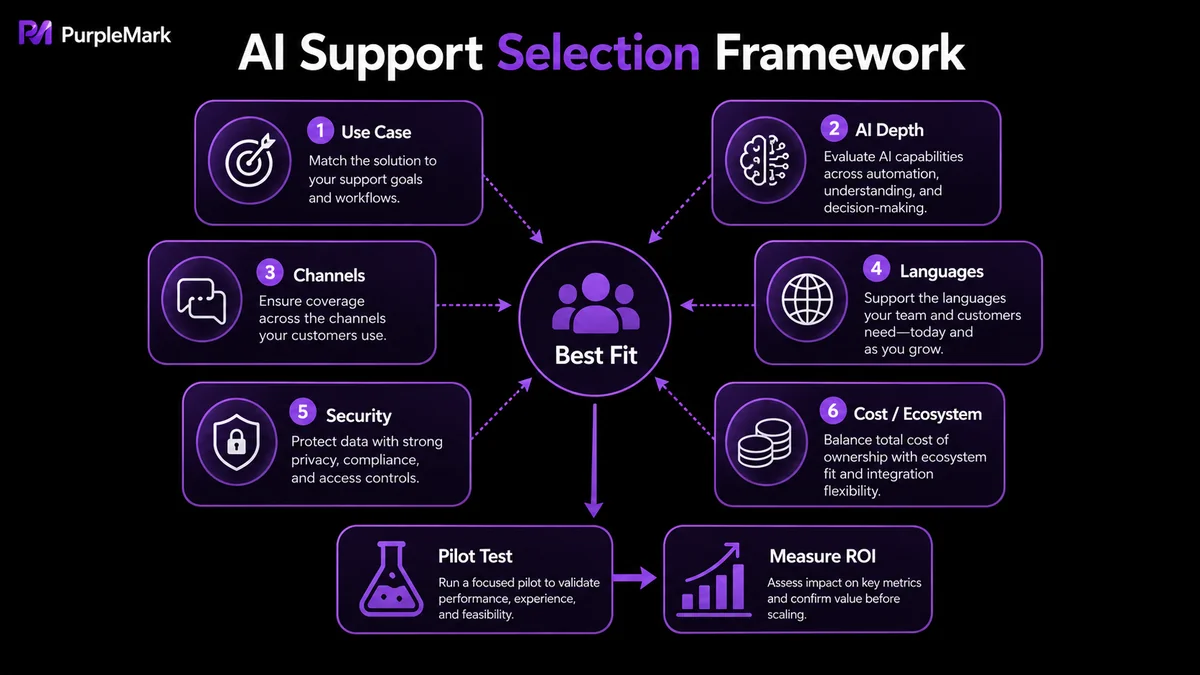
A Six-Dimension Framework for Choosing an AI Customer Service System
1. Define your business scenario and core needs. E-commerce and retail prioritize response speed and conversion, making “strong live chat + marketing automation” a good fit. SaaS and technical teams value multi-turn conversations and ticket collaboration. Cross-border businesses and independent sites should prioritize multilingual support and global channels. Medium and large enterprises need scalability and closed-loop data operations.
2. Evaluate AI maturity and controllability. Can the bot be custom-trained through knowledge-base imports, corpora, or keywords? Can it handle ambiguous questions and context? Is workflow configuration easy with drag-and-drop tools? When the bot fails to recognize a request, can it automatically transfer the conversation to a human while preserving context?
3. Check channel integration and multilingual support. Does the system provide unified support across websites, apps, WhatsApp, Messenger, email, and phone? Does it support multilingual interfaces and interactions? Can it aggregate and assign social-media messages?
4. Consider deployment, security, and compliance. Finance, healthcare, government, and similar sectors may require private or hybrid-cloud deployment, data access controls, permission levels, audit logs, and certifications such as GDPR and ISO 27001.
5. Evaluate pricing and the cost curve. Review the billing model (per seat/interaction/module), boundaries between free and paid features, trial or starter plans, and whether future upgrade costs are reasonable.
6. Evaluate support and ecosystem. Consider Chinese/localized customer support, documentation quality, third-party plugins and open APIs, and the ecosystem partner network.
It is advisable to build a simulated customer journey based on real business scenarios and compare products in practice to ensure the chosen solution meets targets for efficiency, experience, and ROI.
How Can Customer Service Teams Safely Operate Multiple Channel Accounts?
When implementing an AI customer service system, a cross-border support team often needs to sign in to multiple customer service accounts on WhatsApp, Facebook Messenger, Telegram, and other platforms, as well as back-end support systems for different countries, brands, and product lines. If multiple agents repeatedly share one browser for sign-ins, accounts can easily become confused, and unstable account environments may also trigger platform risk controls.
A more reliable approach is to give the customer service team a clear and traceable account-environment system. Each agent gets a fixed browser workspace, business accounts are grouped by brand/country/product line, and Cookies and login states are isolated from one another. Combined with member permissions, sharing, and operation logs, the team can clearly track “who handled which account and what they did.” This reduces operational mistakes and account confusion while making handovers and audits easier. Environment management tools such as PurpleMark can complement AI customer service systems and provide a stable operational foundation for businesses that manage multiple accounts, teams, and service regions.
Compliance reminder: This refers to compliant customer service operations using business accounts genuinely owned by the organization (for example, official support accounts created by a company for different markets). Follow the rules of each messaging platform and customer service channel, and do not use tools to bypass platform verification or create fake accounts in bulk.
Frequently Asked Questions
What is the difference between AI customer service and traditional customer service systems? AI customer service uses natural language processing, machine learning, and related technologies to provide automated replies, customer recognition, and recommendations, making support more efficient and intelligent than traditional human-only service.
Which industries are suitable for AI customer service systems? E-commerce, SaaS, education, finance, healthcare, and other industries with large volumes of customer inquiries and after-sales support are well suited to AI customer service systems.
Will using an AI customer service system affect customer experience? Mature systems can answer questions accurately and seamlessly transfer customers to human agents when needed, which can improve the overall experience.
Can AI customer service and browser environment tools be used together? Yes. Multi-account support teams can use environment isolation to keep accounts stable and operations clear. This complements AI customer service systems, improves efficiency, and reduces account risk.


