
When Facebook ad delivery stalls at the payment stage, the problem is often not the creative. This article explains how ad accounts are tied to payment methods, the risks of sharing payment methods across accounts, the order for handling payment failures, and the knock-on effects when an account is disabled.
When ads fail to scale, people often suspect the creative or bid first. But what actually freezes the budget is often one layer lower: the ad account and the payment method attached to it.
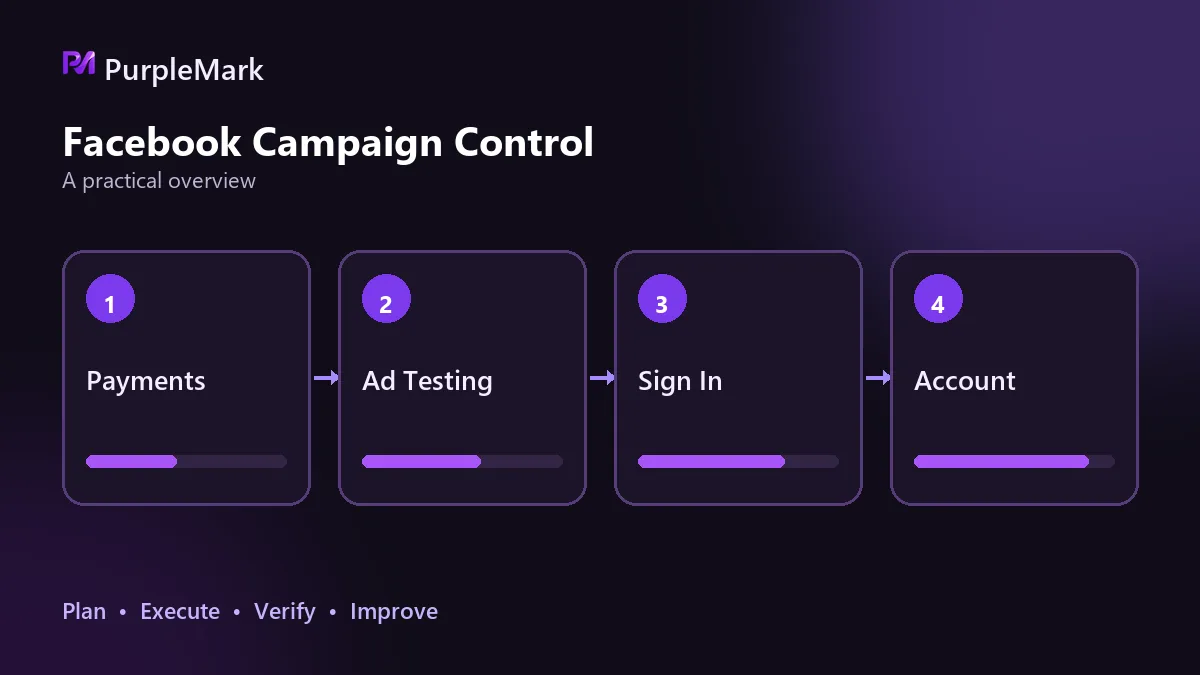
Ad accounts and payment methods are tied together
Facebook has about 3 billion monthly active users, and every charge from an ad account must ultimately be assigned to a specific payer. When an ad account is created, entity information such as the business name, region, and billing address is stored together with the payment method, and the platform cross-checks these details.
There is another detail worth remembering for manual-payment accounts: the payment method is fixed when the account is created and cannot be changed later. That means you should confirm that you will use a credit card before creating the account rather than trying to switch afterward.
If the login environment is in country A, the account entity is registered in country B, and the card billing address is in country C, the mismatch makes payment rejection much more likely. The platform looks at whether these details are consistent with one another, not whether any single detail looks acceptable on its own.
Multiple accounts sharing one payment method
The platform cross-checks three signals to determine whether accounts are related: browser fingerprints, network egress, and payment information. The first two are familiar to most people; the third is easiest to overlook.
If one payer has several cards, or several cards share the same billing address and cardholder name, it is not difficult for the platform to connect those accounts if they have also shared a login environment. The problem with sharing one card is that the risk does not stop with one account: if one account has a chargeback or is restricted, payment verification on the other accounts may become stricter as well.
Put simply, the payment method is part of an account's identity just like the login environment, so it is not suitable for several people to take turns using it.
How payment failures appear and the order for handling them
Payment failures usually show up in three ways:
- The billing address and login IP are in different countries, so the transaction is judged high risk;
- 3D verification fails, or the card-linking redirect fails, so the payment request is blocked by the bank;
- Repeated top-ups or repeated orders in a short period trigger risk controls from both the platform and the issuing bank. At the lighter end, the transaction is declined; at the heavier end, the account's ability to pay is suspended.
It helps to use a fixed troubleshooting order: first check whether the account entity's region, the current network egress, and the card billing address all point to the same country; then confirm that the card can complete 3D verification; finally, check whether payment requests were submitted repeatedly during this period and stop the repeated attempts. Only after ruling out these items should you appeal to the platform or contact the card issuer.
There is an even more troublesome case: after multiple payments in a single day, the ad account itself may become unusable. Repeatedly switching cards or networks to keep testing is an easy way to create problems, because consecutive failed requests are themselves recorded as high-risk signals.
If an ad account is disabled, can the payment method also be restricted?
Yes, and the extent depends on the binding relationship. When the same card or billing address is attached to multiple accounts, if one account is disabled for advertising violations, payment checks on the remaining accounts often become stricter and new charges may even be declined. If the card itself has already been flagged, using it to bind a new account later may also fail.
A more stable setup is to give each advertising account its own payment instrument and billing information, while keeping them consistent with the account entity's region. When the account, payment setup, and login environment all point to the same market, problems are also easier to isolate later.
Keep the login environment fixed as well
Payment is one layer of identity, and the login environment is another. Once you manage many accounts, manually switching accounts and entering payment information one by one can take around three hours a day. Frequent logouts and logins also leave traces on the platform and increase the chance of operational mistakes.
A common approach is to keep each advertising account tied to a stable browser environment and a stable network egress over the long term, then open the environment for whichever account you need. Multi-environment management tools such as PurpleMark are used for this purpose: each environment stays separate, so account operations do not have to be switched back and forth within the same environment.
Only after the payment path is in order does it make sense to look at creative and bidding.


