
Instagram account warm-up is not about artificially boosting authority. It is about letting a new account develop behavior patterns that resemble a real user, moving from registration and passive browsing to light interaction and steady posting without repeatedly changing profile details.
When a new account is registered, the platform does not immediately treat it as a normal user. It first observes the account for a while: what it browses, how long it stays, when it comes online, and whether it interacts. This observation period is the account warm-up phase.
What you need to do is not complicated. Slow the pace down so the account behaves more like a real person instead of rushing through a long list of actions just to make progress. Here is the sequence from registration to normal operation.
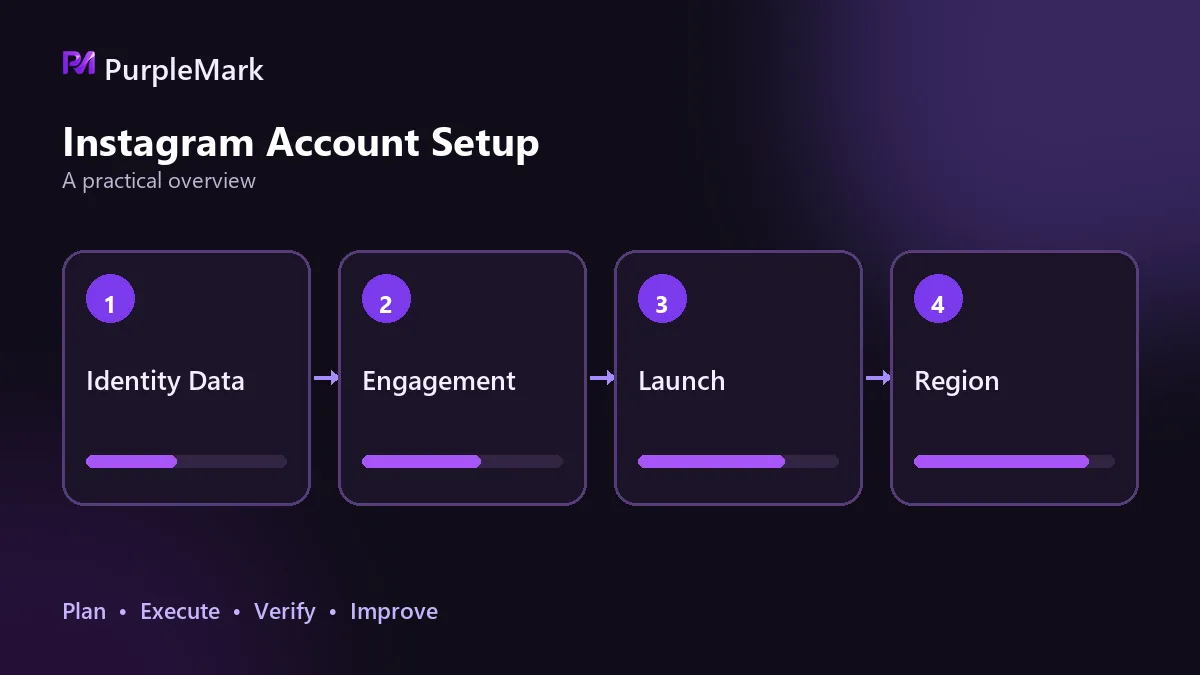
Complete the profile once
Choose the display name, profile photo, bio, and linked information carefully when registering, then avoid changing them unless necessary.
Real users rarely keep editing their profile during the first few days after registration. Changing the photo today, rewriting the bio tomorrow, and changing the name the next day can itself look unusual, especially when the account has no behavior history yet.
The region, language, and time zone in the profile should also match the account's login environment. A U.S. IP combined with a Chinese interface and Beijing time is an obvious inconsistency.
Browse only during the first few days
For the first few days after registration, build up browsing history first. View recommended content, explore the Explore page, spend a normal amount of time finishing content, search for keywords in the target niche, and watch a few short videos. During this period, do not like, comment, follow, or publish anything.
Use the account in small sessions at varied times rather than at exactly the same time and for exactly the same duration every day. Real usage is fragmented.
At the environment level, give each account an independent browser environment. The outbound IP, time zone, language, and geographic location should all point to the same region and should not contradict one another. Ideally, the outbound connection should be dedicated and have a clear location. After setup, run an environment check to confirm there are no conflicting parameters and no WebRTC leaks.
Fingerprint browsers such as PurpleMark can provide a separate environment for each account and keep parameters and outbound connections fixed, reducing manual maintenance.
Start with light interaction and show preferences
Once there is browsing history, begin interacting: like posts, follow accounts, save content, watch stories, and occasionally leave a comment.
The key is to be selective. Liking everything and following every account can look less human, not more. Real people have preferences: they tend to view certain types of content and follow certain types of accounts.
Keep the volume much lower than on a mature account. Limited interaction is normal for a new account, and you can increase it gradually later.
Start posting, then focus on comments again
Once the account has both browsing and interaction history, you can start publishing content. Keep the frequency low at first, watch how the data performs, and increase gradually after activity becomes stable and based on actual results.
Publishing is not the finish line. Replying to comments and taking part in discussions are also part of the account's behavior history.
An account that starts posting intensively immediately after registration does not resemble an ordinary user. Content volume should match the account's current stage.
Three common mistakes
Repeatedly changing profile information. As noted above, frequent profile changes early in a new account's life can be treated as unusual behavior, and real users generally do not do this.
Performing many actions in a short period. Bursts of likes, follows, or several consecutive posts can look very similar to scripted activity.
Synchronizing actions across multiple accounts. Liking, following, or publishing at the same time is one of the clearest cluster patterns. Even when every account has an independent environment, synchronized behavior can still connect them. If batch execution is necessary, the action itself can be the same, but the timing should be staggered.
Warm-up is not about bypassing risk controls
To be clear, the goal of account warm-up is to make the account's behavior rhythm consistent with that of a real user, not to study how to evade platform risk controls. These ideas may sound similar, but in practice they point in opposite directions.
The first approach adjusts your own usage toward normal behavior. The second spends effort trying to counter detection, while detection rules keep changing. Trust builds over time, and there is no shortcut. There is no fixed answer for how long warm-up should last; it depends on the account's purpose and the platform's current level of scrutiny. The principle is simple: do not rush. Intensive activity before the account has enough behavior history usually produces worse results.


