Account disablement is often preceded by warning signs. A sharp drop in engagement, disappearing hashtag and topic reach, repeated verification prompts when posting, and temporary feature restrictions can point to content violations, abnormal behavior, or environment links—and help determine where to start checking.
Instagram has tightened its risk controls in recent years. It is not unusual for someone who believes they have not violated any rules to open the app one day and find that the account has been suspended or disabled.
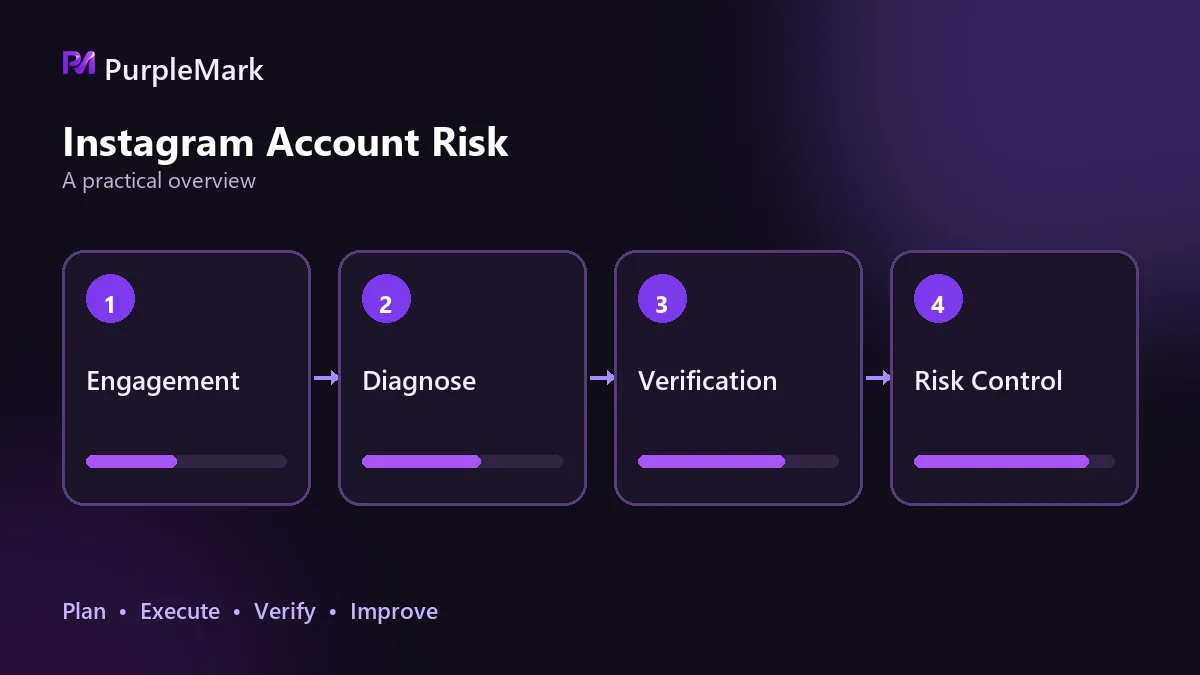
In many cases, there are warning signs before disablement, but they are easy to dismiss at the time. These signs generally fall into four categories, and each points to a different type of cause.
Engagement data suddenly drops
Likes, comments, and new follows that had been stable may fall noticeably within a few days even though posting frequency and content direction have not changed. This usually indicates that the account's distribution weight has been reduced. Penalties for fake engagement often do not begin with an immediate ban; instead, the platform may first stop recommending the content to non-followers. There may be no dashboard warning, so the change is visible only in the data trend.
It may also be less serious: the content itself could be losing its original audience, or the topic selection may have drifted, causing engagement to fall naturally. When you see a drop, do not immediately increase posting volume. First determine whether the problem is at the account level or the content level.
Hashtags and topics no longer bring reach
You add hashtags when posting, but your content does not appear on hashtag pages; topics that once brought steady traffic now produce almost no new visitors. This tends to indicate a content-level issue. Infringing material (unauthorized music, film or TV clips, or other people's photos), exaggerated or misleading claims, promotion of restricted categories, and repeated reposting of other people's content can all suppress distribution of an individual post. Only more serious cases may escalate to account-level penalties.
Repeated verification is required when posting
If verification codes or identity checks frequently appear when saving drafts, publishing, or switching accounts, the cause is more often related to the operating environment. The platform records login devices and network characteristics, and the following situations can create obvious anomalies:
- Logging in from multiple countries or regions within a short period
- An IP location that does not match the account's long-term usage region
- Switching the same account between environments with very different device characteristics
- Repeatedly logging in again within a short period, creating a new session each time
When managing multiple accounts, also check whether they share the same browser environment. A shared environment can cause the platform to treat those accounts as a group, so a problem with one account may affect the others.
Likes, comments, and follows are temporarily restricted
If an action suddenly becomes unavailable or you repeatedly see a message that activity is too frequent, the issue usually points to behavior cadence. The platform uses behavior models to judge whether activity resembles that of a real person, and action density is a core signal. An official reference limit previously given is no more than 60 combined likes, comments, follows, and direct messages per hour for newly registered accounts, with no more than 1,440 total actions per day and activity distributed evenly. In real operations, several accounts performing the same bulk actions during the same period can also be easily identified as scripted behavior.
After a signal appears, check in this order
The principle is to work from the outside in: first examine common issues that could affect a whole batch of accounts, then return to the individual account.
- First determine the scope. Is only one account affected, or are accounts in the same batch developing problems around the same time? If the whole batch is affected, the common factor is usually the environment, and repeatedly registering new accounts will not solve it.
- Next check the login environment. Verify whether the IP location matches the account's usual region, whether the account has been jumping among cheap, public, or random proxy nodes, and whether multiple accounts share one browser environment.
- Then review behavior. Think back to whether you recently concentrated bulk follows, likes, or mass direct messages into a short period, whether the cadence was overly regular, and whether accounts performed synchronized actions.
- Finally return to the content. Confirm that the source of materials is clear, that no unauthorized music or images were used, that copy does not contain exaggerated promises, and that no restricted category is involved.
For new accounts, also check profile completeness. Accounts with no profile photo, an empty bio, or an unverified email address or phone number start with lower trust and are more likely to trigger risk controls when the same unusual behavior occurs. A common warm-up practice is to keep activity low during the first two weeks, with about 5–10 likes and comments per day.
A few common misjudgments
Immediately increasing posting frequency when data falls is a common wrong response. The decline itself may already be a sign of reduced distribution, and increasing activity can make the situation worse.
Blaming everything on platform errors does not solve the problem either. The platform has had periods of widespread mistaken enforcement and has continued to improve support processes for account recovery, but for operators the controllable factors remain the environment, behavior, and content.
One more point is worth clarifying in advance: does the account itself have a legitimate reason to exist? Official accounts for cross-border stores, regional brand accounts, and personal multilingual content accounts can all be viable when the environment is stable and the content is compliant. By contrast, if mass registration itself becomes the objective, the accounts are not sustainable.
In multi-account scenarios, another common practice is to assign each account an independent, stable browser environment, keep the login region consistent with the account's usual region, and avoid sharing cookies or local storage between accounts. This reduces association signals. PurpleMark provides this type of environment isolation: one independent environment per account, created and removed as needed.
The above is only an explanation of platform rules and a sharing of operational experience; it is not operational advice. For specific determinations, refer to Instagram's officially published Community Guidelines and policies.


