
Organic traffic inside marketplaces is increasingly insufficient, making offsite traffic a key way for small and midsize sellers to break through. This article explains the core logic of offsite traffic, breaks down practical approaches for social media, content marketing, and affiliate marketing, and reminds you to manage multi-platform accounts carefully.
Cross-border e-commerce is becoming more competitive, while the amount of traffic available inside platforms is limited and everyone is fighting for it. If you want to sell more and build brand awareness, relying only on organic platform traffic is far from enough—offsite traffic generation has become an almost unavoidable way to break through. Whether you sell on Amazon or eBay, or run a Shopify store, understanding offsite traffic can noticeably improve both orders and exposure.
First, understand the core logic of offsite traffic
At its core, offsite traffic means finding your target customers outside the platform, then using “valuable content” or “attractive offers” to bring them into your store.
Here is a common example: a user sees an article on Facebook about “storage tips for small apartments.” The article naturally introduces a storage box and includes a store link—this is a typical example of offsite traffic generation. You trade something valuable—knowledge—for a potential buyer. Once you understand this, every strategy that follows revolves around “attracting people with value.”
Traffic rules differ across the three platforms
- Amazon: Offsite traffic is subject to tighter restrictions. Social media promotion links should go directly to the product page rather than directing users to an independent site.
- Shopify (independent store): The most flexible option. You can send users directly into the store and use brand stories and product details to improve conversion.
- eBay: Well suited to sharing “deal-hunting experience” in second-hand trading groups and value-focused recommendation communities, where you can naturally mention your store and attract price-sensitive users.
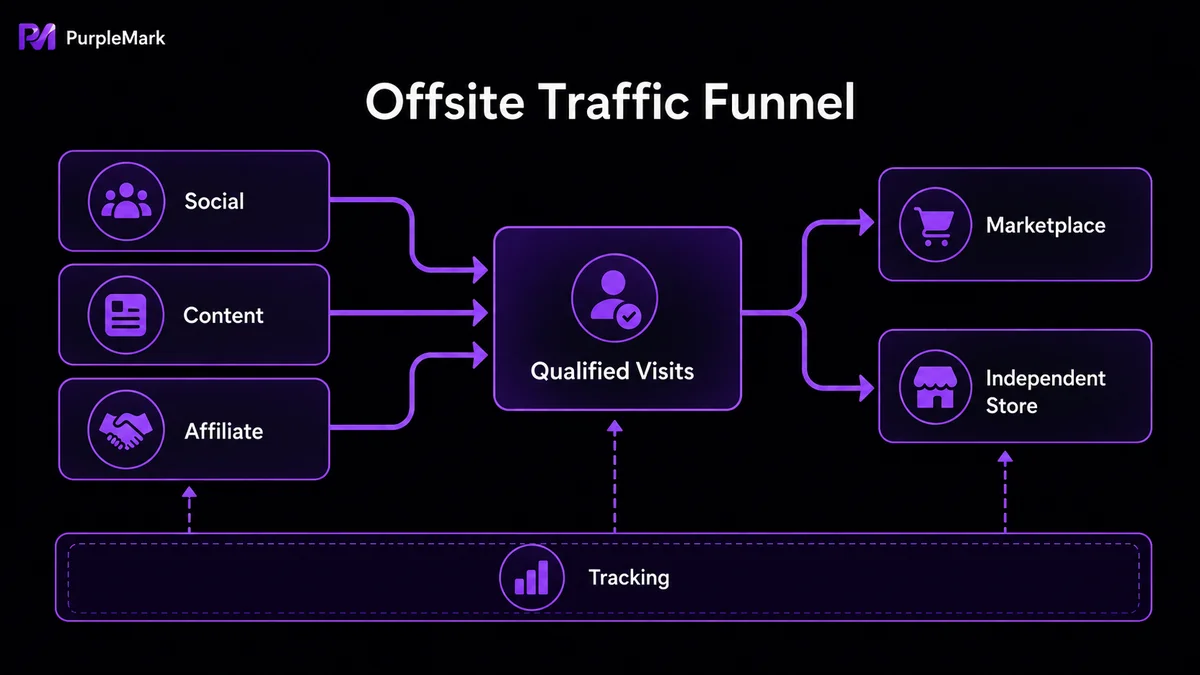
Channel 1: Build a useful-content account on social media
TikTok, Instagram, and Facebook are natural traffic pools. The key is to avoid hard selling and instead build an account that consistently shares useful information; soft product placement usually works better. For example, if you sell fitness equipment, you can regularly share “quick office workout tips” and naturally show how the product is used in the content.
Each platform also has its own rhythm: TikTok works well for short videos that explain the selling point in 30 seconds; YouTube is better for in-depth long-form reviews; and text-and-image content should keep the sales tone restrained and focus on genuinely solving problems.
Channel 2: Use content marketing to build a long-term traffic pool
Do not underestimate “writing content”—it is slow work that can keep bringing in free traffic over time. When writing blog posts or text-and-image content, build solutions around users’ problems and introduce products naturally. At the same time, optimize keywords so the content is easier for search engines to index and can continue contributing organic traffic to the store.
For video, TikTok is suitable for quick demonstrations such as “assemble a pet playpen in 30 seconds,” while YouTube is better for longer reviews such as “hands-on cat litter testing.” At the end, remember to guide users to click into the store and complete the conversion from content to sales.
Channel 3: Pay for results with affiliate marketing
Affiliate marketing is well suited to small and midsize sellers who want to control costs—you do not have to pay when no sale is generated. To get it running from zero, follow these steps:
- Choose an affiliate platform: Amazon can use Amazon Associates, eBay can use eBay Partner Network, and Shopify can build its own program with the Refersion app. Professional platforms such as Awin and CJ Affiliate also bring together many influencers and bloggers.
- Select partners precisely: Do not look only at follower counts; focus on whether their audience matches your customers. If you sell baby products, work with parenting bloggers. If you sell outdoor gear, contact outdoor review websites.
- Set commissions reasonably: Use lower rates for low-ticket products (for example, 5%–8%) and higher rates for high-ticket products (10%–15%). You can also use tiered commissions to encourage stronger promotion.
- Prepare enough promotional assets: Have high-resolution product images, short videos, and selling-point copy ready in advance so affiliates can create content more easily.
- Stay in communication: Keep regular contact with affiliates, follow up on promotion progress, and answer questions.
Do not forget: manage your multi-platform accounts well
When running offsite traffic campaigns, account problems are one of the biggest risks—especially when multiple platform accounts are logged in on the same device, which can easily be judged as associated and may even lead to account suspension. One common approach is to use an anti-detect browser to provide separate, isolated login environments for different accounts, so each account has its own “online identity” and the risk of platforms identifying them as linked is reduced.
These tools can manage not only e-commerce accounts such as Amazon and eBay, but also social media accounts on Facebook and Instagram as well as affiliate marketing accounts. Switching stores can be done with a click instead of repeatedly logging out and back in. Combined with window synchronization, RPA, or a local API, they can also support bulk posting, scheduling, and repetitive interactions, freeing people from mechanical tasks.
It is important to stress again: account isolation is for compliant operations and reducing accidental account linkage, not for bypassing platform rules. Consistently creating useful content and solid products is what allows offsite traffic to turn into long-term business.
Final thoughts
Whether offsite traffic works comes down to three things: value attraction (create useful content users actually need), precise partnerships (find the right affiliates and content channels), and tool-assisted efficiency (organize multiple accounts and repetitive operations). Put these three into practice, and traffic can gradually turn into orders while your store gains a better chance to accelerate in cross-border e-commerce.


