
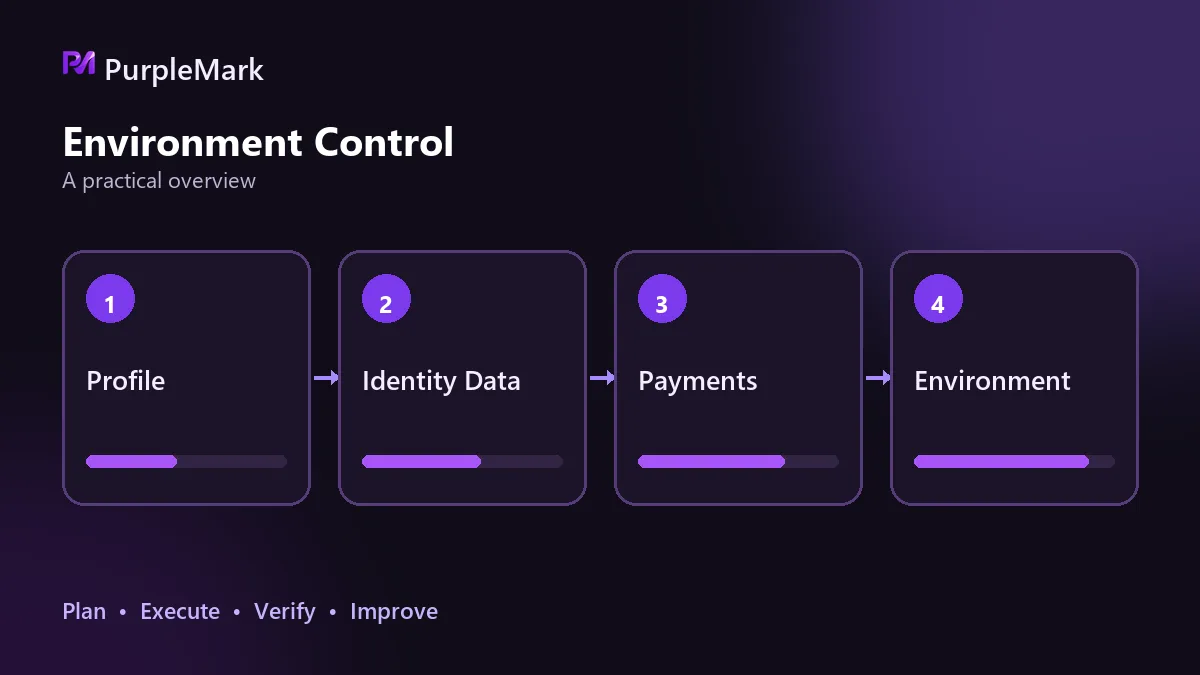
An identity that works reliably on overseas platforms can be viewed as four layers: accounts, profile data, payments, and devices/environment. What each layer controls—and how consistently the layers align—determines whether the setup can last or falls apart under scrutiny.
People working across borders often make the same mistake: build the product first, publish the content, and deal with everything else later.
The result is often predictable: the product is ready, but the account is suspended; orders arrive, but payments cannot be received; advertising is planned, but no payment method can be linked.
The first problem to solve when going global is infrastructure. Infrastructure is not a checklist of tools; it is better understood as several layers stacked together. For one identity to work normally on overseas platforms, four layers must all hold together: accounts, profile data, payments, and devices/environment.
Account layer: email and phone number are the entry points
An overseas phone number is one of the main entry points into the system. Account registration, verification codes, and payment-tool linking may all depend on it. The key is number retention: can it be kept active at low cost over the long term, and can it receive verification codes reliably? Once the number expires, every account tied to it may enter recovery at the same time.
Email belongs to the same layer. A general-purpose mailbox is usually enough early on. Once the business becomes more formal, it is advisable to use email on a custom domain for B2B communication and platform reviews, while keeping registration email separate from business email.
This layer also includes overseas accounts used to download apps, subscribe to tools, and test products. The principle is to keep them separate from everyday domestic accounts so region, payment methods, and usage habits do not become mixed and cause problems on both sides. After registration, build usage history gradually instead of starting with bulk actions.
Profile-data layer: identity and address determine who ultimately controls the account
The verified identity, address, and tax number linked to an account make up the profile-data layer. It may be invisible most of the time, but it determines who can establish ownership when a dispute occurs.
Registration data should be genuine and mutually consistent. A mismatch between identity information and account region is a common reason for later restrictions. If the business needs deeper financial services such as banking, brokerage, or credit cards, a tax number in the target country may be required. Keep in mind that obtaining one can create ongoing filing obligations rather than a one-time task, so the decision should be assessed against the actual business and discussed with qualified professionals.
The profile-data layer has another easily overlooked role: it is the reference point used to verify the other three layers. Payment onboarding, account appeals, and regional consistency in the environment layer all eventually trace back to this identity information.
Payment layer: money must be able to come in and go out
The payment layer has several parts.
Overseas bank cards can act as a bridge for funds, including platform settlements, service subscriptions, and cross-border purchases. As account-opening policies become stricter, an early-stage business can first validate the flow through compliant cross-border payment platforms before considering a bank account. Cross-border payment tools handle transfers and treasury management; for individuals and small teams, the key factors are currency coverage, settlement speed, and fee structure.
Receiving payments is central to monetization. Evaluate three things: coverage of supported payment methods, settlement cycles and withdrawal thresholds, and the identity and regional information required for registration. The essential requirement is consistency with the profile-data layer. A mismatch between the payment account's identity and account region is a common reason for later freezes.
Funds are usually returned through an overseas account plus compliant cross-border payment channels before reaching the home market. Remember three points: annual quota requirements, complete transaction and compliance records, and avoiding frequent large transfers that may trigger reviews.
Device and environment layer: IP, time zone, and language belong together
This is the layer whose importance has increased fastest in the past two years. Platform risk controls have moved beyond asking whether an IP is clean and now focus more on device fingerprints, behavior patterns, and linkage detection.
A common setup uses complementary web and mobile environments. On the web, each account gets its own browser environment, with fingerprints, Cookies, and local storage isolated from one another and a network exit that matches the account region. PurpleMark provides environment isolation and centralized management at this layer. On mobile, cloud devices or similar methods can be used when isolation is needed, with the same requirement that the region stays consistent with the web side.
The principle is simple: keep the whole set consistent. IP region, time zone, and language must match; any inconsistency can become an anomaly signal.
A problem in one layer can affect the others
The four layers are not independent. They validate one another.
If a phone number at the account layer expires, recovery pressure shifts to the profile-data layer, and false or inconsistent profile data can make recovery impossible. If the device and environment layer shows a regional conflict, the platform may follow that signal to verify the profile and payment layers, connecting issues that originally appeared separate. When the payment layer is frozen, the cause is often not the funds themselves but a mismatch with profile data. Conversely, when the profile-data layer is solid, small fluctuations in the other three layers are more likely to be treated as normal.
Beyond identity, you also need operating assets
Domain registration, DNS and CDN, front-end deployment, and database hosting are the foundations on which the business runs. For small teams, the practical principle is to prefer managed services, minimize self-maintenance, and keep attention on the business itself. A social-media presence should not cover every platform from day one: content-led projects can start with long-form content and video, while product-led projects can first focus on developer and business communities, going deep on one platform before expanding laterally.
These assets are not identity itself, but their registration details still need to map back to the four layers above; otherwise they can create identity problems in return.
Recommended order of setup
The value of infrastructure is not merely having it; the value is having the pieces match. Phone number, profile data, payments, and environment all validate one another. Any contradiction between one part and the rest will eventually surface.
A sensible order is therefore to determine the business location and target market first, then configure identity, profile data, payments, and network routes as a consistent regional set.
This article is a summary of practical experience only. For financial or tax-related actions, comply with the laws and regulations of China and the relevant target country or region and consult qualified professionals. Nothing here constitutes financial or legal advice.


