
Want smoother checkout and easier payment collection for your Shopify store? Shopify Payments is a common choice. This guide explains why to enable it, how to set it up step by step, and how entity eligibility, product compliance, low chargeback rates, and other practices can help prevent account issues.
Shopify Payments is Shopify’s built-in payment system. It offers convenient integration, a smooth checkout experience, and a transparent fee structure, making it a common payment choice for independent-store sellers. This guide walks you through the setup process and explains the details that can cause problems if overlooked.
Why enable Shopify Payments?
- Better suited to overseas customer habits: Built on a Stripe-based payment solution, it supports most credit cards as well as Shop Pay, Apple Pay, Google Pay, Facebook Pay, and more. Compared with relying only on PayPal, it covers more overseas shoppers who prefer credit cards;
- Improve conversion: A smooth native checkout experience can increase order conversion rates;
- Convenient integration: It connects seamlessly with the Shopify admin, allowing centralized management of orders, refunds, and reconciliation.
Shopify Payments setup tutorial
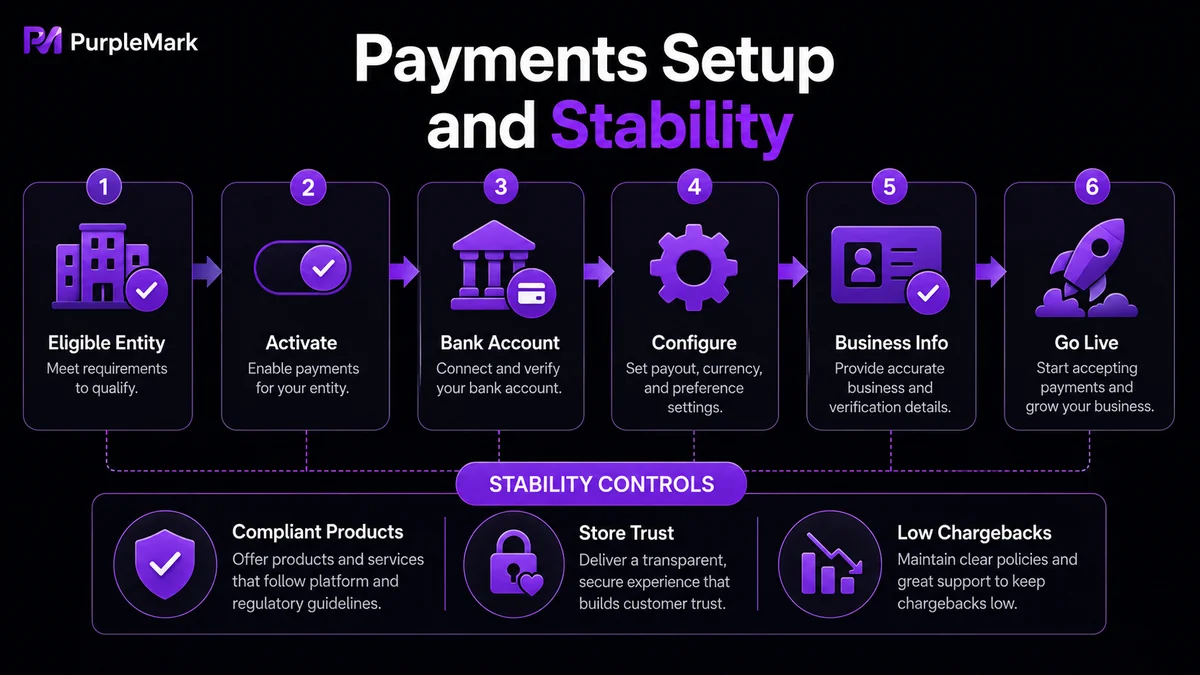
1. Activate your Shopify Payments account Log in to your Shopify admin → “Settings” → “Payments” → choose a payment provider → select “Shopify Payments,” then follow the prompts to enter your business name, address, business type, and other details to complete activation.
2. Connect a bank account To receive payouts, connect your Shopify Payments account to your bank account. In the settings, choose “Connect payment provider account” and follow the instructions to provide your bank account information.
3. Configure payment settings In the “Payments” section, configure payment methods, authorization, refund policies, and other settings according to your business needs.
4. Complete merchant information Enter your business name, address, contact information, and other details accurately so your account information is genuine and consistent.
Key considerations
1. Entity requirements Shopify Payments currently does not support applications by entities in mainland China, so you need an eligible overseas entity to apply. When deciding where to register a company, consider your business model, registration and maintenance costs, and tax circumstances, and use legitimate channels. Do not use a fake entity merely for convenience. First check Shopify’s official information to confirm whether your entity and region are supported.
2. Products must be legitimate Products sold on the site should be lawful and legitimate. Avoid counterfeit goods, imitation brands, adult products, and other prohibited categories that may trigger risk controls.
3. Improve website trust Providing detailed terms of service, return and refund policies, and store contact information can help with review and increase buyer confidence.
How can you keep the account more stable?
- Control the chargeback rate: Handle orders and customer service well and keep the chargeback rate low, especially for early orders. It is generally recommended to keep chargebacks at a low level, such as below 1%;
- Product compliance: Do not sell imitation brands, infringing products, or prohibited categories;
- Clean registration information: Use genuine identity information and a device environment without a history of violations.
If you operate multiple Shopify stores at the same time, consider using PurpleMark to create separate browser environments for different stores, isolating admin logins, payment configurations, and Cookies to avoid misjudgments caused by mixed environments. With RPA, you can also automate repetitive tasks such as price changes, product listings, and order checks to reduce manual work. Operate each store with a genuine, compliant merchant entity. The security of Shopify Payments accounts ultimately depends on compliant operations, not on “multi-account tricks.”
Summary
Shopify Payments can make payment collection smoother for an independent store, but activation is only the first step. Overseas entity eligibility, product compliance, a low chargeback rate, and clean registration information together determine whether the account can remain stable over the long term. Following official rules and operating compliantly with a genuine entity is the most reliable approach.


