
Tinder clearly allows one account per person and closely monitors linked accounts. If your account is banned, do not rush to rebuild it through workarounds. First identify the likely cause, use the official appeal center, and learn how to avoid being banned again.
Tinder is one of the world’s most widely used dating platforms, but many users have experienced account bans. Start with one important rule: Tinder officially states that each user may have only one account and strictly prohibits multiple accounts from being used on the same device—in serious cases, the device itself may also be banned. So when an account runs into trouble, the right approach is to identify the cause and use the official appeal process, rather than rushing to “rebuild” the account through a workaround.
Why does Tinder ban accounts?
Tinder bans generally come from two categories: user violations and abnormal technical environments.
1. Violating the Terms of Use or Community Guidelines
- Prohibited content: posting sexual, violent, advertising, or politically sensitive content, or using fake photos or false identity information;
- Harassment: repeatedly sending duplicate messages, insulting others, or abusing the reporting feature;
- Commercial use: promoting products, services, or third-party links through the account.
Tinder’s AI risk-control systems can scan content in real time. Sensitive content or abnormal behavior may trigger an automatic ban.
2. Device and IP association Tinder closely monitors “multiple accounts on one device.” If your device previously logged in to another account and you then use it to register a new one, it may easily trigger an association warning. The platform may use device fingerprints (hardware model, operating system, browser cache, and similar signals) and IP addresses to track account relationships. Logging multiple accounts into the same device, or having multiple accounts share the same IP, violates the Terms of Service and can cause all related accounts to be banned. In particular, once a device has been flagged, creating another account—even with a different IP—may still lead to another ban because of information left on the device.
3. Duplicate or abnormal registration information Using a name, photos, or linked social-account history that closely resembles someone else’s, or using highly uniform information during bulk registration (for example, the same birthday or location), can make the account look fake. In addition, an unstable network environment—such as frequently changing IP addresses or using IPs from restricted regions—can mark an account as “high risk” and increase the chance of a ban.
How do you use the official appeal process after a ban?
Not every ban means you actually violated the rules—some bans can result from false positives or technical errors, such as malicious reports from other users or a system temporarily failing to distinguish a genuine account from an impersonation account. These cases can be appealed, although the outcome depends on Tinder’s review process.
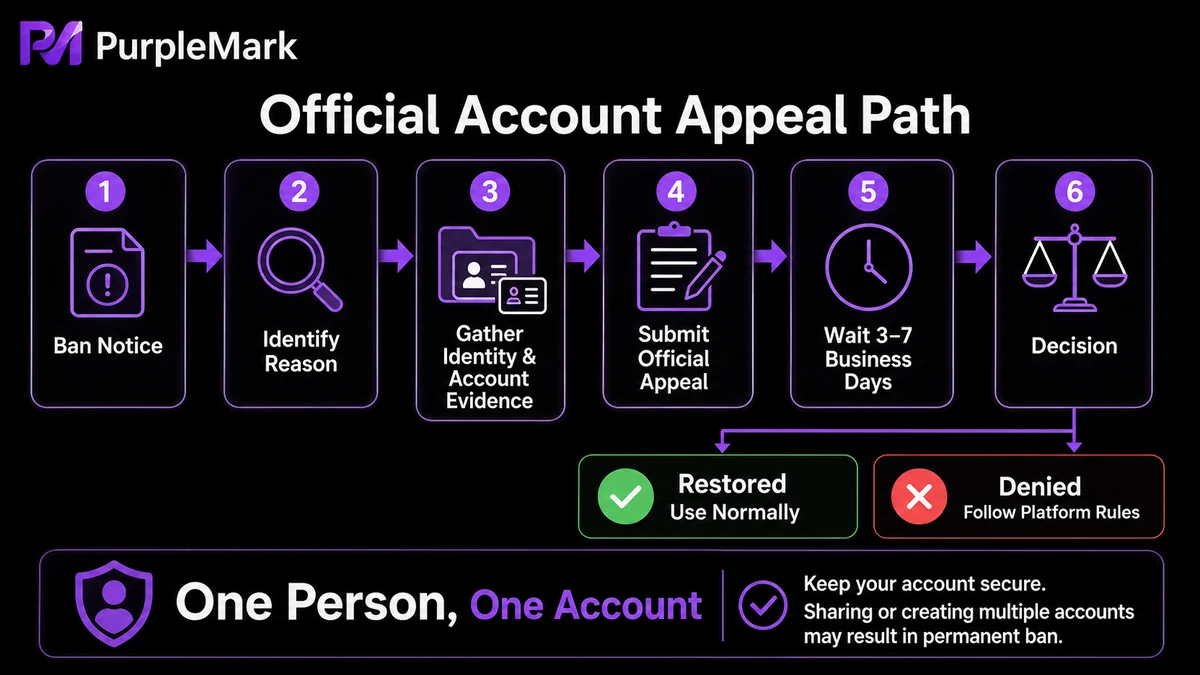
If you want to appeal, Tinder provides an official appeal center. The general process is:
- Visit Tinder’s official appeal center and complete the appeal form;
- Select “Can’t log in → Account disabled”;
- Enter the relevant information and explain in detail why you believe the account should not have been banned. If another user simply misunderstood you, explain that truthfully. If you do not know the reason, ask Tinder to review the account again;
- Submit the appeal and wait for a response, usually 3–7 business days. If the appeal succeeds, you will receive an email confirming the ban has been lifted; if it fails, the email will explain the reason.
When appealing, provide materials that can verify your identity and how the account was used, explain the purpose of the account, and state that you will comply with the rules going forward. A sincere, truthful, and evidence-based appeal is far more useful than an emotional explanation.
How can you avoid being banned again?
If your appeal fails and you genuinely need a new account, remember: Tinder allows one account per person. Do not try to “work around” the rule through bulk registration or fake identities. To reduce the risk of another ban at the source, focus on the following points:
1. Follow the platform rules strictly
- Keep identity information consistent: name, age, gender, and other details should match reality, and do not use someone else’s photos. If you need to use a nickname, consider noting it in your bio;
- Link genuine social accounts (such as Instagram or Spotify) and keep their content consistent with your Tinder profile. After linking, avoid frequently unlinking or replacing them;
- Avoid high-risk terms such as “transfer money” or “pay” in chats, and use natural alternative wording where appropriate;
- Check images before posting and avoid brand logos, QR codes, contact details, and other elements that may be interpreted as marketing.
2. Maintain genuine, moderate usage habits Do not immediately start swiping right in large volumes, sending mass messages, or repeatedly logging in and out on a new account. Let the account develop naturally: complete the profile first, then gradually increase activity. Long periods of inactivity may also trigger platform cleanup mechanisms, so maintain moderate login and interaction levels without “over-operating.”
3. One real person or entity should correspond to one account If you need multiple accounts, first ask whether they represent genuinely different people or independent entities. If one person simply wants several accounts, that already violates Tinder’s policy, and isolating the environments does not change the fact that it is a violation. Legitimate needs to manage accounts for separate subjects are more common in institutional scenarios that require compliant separation. In those cases, it is more appropriate to use independent login environments and network exits rather than having different subjects share the same browser on the same device.
To be clear, this article does not encourage or recommend spoofing device parameters, disguising identities, or otherwise bypassing Tinder bans or its one-account-per-person policy. Those methods violate platform rules and are not sustainable. If an account was banned by mistake, the official appeal process is the safest route.
Frequently Asked Questions
Why was my Tinder account banned? Common reasons include prohibited content (sexual content, advertising, or harassment), multiple accounts using the same device or IP and triggering association controls, or high-frequency activity in a short period. Tinder uses AI to detect device fingerprints and IP signals; if it determines there is abuse or identity fraud, an account may be banned even if the user did not see a specific violation notice.
How can I appeal a Tinder ban? First review the ban email to identify the type of violation, and prepare identity documents plus proof of account ownership such as the linked phone number or email. Submit an appeal form through Tinder’s website or in the App, explain the account’s purpose, promise future compliance, and wait for the platform’s review, which usually takes 3–7 business days.
Can I register a new account after Tinder bans my device? If your device fingerprint has indeed been flagged, registering directly may result in another association-based ban. First determine whether this is a mistaken ban that should be appealed or whether you genuinely need to start over as a new, real person or independent entity. In the former case, appeal; in the latter, use truthful, independent identity information and an appropriate environment rather than spoofing parameters to evade a blacklist.
Is a Tinder account ban permanent? Not always. Bans caused by minor violations or false positives may be reversed after a successful official appeal. Serious abuse or repeated violations may result in a permanent ban. The key is to appeal truthfully and use the platform compliantly afterward.


