
New accounts get almost no distribution for original posts, while replies are the fastest route to visibility. This article explains why replies carry more ranking weight, how to split effort between posting and replying, how to choose topics and timing, and what gets flagged as spam.
A newly registered X account publishes an original post and, hours later, it may have only single-digit impressions. It is not that the content is bad: there is no engagement history to base a decision on, so the system will not push it out. The only place where you can get visibility immediately is one — under someone else's post.
Why replies get recommended more easily than posts
In 2023, X published part of the ranking code of its recommendation system. In that published logic, engagement is the core signal, and engagement weights are not equal — replies clearly drive distribution more than likes. How much engagement a post gets in the first few tens of minutes after publishing basically determines how many people it will be shown to afterwards.
Apply this rule to small accounts and the conclusion is clear. Every bit of engagement on an original post depends on other people seeing you first, whereas replies are naturally placed where the traffic is: when you leave a high-quality reply under a big account's popular post, the people who see it are not only the author but also that author's followers. The engagement a reply generates is recorded in your engagement history, and your account weight shifts accordingly.
This is not exploiting a loophole; it is a natural consequence of how ranking works. The platform is also happy to see comments that carry information.
How to split your effort
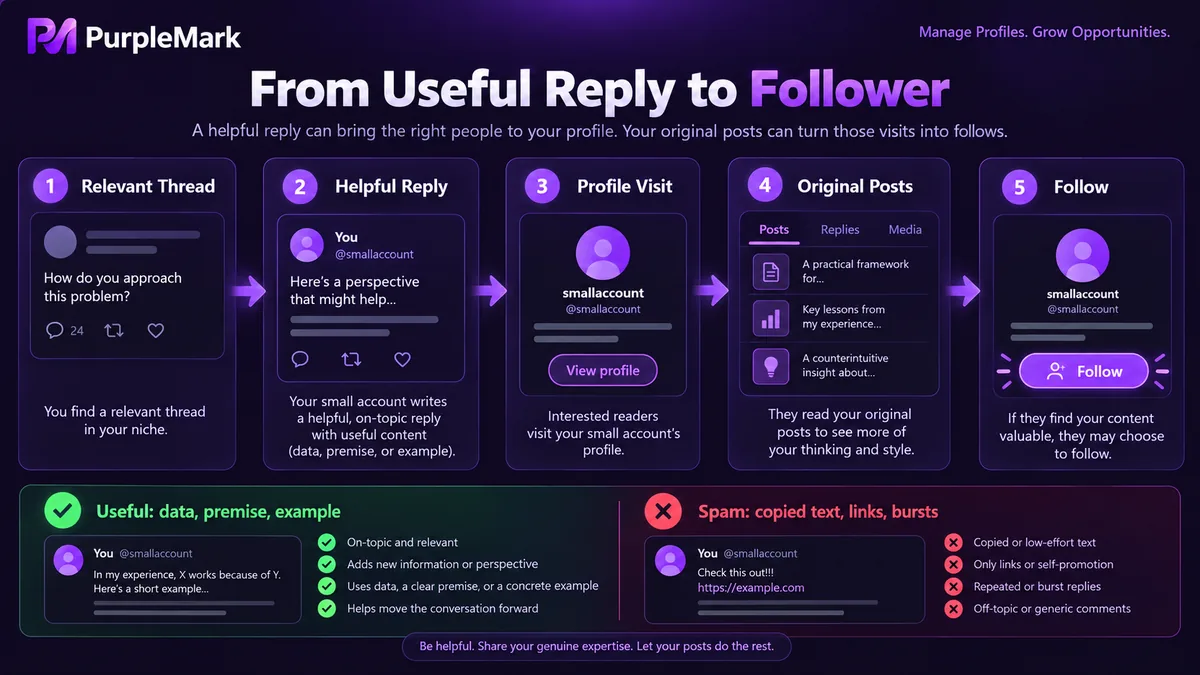
The common approach is to spend most of your time on replies and keep original posts at a steady low frequency — a few per week, for example — so that your profile has something to show.
Never posting original content is a trap. People drawn in by a reply will click through to your profile, see a blank page or a post from six months ago, and leave. Replies bring new people in; the profile keeps them. You need both.
Do not pile on reply volume either. Between dozens of homogeneous replies a day and ten informative replies a day, the former carries far more risk than reward. Quality here is quantifiable: does anyone continue the conversation under your reply, does anyone like it, does the author reply to you.
How to choose topics and posts
First decide which group of people you want to attract, then go reply where that group gathers. If you work in cross-border trade, reply in e-commerce and payments threads; if you work in development, reply in toolchain threads — rather than jumping in just because something is trending. Visibility from a popular but irrelevant post will not convert into follows.
The target account matters too. On very large accounts the reply section holds hundreds of comments and yours will be buried; very small accounts have no distribution. Accounts with a decent follower count, a comment section that is not yet overwhelmed, and an author who actually reads replies offer the best value.
On timing, the first half hour after a post goes live is the golden window. Turn on notifications and reply as soon as you see a relevant post — do not wait to batch it in the evening, by then the ranking has already settled.
Make your reply land on something specific. Add a data point, point out an overlooked premise, offer a counterexample — all of these are more useful than agreement. If you only express approval, readers have no reason to click through to your profile.
What gets flagged as spam
The platform's spam detection focuses mainly on two things: repetition and intent. Copying the same sentence under different posts, stuffing many replies with links, sending structurally identical replies to dozens of accounts in a short time, taking part in follow-for-follow or like-for-like groups — all of these fall into that category.
Consequences come in tiers: mild ones include your reply being collapsed, limited reach, or your reply function being restricted for the day; serious ones mean the account is judged a spam account, with features frozen or even suspended. There is a simple test for whether you have crossed the line: delete the reply and ask whether the original thread loses anything. If nothing is lost, it was superfluous to begin with.
Be especially restrained with external links. In the public ranking logic, posts with external links are downranked, and the same applies to links stuffed into replies. When you must include a link, your profile or a later post is a better place for it.
Where the "reply guy" label comes from
"reply guy" began as a mocking term in English-speaking communities for accounts that constantly chime in under other people's posts: commenting on any topic, giving advice to strangers, correcting what others say, or simply doing it to be seen. The label was later widely applied to the pointless replies women users receive, and its mocking tone cemented the negative meaning.
The dislike is not hard to understand. Such replies add nothing; they borrow someone else's traffic to show off and they drag discussions off track, leaving the author and readers to clean up. Some are unfairly caught too: accounts that carefully add information or offer a different view sometimes get tarred with the word. The difference lies in the starting point — making the original post more complete, or making yourself more visible.
Reply-driven growth is a valid path for small accounts, provided the replies themselves hold up. In the long run, accounts that last are still built on the real substance on their profile.


