
Once you qualify for Twitch Affiliate, the real reading is the agreement. Subscription and Bits revenue shares are there, and so are the exclusivity clause, advertising obligations, content rules and payout thresholds. The article separates earnings from constraints and explains who should sign early.
After reaching Twitch Affiliate status, the first thing to deal with is not how money comes in but an agreement. Subscription revenue shares, Bits and advertising income all sit inside that agreement's framework, and so do the exclusivity clause, content rules and payout thresholds. Benefits and costs are two sides of the same document.
Requirements and activation process
The Affiliate requirements are several publicly listed metrics that must be met at the same time: follower count, total streaming time, number of distinct streaming days, and average concurrent viewers. The exact figures follow the official help page; once you meet them, an activation entry appears in the creator dashboard, and in some cases you also get an on-site notification.
The process is not hard, but no step can be skipped: enable two-factor authentication, fill in tax information, link a payout method, sign the affiliate agreement. Miss any one of them and no money is paid out. Earnings must accumulate to the platform's stated minimum payout threshold before withdrawal; below that, the balance simply sits on the books. For a new streamer, saving up to that first payout often takes longer than signing the contract itself.
What you actually get
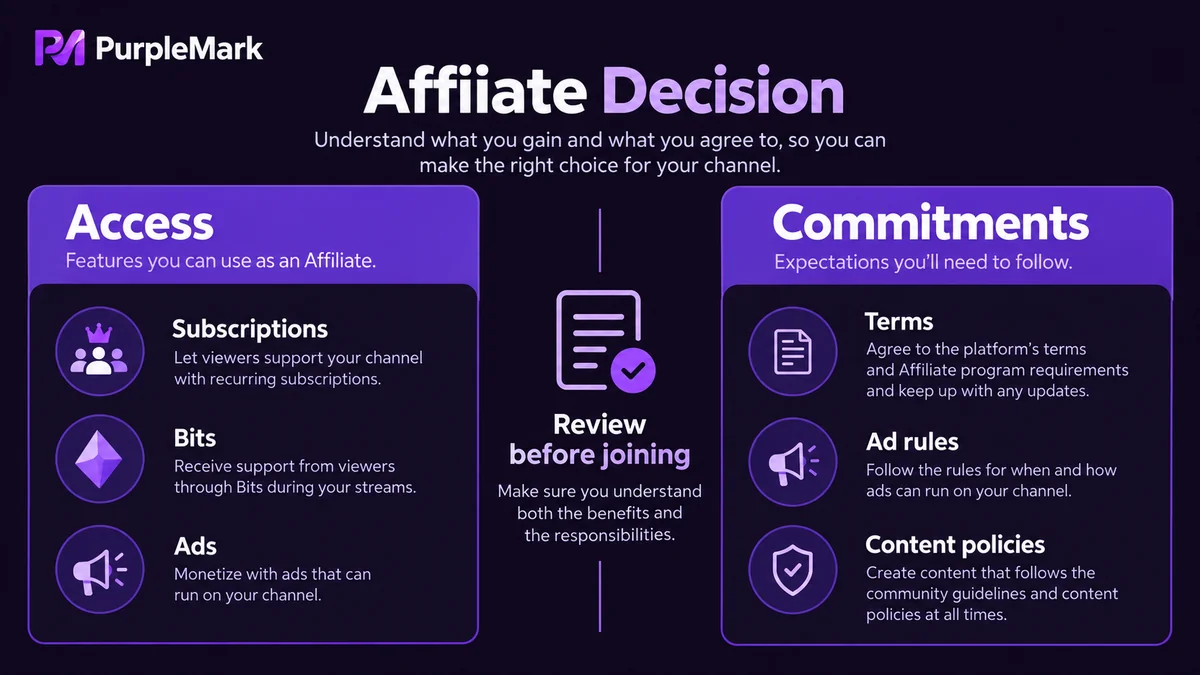
The most direct item is the subscription revenue share. Viewers pay monthly for a subscription or use the platform's own subscription perks, and the streamer receives a proportional cut — for most small and mid-sized streamers this is the steadiest cash flow. Bits are the other channel: viewers buy them and send them as tips, and the streamer converts them into income at a fixed rate. Both rest on the same thing: viewers willing to pay for this channel consistently.
Ad revenue sharing looks more passive, but in practice it usually pays less than subscriptions and is strongly tied to viewership scale. The real value is elsewhere — only with Affiliate status are you allowed to offer subscriptions, turn on channel points and use the official interaction tools, and only then are you in a position to discuss off-platform partnerships. For brands, it is a signal that the platform already recognizes you as a creator, which removes a lot of self-verification steps.
Cost one: the exclusivity clause
The part of the agreement to read word by word is exclusivity. The core point: content streamed on Twitch cannot appear on other platforms at the same time within a certain window; simulcasting is essentially ruled out, and recorded content also has time-window limits. The rules are not entirely the same for different content types, so read the specific terms carefully before signing.
This constraint directly affects distribution strategy. If your content relies on running across multiple platforms at once and cross-promoting between them, Affiliate blocks that path; conversely, if Twitch is already your main stage, the cost of this constraint is close to zero.
Cost two: advertising obligations and content rules
Affiliates are required to run ads as the platform arranges. Ad breaks interrupt the flow of a stream and push some viewers away — that is a real trade-off. Whether they can be turned off and to what degree they can be adjusted depends on the rules in effect at the time; it is not a one-sided decision by the streamer.
Content rules are also stricter. Community guidelines, copyright requirements for music and film material, and the process after a report only affected your mood before you became an Affiliate; afterwards they affect your income. The loss from a single ban is not just that period's revenue but also the continuity of subscriptions — viewers renew for stable updates, and one interruption is hard to recover from.
When joining early makes sense
Your content runs only or overwhelmingly on Twitch, your viewers are concentrated there, and the exclusivity clause has almost no effect on you. You already have a stable streaming schedule that can absorb the churn caused by ad breaks. You want to test how many people are willing to pay for this channel — subscriptions and Bits are the most direct tool for that, more accurate than any survey. You need interaction mechanics like channel points to retain long-time viewers, and you need identity markers like subscription badges and emotes to build a sense of belonging.
Another case is planning a long-term brand and being willing to trade two or three years for a stable core audience. In that situation, signing early and building subscription numbers early is worth more than repeatedly weighing the decision.
When to hold off on signing
The content strategy itself is multi-platform simulcasting, relying on traffic from different platforms to feed each other — signing is then like cutting off one of your own legs. If your material leans heavily on music or video from outside the platform, you are already on the edge copyright-wise, and once an income structure is built, the cost of a complaint gets amplified. If your streaming times are irregular and you can only squeeze out two or three hours a week, the drain from ad breaks will not buy back subscription retention.
There is also the case of wanting to park the account and see how it goes, without having figured out what you want to stream. In that state, you should first get your content running smoothly as a creator, and only then take on income-related terms. An agreement is easy to sign; the room to exit and renegotiate afterwards is very limited.


