
An AROC feed is a continuously updated feed of search ad campaigns, and its returns depend on traffic quality and how well queries match. The article explains how it differs from a traditional static feed, the complete pipeline from buying traffic to monetization, and the entry requirements and compliance red lines that practitioners commonly mention.
Search arbitrage sounds like a financial term, but what it actually does is buy and sell traffic: you buy clicks at a lower cost, send users to a page that can capture search intent, and earn the spread from the click revenue of search ads. The AROC feed is the link in this chain that determines the ceiling on revenue.
How it differs from a traditional feed
A traditional feed is closer to a static list: links and ranking are produced by fixed rules, and the update cycle is measured in days or even weeks. You run whatever you are given, and the room for optimization is mainly on the traffic side.
An AROC feed emphasizes real time. Based on click-value feedback from the current period, it dynamically adjusts which queries go to which links and how they are ranked, pushing traffic toward whatever earns more at that moment. The upside is that the same traffic can be squeezed for more revenue; the cost is that volatility is amplified along with it: a combination that runs well in the morning may drop off in the evening.
Optimizing links by RPM is the core of this mechanism, but RPM is an outcome metric, not a cause. It depends on what incoming users want to look up, whether the page can capture that intent, and how well the ads themselves match.
What the complete pipeline looks like
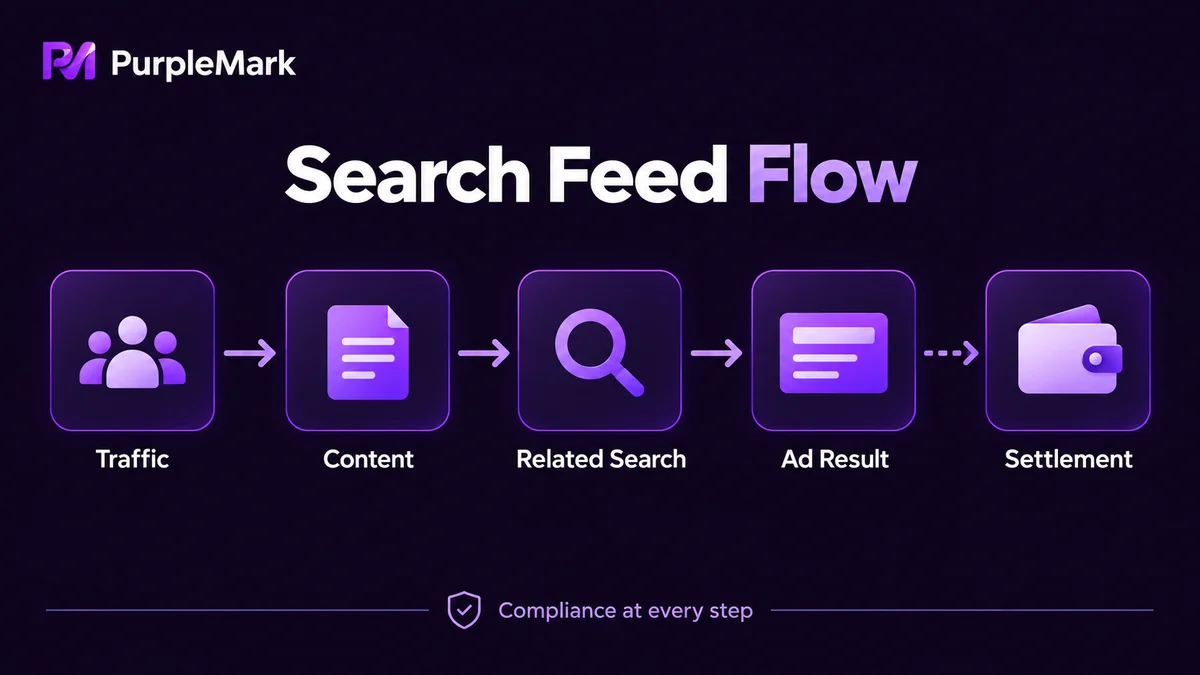
The first stage is buying traffic, usually from social feeds, native ads, short-form video, or search ads, and different traffic sources bring very different levels of user intent.
The second stage is the content page. The job of this page is not to sell something but to convince users that the answer can be found here and that they should type their question into the search box on the page. The topic of the content page and the traffic source must match; if someone clicks through from a pet video and lands on a car insurance page, their first reaction is to close it.
The third stage is the related searches unit: after users click, they reach a results page, and the ad mix supplied by the feed is settled there. The fourth stage is where the money comes back.
If any one of these four stages is out of alignment, the whole chain runs for nothing. That is why the barrier in this business is not technology but an understanding of traffic sources and user intent.
Why entry approval filters people out
Feed providers usually do not accept just anyone. The things they commonly investigate include company or individual qualifications, traffic source channels, historical campaign data, and the compliance status of content pages. The threshold widely cited in the industry is that you need presentable past case studies and a relatively stable traffic volume, because these directly affect settlement and complaint risk.
For newcomers this means a circular problem: without traffic you cannot produce case studies, and without case studies you cannot get a feed. Most people get stuck here rather than on campaign skills. If you want to enter this direction, the more realistic approach is to first build stable conversion data in traffic channels you control yourself, raise the quality of your content pages, and then talk about partnerships.
Compliance is not an add-on
Search arbitrage itself is not illegal, but its common methods of operation easily cross red lines. Disguising a landing page as an official entry point, using headlines unrelated to the results to induce clicks, and putting only a search box on a page with no substantial content all count as misleading advertising or low-quality content under ad network policies.
The consequences are equally direct: the feed provider terminates the partnership and withholds unsettled revenue, the upstream ad account gets banned, and other parties you have worked with will find the record. Ad networks already have low tolerance for arbitrage traffic, so a single violation basically means this path is closed.
Content quality is another line. Scraped and stitched-together pages, blank pages with almost no body text, and layouts that show ads only on mobile are all judged as non-compliant. Anyone in this direction who plans to stay long term has to maintain the content page as a real product, not a one-time springboard.
Understand the mechanics, then decide whether to do it
What makes the AROC feed worth understanding is that it lays out the relationship between traffic, content, and advertising very clearly: revenue comes from user intent and ad matching, not from clever tricks. Once you see this, it becomes easier to judge whether this direction suits you: whether you have stable traffic from transparent sources, and whether you can keep producing compliant content pages. These two things determine everything that follows.


