
Overseas live commerce is no longer new, yet many sellers get stuck at the first decision: stream themselves or work with creators, and which platform to try. This article clarifies the two approaches, where hosts come from, and a practical route to start.
Short video and live streaming have reshaped e-commerce traffic in recent years. Overseas markets are the same: more consumers accept buying while watching a live stream, making this a channel cross-border e-commerce deserves to take seriously.
For many sellers, however, the difficulty is not whether to do it, but the first step: stream on your own or use creators? What if you have no host? Which platform should you test first?
This article first sorts out the models, then gives a path to put them into practice.
Choose a model first: self-streaming or creator selling?
There are essentially two routes for overseas live commerce. Work out which suits you.
Merchant self-streaming
You or your employees run an account and sell in your own live room.
- Advantages: You know the products and brand best, can build up your own live room and followers over time, and retain the margin.
- Challenges: You need people who can host and content that can be prepared; traffic and conversion need time to develop when starting an account.
- Language: For English-speaking markets, you need operators who can speak English. Teams uncomfortable with foreign languages can consider outsourcing to professional foreign-language hosts.
Creator-led selling
Work with creators (streamers/KOLs) who have traffic. Common arrangements include commission-only, a placement fee plus commission, and dedicated sessions.
- Advantages: Use a creator's followers and trust to gain volume quickly, especially before you have a live-streaming foundation.
- Challenges: You pay commission or a placement fee; choosing the wrong creator may mean spending heavily without sales.
Advice for beginners: use creator selling to validate product-market demand quickly, then use self-streaming to build your own traffic pool. They are not an either-or choice; they work in sequence.
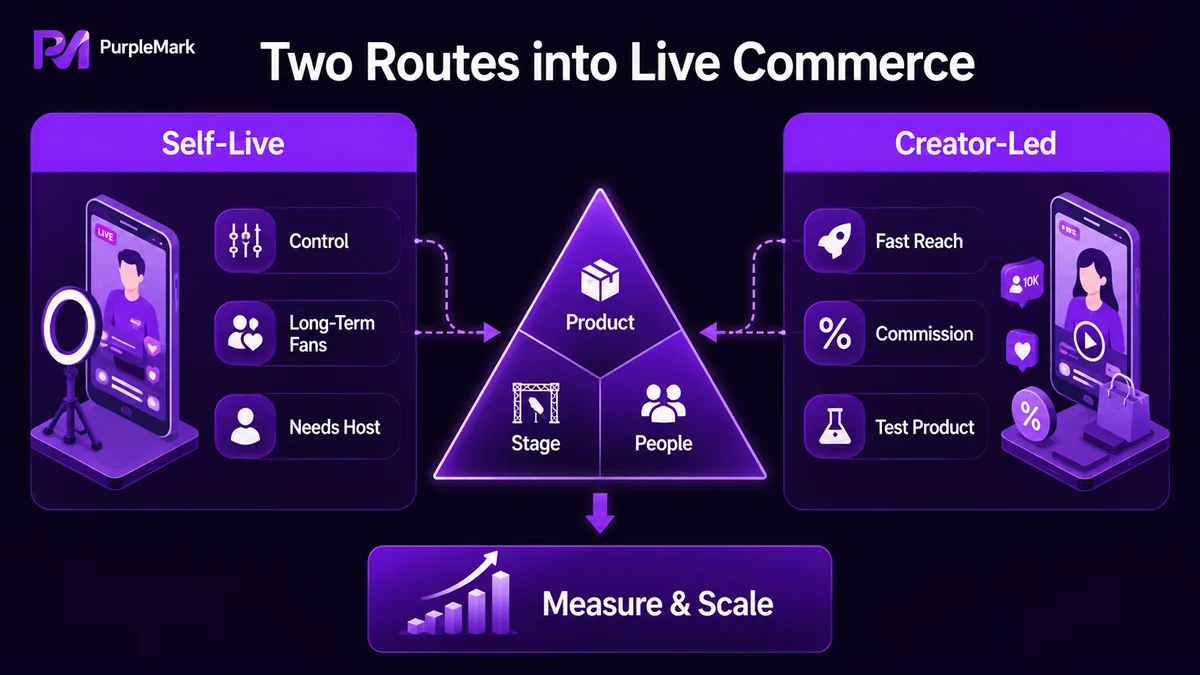
Live commerce is still about products, the venue, and people
Whether you stream yourself or use creators, three things are unavoidable:
- Products: What you sell should suit buying while watching—something explainable, visually compelling, and attractively priced. Do not offer too many SKUs; focusing on winners converts more easily.
- Venue: The live room must enable a direct transaction. Overseas live commerce usually uses a shopping cart to take viewers to a product page, so first make payment, logistics, and after-sales work end to end.
- People: Who hosts and how do you keep viewers? Beyond the host, you need scripts, pacing, and interaction design. Dead air is a major enemy of conversion.
How do you start on specific platforms?
Platforms differ substantially in streaming requirements and methods. Use these directions as reference:
- TikTok Live: A content-platform representative, suitable for streaming after building followers through short videos; you can run your own account and shop or cooperate with creators.
- Shopee Live / Lazada Live: Southeast Asian platforms that provide public-traffic support to live rooms. They suit sellers already serving Southeast Asia, and some regions support Chinese- or English-language streams.
- AliExpress Live: An established marketplace platform for taking live commerce overseas. Merchants can build a live room, create creator-streaming tasks, or work with influencers.
- Amazon Live: For professional sellers; its live shopping cart goes directly to product pages. It suits sellers with Amazon stores who want live streams to add exposure.
- YouTube Live: Suitable for brands with a stable follower base and content capability. Streams can accumulate lasting content, with conversion oriented more toward brand building.
Note: Platform entry points, markets, and eligibility requirements for live streaming and selling change dynamically. Check each platform's current official policy before acting.
A realistic starting route
For cross-border sellers, a prudent sequence is:
- Clarify the product first: Choose a category suited to live streaming and prepare its talking points and traffic hooks.
- Test one session at low cost: Start with one creator collaboration or self-stream on a platform whose audience you know and whose threshold is manageable. Do not cover every platform immediately.
- Read data, then scale: After a session, focus on views, retention, clicks, and transactions. Find the issues and iterate rather than blindly adding sessions.
When live accounts multiply, do not forget environment management
Live-commerce operators often run stores or accounts on several platforms at once—for different markets, creator partnerships, or categories. At that point, what determines whether you can operate steadily is often not the sales pitch but the account environment.
If accounts from several platforms are repeatedly signed in and out on the same computer and browser, browser fingerprints, cookies, and login sessions can cross over. Platforms may treat that as association, causing reduced reach or, in serious cases, linked enforcement—especially in live streaming, where account activity and reputation are sensitive.
If you sell through live streams across platforms and manage multiple accounts, consider PurpleMark browser. It creates an independent browser fingerprint, cookies, and local-storage environment for each account, separating accounts, proxies, and operating spaces by account so you can independently manage multiple live accounts and stores on one device. With account groups, work across platforms and markets becomes clearer and more controllable.
Reminder: Follow every platform's policies and keep streams and sales compliant. Account-environment isolation is for normal operations and clean account data, not for bypassing platform rules at scale.
Conclusion
The opportunity in overseas live commerce lies in the fact that the combination of people, products, and venue has not yet solidified; those who establish a working model first gain an advantage. Do not stay stuck on whether to do it. Decide whether to stream yourself or use creators, what to sell, and which platform to test, then validate with one low-cost session. Once the direction is right, the rest is continual iteration.


