
Once an environment management tool is in use, accounts, configurations, and team habits become tied to it, making switching far more costly than the difference in software fees. The real question in vendor selection is whether the provider can support you for the next two or three years.
Buying software and buying infrastructure require different evaluation criteria.
If a tool is awkward to use, you can simply replace it. But once an environment management system is running, your account inventory, environment configurations, and team operating habits all become built around it. When you eventually need to switch, the migration workload and business disruption during the transition often cost far more than the difference in software fees.
So the real question in vendor selection is not how many features the product has today, but whether the provider can stay with you for the next two or three years. The six signals below can all be checked independently, without any special cooperation from the vendor.
Update and maintenance cadence
Browser engines keep moving forward, and platform risk controls keep changing. Once an engine version falls behind, a single platform upgrade can make an entire batch of environments stop working.
A practical way to check is to compare the engine version the product uses with current mainstream browser versions; review its changelog to see whether entries are mostly vague wording or clearly explain what changed; and observe how quickly it follows up after platforms adjust their risk controls.
If there have been no substantive update records in the past six months, declining investment is usually hard to hide.
Whether the technology is explained clearly
Environment management inevitably comes down to how isolation is achieved. Products that cannot explain the principle clearly usually cannot implement it thoroughly either.
Two checks are enough: whether there is public technical documentation rather than only marketing copy; and whether the documentation is complete, such as API references, parameter definitions, and troubleshooting guidance for common failures.
There is also a reverse signal. Statements such as “100% undetectable” or “absolutely impossible to identify” are absolutes. Whatever the product itself is like, this at least shows the vendor is trying to tell you what you want to hear rather than explain the problem.
Whether you can take your data with you
This determines whether you will be locked in.
Confirm whether account information and environment configurations can be exported; whether the export preserves the full chain showing which account belongs to which environment and which egress is bound to that environment; and whether login state can be migrated as well.
If none of this can be taken out, migration effectively means rebuilding everything. It is best to clarify this before paying; discussing it afterward is usually too late.
Scope of certifications and qualifications
You will be placing business data and account information with the provider, so appropriate qualifications are a necessary threshold.
The key is scope, not merely whether a certification exists: does it cover the product you actually use, does its geographic coverage include you, and is it still valid now?
It is also important to remember what certification does and does not prove. It shows that the company has established a corresponding management system. It does not mean the product is easier to use, nor does it mean your own usage is compliant. It is a screening threshold, not a reason for the final decision.
Whether you can reach someone when something goes wrong
Account problems are often time-sensitive. If you cannot reach anyone, losses can keep growing.
The test is straightforward. Before making a formal purchase, send a real technical question and check several things: how long it takes to get a reply, whether the reply contains actionable guidance or just template language, and whether there are documents and a knowledge base you can consult yourself.
Many people skip this step, but it is actually one of the strongest predictors of the long-term experience.
Whether the business model is sustainable
A plan priced implausibly low usually has to recover the money somewhere else.
Several patterns deserve caution: pricing that is clearly below the operating cost of comparable services; growth that relies heavily on referral commissions; and frequent major changes to package structures.
A more reasonable benchmark is whether the price roughly matches the resources actually provided. Environment capacity, bandwidth, and support staffing all have real costs.
A recommended order for evaluation
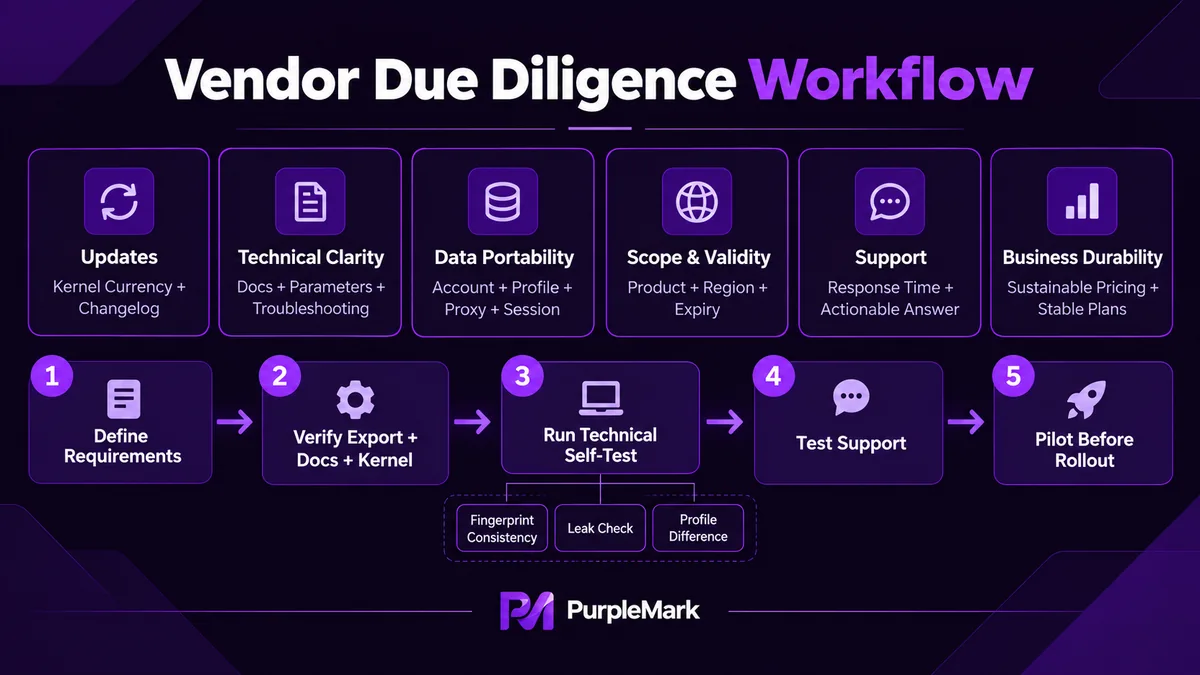
First, categorize your own requirements: how many environments you need, whether multiple people will collaborate, and whether API-based scheduling is required.
Then verify three hard requirements: whether data can be exported, whether documentation is complete, and whether the browser engine stays current.
Next, perform technical self-checks on fingerprint consistency, leak detection, and the degree of differentiation between multiple environments.
Then submit one real question and test the support response.
Finally, run the tool on a small scale for a period before deciding whether to roll it out broadly.
It is best not to reverse this order. An evaluation process that looks at price first and capability second will almost certainly create rework.
Where the capability boundary lies
One final point applies to all tools in this category. They are designed to provide environment isolation and stability across multiple accounts, not to help you bypass platform rules.
The approach that remains effective over the long term is still to follow each platform's terms of service, use genuine and traceable account information, and avoid technical measures intended to evade rules.
PurpleMark provides the environment isolation and management layer: it turns each account's environment into an independent, stable, manageable unit so normal operations are not disrupted by environment-related issues.


