
Applying every promotion tactic at once often produces the weakest results. This guide organizes Facebook promotion into four stages—testing, optimization, scaling, and stabilization—and explains each stage’s goal, budget approach, key metrics, and actions that should not be taken too early.
Most Facebook promotion advice online comes as checklists: ten tips, eight methods, each one sounding useful. When results are poor after following them, the problem is usually not the tactics themselves, but that each tactic belongs to a different stage. Scaling while an account is still new or going back to fix the basics only after it is stable tends to produce poor results.
A better way to organize the work is by the stage the account is currently in.
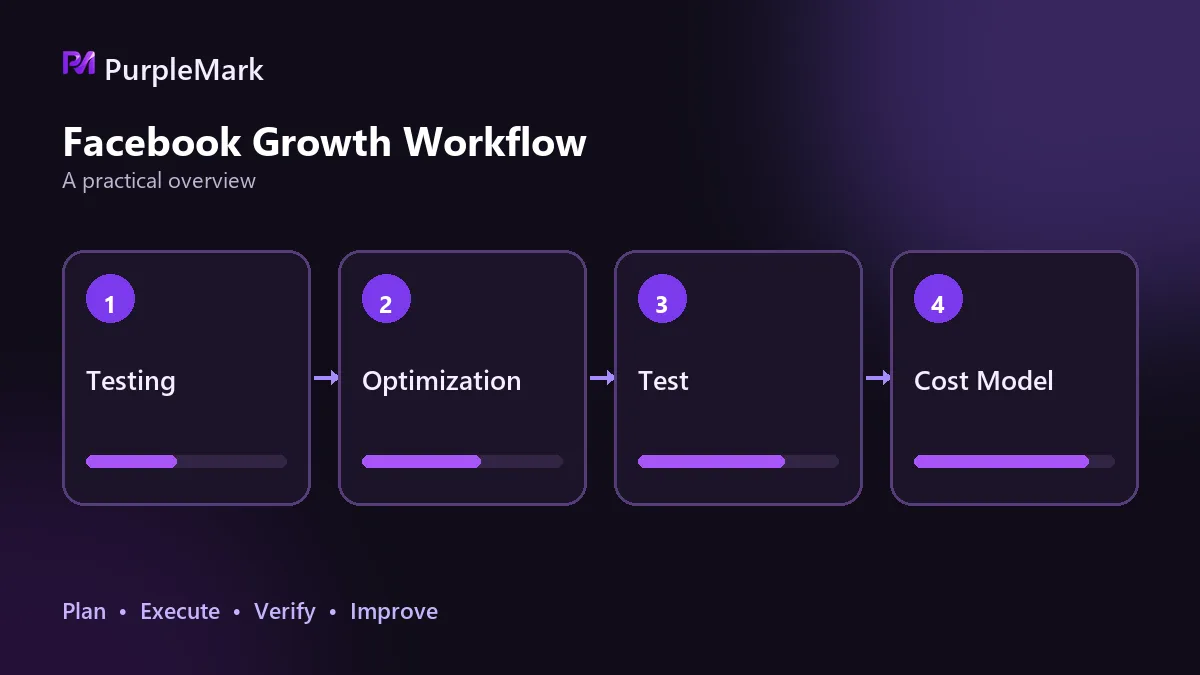
Testing stage: Make the account usable before judging performance
This stage has one goal: keep the account running and build basic trust. Keep the budget as small as practical. Use it mainly to verify that the environment and creatives can run reliably, not to expect immediate orders.
Environment setup comes first. Give each account its own stable login environment, with time zone, language, and network egress matched as a set. Repeatedly switching among multiple accounts in the same browser can undo careful work later on. PurpleMark supports environment isolation so each account can operate long term as an independent device identity.
Beyond the environment, complete the Page information: profile image, bio, contact details, and business information. A Page with many blank fields is disadvantaged both in organic reach and during ad review. For the first two weeks, keep activity close to a normal human rhythm: browse, like, leave a small number of comments, and publish three to five basic posts so the Page looks active.
Watch reach and engagement as well as environment stability: Are there unusual login warnings? How often do verification codes appear? Avoid three things at this stage: adding friends in bulk, joining groups in batches to post ads, and frequently publishing hard-sell posts with links. Before the account has established a normal usage pattern, these actions only bring risk forward.
Optimization stage: Narrow down the variables
Once the account is stable and content starts receiving organic engagement, move into optimization. The question changes from whether the account works to which audience and which creative actually perform.
For budget allocation, keep several small units that have already been tested and lean toward the one or two that perform consistently, but do not change the whole structure at once. At minimum, segment audiences into core-interest audiences, lookalike audiences, and retargeting audiences. If they are mixed together, optimization loses direction because you cannot tell where the money was actually spent.
Change only one variable at a time when testing creatives. Test images, copy, and audiences separately; otherwise, once the data arrives, you cannot attribute the result and end up relying on intuition. For paid amplification, use content that has already performed well organically. Do not start creative testing from zero inside ads when organic data has already given you an initial filter.
Watch click-through rate, cost per conversion, and conversion rate, with special attention to which unit has a clearly lower conversion cost than the others. Avoid frequently changing audiences and budget structure. Each change can push the system back into a learning phase, reducing the value of the data accumulated before it.
Scaling stage: Add budget to a structure that already works
Scaling comes only after you have found a unit that converts consistently. The goal is to expand what works without significantly increasing conversion costs.
Increase the budget in small steps while watching whether conversion costs rise with it. If they rise too quickly, the reachable audience may already be expanding beyond its efficient boundary. Stepping back at that point can be more economical than continuing to add budget. Creatives also need ongoing iteration. When the same assets run continuously and frequency climbs, both engagement and conversion tend to fall.
Continue accumulating conversion events and data. Long-term ad performance depends heavily on how much usable conversion data you can build. Those assets are tied to the account environment, so if the environment fails, the loss goes beyond a single campaign.
Watch ROAS or overall return on spend, the trend in conversion costs, and whether the reached audience shows obvious repetition. Avoid major structural changes and abrupt budget jumps. In the scaling stage, disorder is a bigger problem than moving slowly.
Stabilization stage: Spread out customer acquisition costs
The earlier stages mainly spend money; this stage starts recovering more value from that spending.
There are two main actions. One is retargeting: advertise separately to people who visited a page, added to cart without purchasing, or watched a video. This is often the traffic segment with the lowest conversion cost. The other is moving customers into channels where you can reach them repeatedly, such as groups, owned contact lists, or email. The aim is to reduce dependence on traffic from a single platform.
Shift attention to repeat-purchase rate, retargeting conversion cost, and changes in new-customer acquisition cost. Do not stop maintaining relationships with existing customers. The marginal cost of generating a repeat purchase is far lower than acquiring a new customer again.
Three prerequisites that apply to every stage
First, account security is a prerequisite throughout. If an account is disabled, the accumulated assets can effectively be wiped out, especially pixel data and audience assets inside the ad account.
Second, environment consistency matters more than the number of tactics. Time zone, language, and network egress should match as a set. If this foundation is wrong, every later optimization is built on the wrong base.
Third, do not copy someone else’s pace. The stages are a framework for judgment, not a calendar. When your account enters the scaling stage depends on its actual performance, not on what someone else did in a particular week.
This article shares operational methods only and does not promise advertising performance or returns. Follow the platform’s official advertising policies for specific requirements.


