
Making content for US users is hard because content, account details, and ad settings all have to agree with one another. This article covers time zone and language consistency, localization details, the signals that make up an account's region, preparing payment and verification, and the basic logic of ad targeting.
Running an account for US users is not about switching the interface language to English. The hard part is keeping content, account details, and ad settings consistent within one and the same logic. When several signals contradict each other, both recommendations and ads become unstable.
Align content and timing first
Posting cadence should follow the audience's time zone, not your own. The US spans several time zones, and the East Coast and the Pacific are three hours apart, so most brands place their main content in the Eastern morning and evening windows, then fine-tune using backend data on actual activity curves.
Language should consistently be American English, with spelling, date formats, and units of measure following US conventions. If your copy contains British spellings, jokes only locals would get, or prices not in US dollars, users will immediately feel the account is not for them. That is not a translation problem, it is a credibility problem.
Localization is more than language
US users care a great deal about return policies, delivery times, and customer service response times. Spelling these out clearly on your profile and landing pages changes conversion rates far more than swapping in a new set of creatives. Payment and subscription descriptions also need to follow local conventions, such as whether tax is included and whether renewal is automatic.
On topic selection, copying your original market's top performers usually delivers mediocre results. The same subject has a different context, humor, and focus in the US. Working with local creators and reading what real comment sections are discussing is faster than staring at backend data. If you can, have small US creators produce part of your assets; it looks more natural than purely translated content.
Region signals in your account details
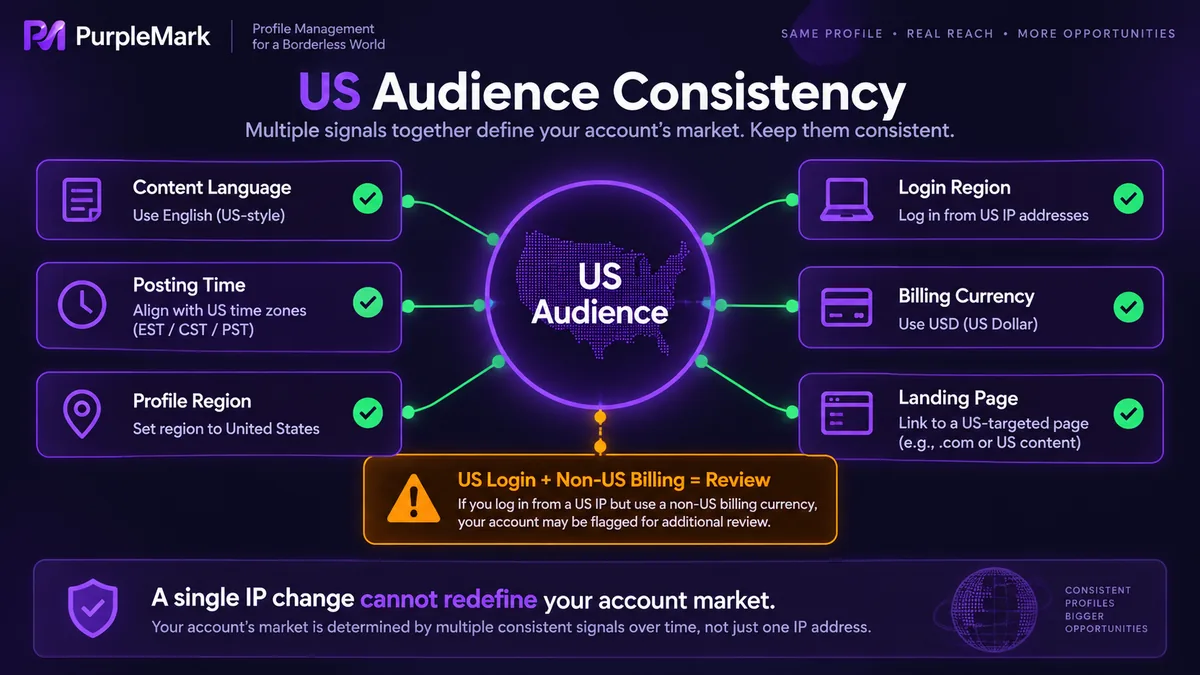
Platforms decide which market an account belongs to based on a set of long-term signals, not the address of a single login. The geographic origin of the login exit, the country of the phone number used at signup, the region filled in on the profile, the language of the content, the geographic spread of audience engagement, and the ad account's billing address and currency are all read together.
These signals have to explain one another. If an account targets the US market, with a login exit in the US, a phone number that can receive US verification codes, a payment method that can settle US dollar bills, and content in American English, the whole trail is consistent. Conversely, if the exit is in the US but the profile, language, and payment method all point elsewhere, the account gets flagged as cross-region, which affects recommendation stability and the settlement and verification steps for ads.
Some people take changing the exit to mean that a different IP alone turns an account into a US account. That does not hold up. A single change only creates contradictions, and when verification is required the platform asks for credentials that match the account details; accounts that do not match get restricted.
Prepare payment and verification in advance
An ad account needs a payment method that can actually settle US dollar bills, with the bank card's billing address and entity information matching the account details and a sensible currency setting. Before scaling, run a small test charge to confirm the payment goes through; that costs far less than being paused mid-campaign.
Phone number availability matters just as much. Many verification steps only accept numbers that can receive SMS in real time, and disposable numbers fail frequently during critical checks, which can stall the account exactly when you need it most. Business accounts may also need to complete entity verification, so the earlier the documents are prepared the better.
The basic logic of ad targeting
Meta's ad platform supports targeting by region, language, interests, and behaviors. Setting the placement region explicitly to the US and the language to English, then layering on interest and behavior tags, is more reliable than relying on organic recommendations to guess. Do not set the audience too narrow, because that leaves the system too little room to optimize; build a stable base audience first, then duplicate and expand it.
Creatives and landing pages must match in language. Landing page load speed and mobile responsiveness have a big impact on US conversions, and these two are often overlooked.
Environment issues when running multiple markets
When one team runs accounts for the US, Europe, and Southeast Asia at the same time, region signals between accounts get cross-contaminated most easily. Switching accounts inside the same environment and sharing a single exit both make it easy for the platform to link accounts from different markets. Putting each market's accounts into an independent browser environment, each with its own fixed exit and login state, is a common practice for these teams. PurpleMark provides exactly this account-level environment isolation, suited to scenarios organized by market.
Targeting a US audience comes down to staying consistent in every detail: content that looks like it was made for Americans, account details that look like an American signed up, and payment and verification that match. Do all three and recommendations and ad delivery will naturally give you the position you deserve.


